



SCIENCE
How the brain monitors our movements
How the brain controls hand and whole-body movements – and what insights this provides for postural control and rehabilitation.

Jakob Tiebel
Health Business Consultant
When the body acts without our conscious observation
Picture yourself standing in the kitchen, reaching for a cup. You might be careful not to knock over the hot kettle. However, how you shift your weight, which grip you select, or which muscle activates first largely remains outside your conscious awareness.
Nevertheless, you perceive the movement as unmistakably your own: it is you who reaches for the cup – not someone else, not by chance. Researchers refer to this experience as the sense of agency: the feeling of being the author of one’s own actions.
A research team led by Oliver Kannape and Olaf Blanke at EPFL Lausanne examined this phenomenon, in a study published in the journal iScience in 2026, from a perspective that had received little scientific attention until now.
The key question was: Does the brain use the same monitoring system, regardless of whether we are moving our hand or our whole body? Or do body part-specific systems exist – for instance, one for the hand and another for the trunk?
The idea behind it
From everyday experience, it initially appears plausible that hand movements and whole-body movements are controlled differently. After all, they differ markedly in their complexity, degrees of freedom, and the muscle groups involved.
Fundamental motor research has, however, provided evidence for decades that movements are represented in the brain, at least in part, at a more abstract level. So a signature remains recognisable in its characteristic features, even when it is drawn not with the hand but, for example, with the foot in the sand. The motor scientist Karl Lashley described this phenomenon as early as the 1930s as motor equivalence.
The team led by Kannape applied this idea to the experience of one’s own agency. This study was the first to examine, in the same participants and within the same experimental task, how the sense of agency changes when a comparable target movement is performed using the hand versus the whole body.
The methodological key: the THERA-Trainer coro
To compare hand and whole-body movements, the researchers required an experimental setup that would allow both movement types to be examined under conditions as similar as possible: safe, reproducible and precisely measurable.
For this purpose, they used the THERA-Trainer coro. The participants stood upright and were secured at the pelvis. The device's spring elements enabled controlled displacements in all directions and subsequently returned the body to its starting position. At low resistance, this mechanism functioned effectively as a joystick.
Integrated inertial sensors captured the tilt of the frame at a sampling rate of 30 measurements per second. Additionally, a joystick was mounted directly onto the device. This allowed participants to perform the same task using either the hand or a shift of the entire body, without altering position, gaze direction or the experimental environment.
The coro therefore functioned not only as a safety system, but also as a standardised interface for the controlled recording of whole-body movements.
GET IN TOUCH
Postural control is more than just muscle strength and reflexes.
The experiment
22 healthy adults steered a cursor towards a target point, either by means of a joystick or by tilting the body in the coro. In a substantial proportion of trials, the displayed direction of movement was covertly altered by 7.5 to 30 degrees. Participants then assessed whether the visible movement corresponded to their actual hand or body movement.
In half of the trials, an additional cognitive dual task was introduced. This allowed the researchers to examine whether cognitive load influences the perception of one’s own movement.
In half of the trials, an additional cognitive dual task was introduced. This allowed the researchers to examine whether cognitive load influences the perception of one’s own movement.
The results
With unaltered feedback, participants correctly identified their movement in approximately 90 per cent of cases. No significant difference was found between hand movements and whole-body movements.
The individual perceptual thresholds were also closely correlated with one another: individuals who reliably detected deviations in hand movements generally also detected them in whole-body movements. The strong correlation of r = 0.71 points to a shared mechanism of action control that is largely independent of the effector involved.
Differences emerged primarily under more demanding movement conditions. Under these more demanding conditions, perception proved more sensitive during whole-body movements. The researchers suggest that, in such situations, the brain relies more heavily on body-part-specific information, such as vestibular and proprioceptive signals.
In an additional task without visual feedback, participants steered towards the target even more accurately using the body than using the hand. The mean deviation was 18 millimetres for whole-body movement, compared with 26 millimetres for hand movement.
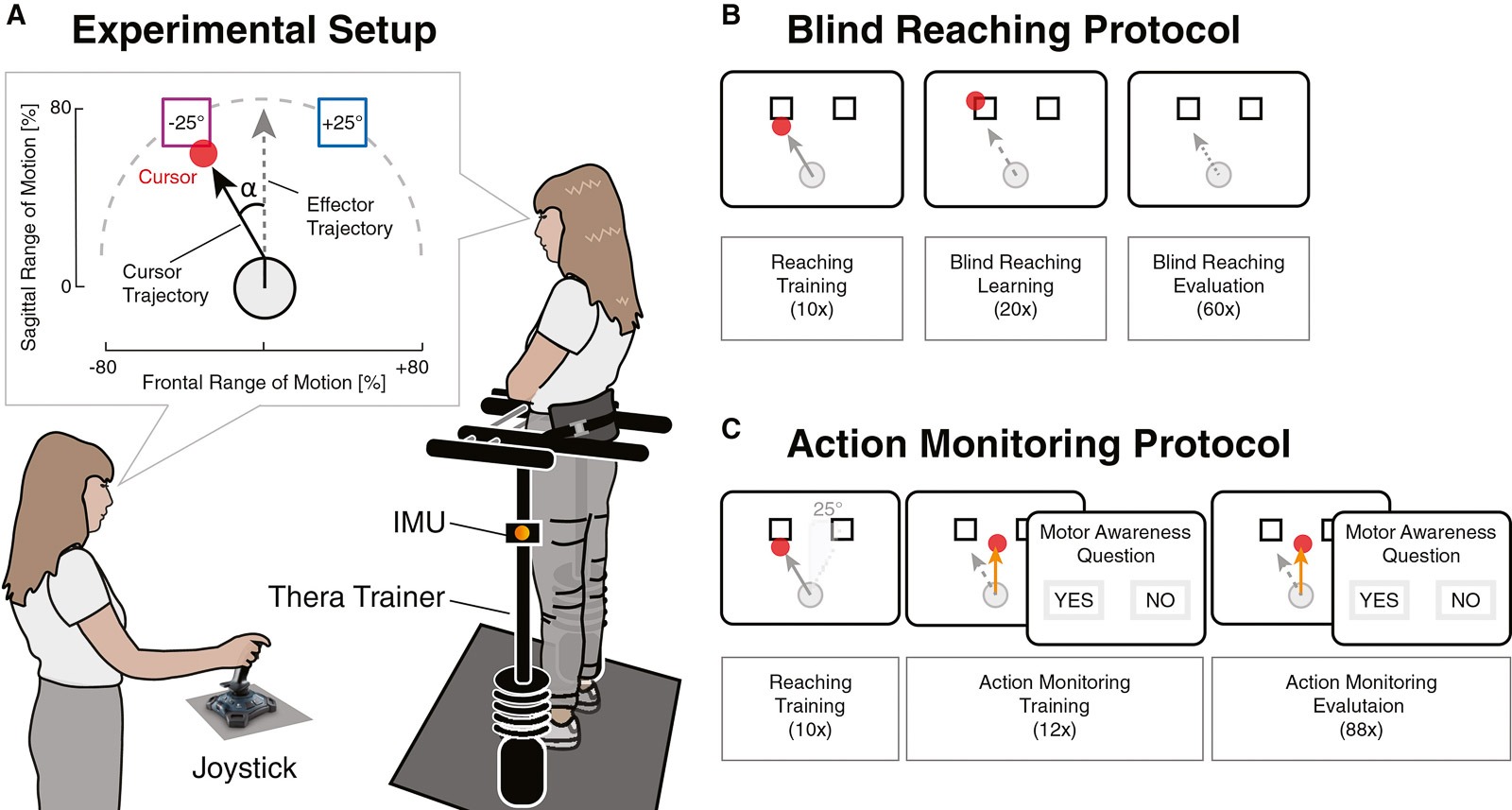
Figure 1 Setup
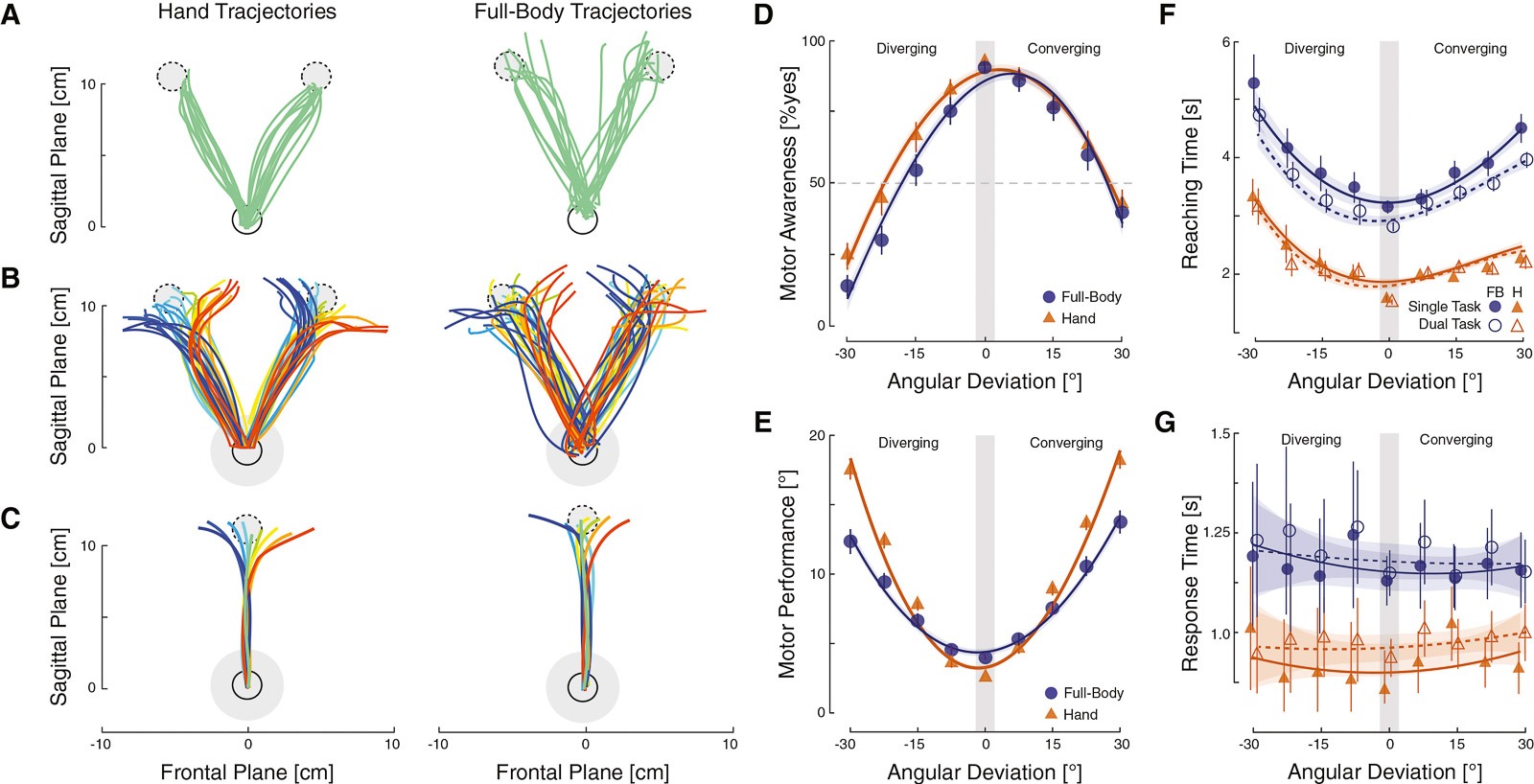
Figure 2 Motor performance
Significance for research and rehabilitation
The findings support a hierarchical model of movement control: the brain initially monitors actions according to their goal, largely independent of the body part executing the movement. It is only under conditions of increased demand that specific sensory feedback signals gain greater importance (sensory weighting).
For rehabilitation, this supports a task-oriented approach. After neurological injury, it is therefore advisable not to focus exclusively on training individual muscles or movement segments, but rather to train goal-directed actions under varying sensory and cognitive demands.
The study also demonstrates the potential of the THERA-Trainer coro as a research platform. The device enables whole-body movements to be safely standardised, precisely captured, and combined with visual or cognitive tasks.
This opens up further potential applications, for example in the assessment of balance disorders, dual-task demands, or changes in postural control over the course of neurological rehabilitation.
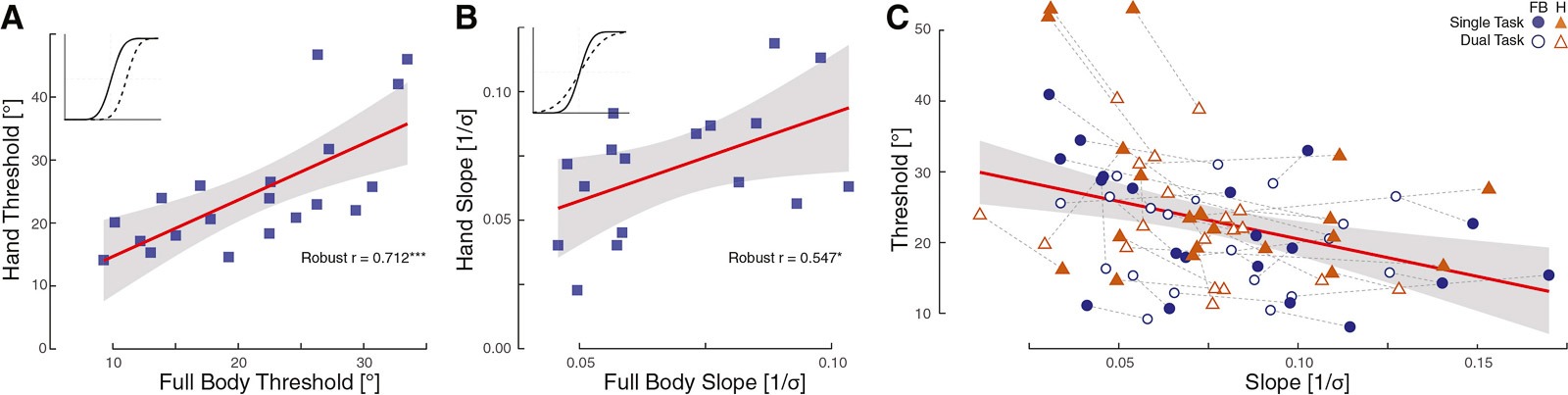
Figure 3 Motor awareness and psychophysics
What do these findings mean for postural control therapy?
The study was conducted with healthy adult participants and therefore does not permit direct recommendations for therapeutic practice. However, it provides plausible starting points for neurological and geriatric rehabilitation.
Task-oriented training of postural control
The findings suggest that movements are initially monitored according to their goal, largely independent of the body part executing them. For therapy, this supports a task-oriented approach: The focus lies on functional goals such as targeted weight transfer, reaching a target point or postural stabilisation – rather than the isolated activation of individual muscles. An external attentional focus can support this goal-orientation, for example through tasks such as: “Move the cursor to the target” or “Shift your weight to the affected side”.
Using the trunk as a precise effector
In a task without visual feedback, participants steered towards the target even more accurately using the body than using the hand. The trunk is therefore not only responsible for stability, but can also be employed with precision and purpose. Weight shifts can accordingly be trained as differentiated movement tasks. The THERA-Trainer coro enables such movements to be performed safely, recorded via sensor technology, and documented in a comparable manner throughout treatment.
Incorporating proprioceptive awareness
Postural limitations may encompass sensory and perceptual components in addition to motor ones. What matters is not only whether a movement is successfully executed, but also whether patients adequately perceive its direction and extent. Visual feedback can be used to support this perception and to reveal discrepancies between intended, executed and perceived movement. Whether targeted feedback manipulations are diagnostically or therapeutically effective in neurological patient groups, however, must be investigated separately.
Gradually increasing task demands
Under more demanding movement conditions, body-part-specific sensory information became increasingly significant. This suggests a systematic progression for therapy: from stable, visually supported tasks towards higher sensory, coordinative and cognitive demands. Possible variations include altered bases of support, reduced visual input, head movements or additional cognitive tasks. This is contingent upon the demands being tailored to the functional level and safety profile of patients.
Safety creates room for manoeuvre
Fear of falling can diminish movement, encourage avoidance strategies and prevent full exploitation of functional boundaries. A secure training environment enables larger weight shifts and more demanding tasks to be trialled, without the fear of falling dominating movement. The THERA-Trainer coro combines this safety with measurable whole-body movements and the possibility of incorporating visual or cognitive tasks.
Key message for clinical practice
Postural control encompasses more than muscle strength and balance reactions. It is based on the interplay of movement target, sensory feedback, body awareness and cognitive processing. Rehabilitation should integrate these components within functional tasks of progressively increasing demand. The THERA-Trainer coro offers a controlled environment in which whole-body movements can be performed safely, directed with precision and quantitatively recorded.
When everything runs smoothly, the brain operates on an abstract representation of movement.
Conclusion
The sense of being the author of one’s own action does not appear to be tied to a specific body part. The first crucial factor is whether the outcome of a movement corresponds to the intended goal. Under more challenging conditions, the brain augments this abstract control with specific sensory input.
The THERA-Trainer coro enabled this comparison to be examined experimentally, as it allowed whole-body movements to be captured safely, reproducibly and with precise measurement control.
The THERA-Trainer coro enabled this comparison to be examined experimentally, as it allowed whole-body movements to be captured safely, reproducibly and with precise measurement control.
Jakob Tiebel
Health Business Consultant
Jakob Tiebel is OT and studied applied psychology with a focus on health economics. He has clinical expertise from his previous therapeutic work in neurorehabilitation. He conducts research and publishes on the theory-practice transfer in neurorehabilitation and is the owner of an agency for digital health marketing.
References:
- Fasola, J., Betka, S., Faivre, N., Blanke, O., & Kannape, O. A. (2026). Motor equivalence in motor awareness. iScience, 29(6), 115835. Motor equivalence in motor awareness