


SCIENCE
Robotics in gait rehabilitation:efficiency, evidence and system pressure
What current healthcare research shows about the strategic use of robotic-assisted rehabilitation in the healthcare system

Jakob Tiebel
Health Business Consultant
Robotics is effective in gait rehabilitation – with the right service delivery model.
While traditional rehabilitation models are increasingly hitting their personnel and economic limits, gait rehabilitation is a field of care in which robotic systems can have measurable effects – both clinically and structurally. However, it is not the technology itself that is crucial here, but the way in which it is used. It is precisely at this interface between evidence, organisation and responsibility that the real debate begins. In a recent paper, a working group led by Waldemar A. Marcinski discusses these questions against the background of the structural burdens on the healthcare system.
Background
The study addresses the increasing demographic, economic and staffing pressures on the UK healthcare system (NHS), particularly in the area of neurorehabilitative care. Against the backdrop of an ageing population, rising incidences of neurological disorders and significant gaps in the skilled labour force, the potential contribution that robotic-assisted rehabilitation can make to ensuring the quality and efficiency of care is being investigated.
Objective
The aim of the paper is to summarise the clinical, economic and structural evidence on robotic-assisted therapy and to outline its strategic relevance for rehabilitation pathways in the NHS, with a particular focus on gait rehabilitation and scaling effects.
Methodology
It is a narrative, evidence-based perspective work. The authors integrate demographic data, health economic analyses, results of randomised trials, systematic reviews and meta-analyses as well as regulatory and organisational frameworks. No separate primary data is collected.
Results
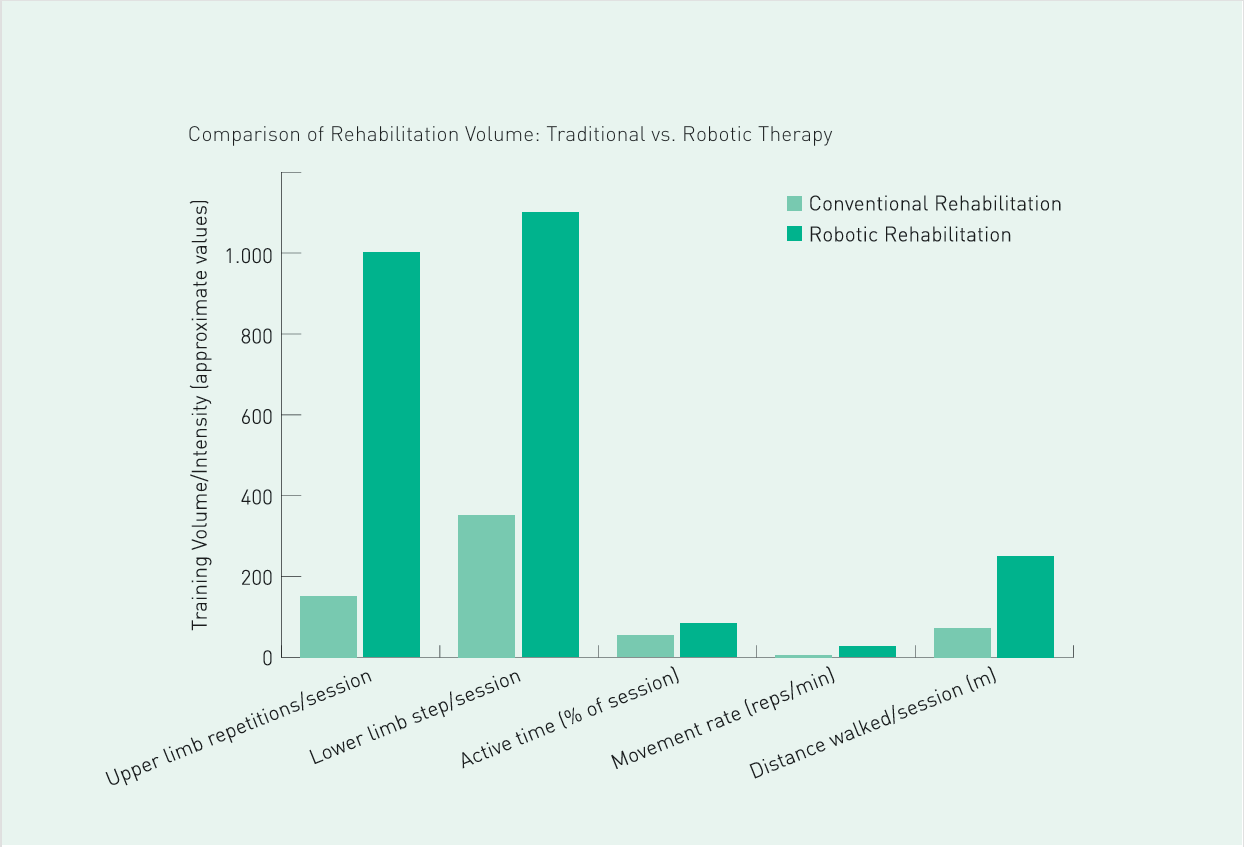
The study shows that robotic-assisted therapy enables a significantly higher therapy intensity than conventional rehabilitation. Consistent improvements in walking speed, walking ability, step parameters, balance and functional mobility are reported, particularly in gait rehabilitation. Economic analyses indicate that robotic-assisted gait therapy can be cost-effective or cost-neutral with high utilisation and suitable care models, sometimes with negative incremental cost effectiveness ratios. For upper limb rehabilitation, the clinical and economic results are more heterogeneous; large studies such as RATULS do not show any cost effectiveness under one-to-one care conditions. Overall, a correlation is described between economic efficiency and organisational form (e.g. multi-patient supervision, long service life).
The study addresses the increasing demographic, economic and staffing pressures on the UK healthcare system (NHS), particularly in the area of neurorehabilitative care. Against the backdrop of an ageing population, rising incidences of neurological disorders and significant gaps in the skilled labour force, the potential contribution that robotic-assisted rehabilitation can make to ensuring the quality and efficiency of care is being investigated.
Objective
The aim of the paper is to summarise the clinical, economic and structural evidence on robotic-assisted therapy and to outline its strategic relevance for rehabilitation pathways in the NHS, with a particular focus on gait rehabilitation and scaling effects.
Methodology
It is a narrative, evidence-based perspective work. The authors integrate demographic data, health economic analyses, results of randomised trials, systematic reviews and meta-analyses as well as regulatory and organisational frameworks. No separate primary data is collected.
Results
The study shows that robotic-assisted therapy enables a significantly higher therapy intensity than conventional rehabilitation. Consistent improvements in walking speed, walking ability, step parameters, balance and functional mobility are reported, particularly in gait rehabilitation. Economic analyses indicate that robotic-assisted gait therapy can be cost-effective or cost-neutral with high utilisation and suitable care models, sometimes with negative incremental cost effectiveness ratios. For upper limb rehabilitation, the clinical and economic results are more heterogeneous; large studies such as RATULS do not show any cost effectiveness under one-to-one care conditions. Overall, a correlation is described between economic efficiency and organisational form (e.g. multi-patient supervision, long service life).
Gait is the field in which robotics shows convincing results, not only clinically but also economically.
Discussion
The authors discuss how robotic-assisted rehabilitation primarily delivers its benefits through a high number of repetitions, standardised movement quality and reduced physical demands on staff. The inconsistent evidence for the upper limb is attributed to methodological differences, device characteristics and service delivery models. In addition, regulatory requirements, staff qualification requirements and integration with digital technologies (e.g. AI, sensor technology, data analysis) are named as key influencing factors for implementation.
The authors discuss how robotic-assisted rehabilitation primarily delivers its benefits through a high number of repetitions, standardised movement quality and reduced physical demands on staff. The inconsistent evidence for the upper limb is attributed to methodological differences, device characteristics and service delivery models. In addition, regulatory requirements, staff qualification requirements and integration with digital technologies (e.g. AI, sensor technology, data analysis) are named as key influencing factors for implementation.
It is not the technology that is the lever, but how it is used in the system.
Conclusion
Robotic-assisted rehabilitation is described as a potentially effective building block for overcoming structural challenges. Consistent clinical and economic evidence is available for gait rehabilitation in particular, provided that the technology is integrated into suitable service delivery models. The authors emphasise the need for further systematic evaluations, but recognise the strategic relevance of robotic systems for sustainable and scalable rehabilitation care.
Robotic-assisted rehabilitation is described as a potentially effective building block for overcoming structural challenges. Consistent clinical and economic evidence is available for gait rehabilitation in particular, provided that the technology is integrated into suitable service delivery models. The authors emphasise the need for further systematic evaluations, but recognise the strategic relevance of robotic systems for sustainable and scalable rehabilitation care.
Comments
This perspective work by Marcinski et al. (2026) impressively demonstrates why robotic-assisted rehabilitation – especially in gait rehabilitation – is not just a technological option, but a structural response to the increasing challenges placed on modern healthcare systems. Against the backdrop of the demographic shift, rising stroke figures and chronic staff shortages, the study argues that the lower limb and gait in particular represent a field of application in which clinical benefits and economic efficiency can be combined with particular consistency.
In the area of gait rehabilitation, the evidence base is much more homogeneous than for the upper limb. Robotic-assisted gait training enables a high number of repetitions, consistent movement quality and early mobilisation, even in severely affected patients. Studies summarised in the paper show improvements in walking speed, step parameters, balance and functional walking ability. The critical factor here is less the “robotics per se” than the possibility of practically implementing evidence-based principles of neurorehabilitation – intensity, task orientation and repetition – even under real care conditions with limited staffing resources.
The health economic outcomes for the lower limb are particularly relevant. For “operational machines”, which involve the mechanical coupling of human and end effector, not only favourable incremental cost-benefit ratios but even net savings are described in high-frequency settings. With high capacity utilisation, for example for several hours a day, six days a week, the cost argument is reversed: robotics goes from cost factor to efficiency driver. This clearly distinguishes gait rehabilitation from upper limb rehabilitation, where early studies such as RATULS primarily depicted inefficient service delivery models.
This has clear implications for providers. Firstly, the work confirms the strategic focus on the lower limb and walking as a clinically and economically robust field of application. Device-based mobility and gait therapy address precisely the patient group for whom conventional therapy is often met with physical, time or safety-related limits. Secondly, the study emphasises that the added value lies not in the device alone, but also in the service delivery model: high utilisation rates, group settings, therapeutic supervision instead of one-to-one care and clear embedding in the rehabilitation pathway are crucial for success.
Thirdly, the analysis points to another, often underestimated advantage: robotic systems deliver objective, continuous movement and performance data. This data foundation opens up prospects for adaptive training control, progress monitoring and, in the future, AI-assisted prognoses. For providers, this means that the combination of mechanical therapy, digital evaluation and motivational interfaces is not only therapeutically attractive, but also compatible with future regulatory and data-driven service delivery models.
In summary, the study shows that robotic-assisted gait rehabilitation is not a luxury, but a rational response to structural problems in service delivery. For providers, it confirms a strategic focus on technology-based, scalable and evidence-based solutions for lower limb therapy. The critical lever here lies less in technological progress alone, but much more in the consistent focus on clinical effectiveness, process integration and sustainable use in everyday care.
This perspective work by Marcinski et al. (2026) impressively demonstrates why robotic-assisted rehabilitation – especially in gait rehabilitation – is not just a technological option, but a structural response to the increasing challenges placed on modern healthcare systems. Against the backdrop of the demographic shift, rising stroke figures and chronic staff shortages, the study argues that the lower limb and gait in particular represent a field of application in which clinical benefits and economic efficiency can be combined with particular consistency.
In the area of gait rehabilitation, the evidence base is much more homogeneous than for the upper limb. Robotic-assisted gait training enables a high number of repetitions, consistent movement quality and early mobilisation, even in severely affected patients. Studies summarised in the paper show improvements in walking speed, step parameters, balance and functional walking ability. The critical factor here is less the “robotics per se” than the possibility of practically implementing evidence-based principles of neurorehabilitation – intensity, task orientation and repetition – even under real care conditions with limited staffing resources.
The health economic outcomes for the lower limb are particularly relevant. For “operational machines”, which involve the mechanical coupling of human and end effector, not only favourable incremental cost-benefit ratios but even net savings are described in high-frequency settings. With high capacity utilisation, for example for several hours a day, six days a week, the cost argument is reversed: robotics goes from cost factor to efficiency driver. This clearly distinguishes gait rehabilitation from upper limb rehabilitation, where early studies such as RATULS primarily depicted inefficient service delivery models.
This has clear implications for providers. Firstly, the work confirms the strategic focus on the lower limb and walking as a clinically and economically robust field of application. Device-based mobility and gait therapy address precisely the patient group for whom conventional therapy is often met with physical, time or safety-related limits. Secondly, the study emphasises that the added value lies not in the device alone, but also in the service delivery model: high utilisation rates, group settings, therapeutic supervision instead of one-to-one care and clear embedding in the rehabilitation pathway are crucial for success.
Thirdly, the analysis points to another, often underestimated advantage: robotic systems deliver objective, continuous movement and performance data. This data foundation opens up prospects for adaptive training control, progress monitoring and, in the future, AI-assisted prognoses. For providers, this means that the combination of mechanical therapy, digital evaluation and motivational interfaces is not only therapeutically attractive, but also compatible with future regulatory and data-driven service delivery models.
In summary, the study shows that robotic-assisted gait rehabilitation is not a luxury, but a rational response to structural problems in service delivery. For providers, it confirms a strategic focus on technology-based, scalable and evidence-based solutions for lower limb therapy. The critical lever here lies less in technological progress alone, but much more in the consistent focus on clinical effectiveness, process integration and sustainable use in everyday care.
Jakob Tiebel
Health Business Consultant
Jakob Tiebel is OT and studied applied psychology with a focus on health economics. He has clinical expertise from his previous therapeutic work in neurorehabilitation. He conducts research and publishes on the theory-practice transfer in neurorehabilitation and is the owner of an agency for digital health marketing.
References:
- Marcinski, W. A., Martínez-Soler, P., & Martínez-Canca, J. F. (2026). Robotics in rehabilitation: A strategic necessity for the NHS in the face of demographic and economic pressures. Journal of Neurology & Stroke, 16(1), 39–42. https://medcraveonline.com/JNSK/JNSK-16-00650.pdf
Related contents
Find related exciting contents in our media library.
Mehr laden
This is not what you are searching for? Knowledge

Meet our specialists.
Are you interested in our solutions? Schedule a meeting with a Consultant to talk through your strategy and understand how TEHRA-Trainer can help you to advance rehabilitation.