


THERAPY AND PRACTICE
Improving balance with the THERA-Trainer balo
Review of a webinar on postural control, motor learning and technology-assisted therapy

Jakob Tiebel
Health Business Consultant
In the webinar, Alisa Barthel, physiotherapist and specialist therapist for neurorehabilitation and founder of Therapeuticum Gehrden, presented her practical approach to using the THERA-Trainer balo in neurological rehabilitation. The starting point was a brief insight into the interdisciplinary, evidence-based practice concept, which combines technology-assisted therapy with high repetition, feedback mechanisms and motivational elements. It became clear that modern devices are not seen as a substitute for therapeutic expertise, but rather as a targeted addition.
Motor learning and neuroplasticity as a therapeutic framework
In the theoretical part, Alisa categorised the balo into central principles of motor learning. Neuroplasticity, a high number of repetitions, sufficiently high training intensity, customisable dosage, and continuous visual and acoustic feedback were identified as key therapeutic factors. The benefits of gamification for increasing adherence and self-motivation were particularly emphasised, without relinquishing therapeutic control in the process. The technology enables objectifiable progress documentation and makes progress transparent for patients, relatives and caregivers.
Classification of the THERA-Trainer balo in the device range
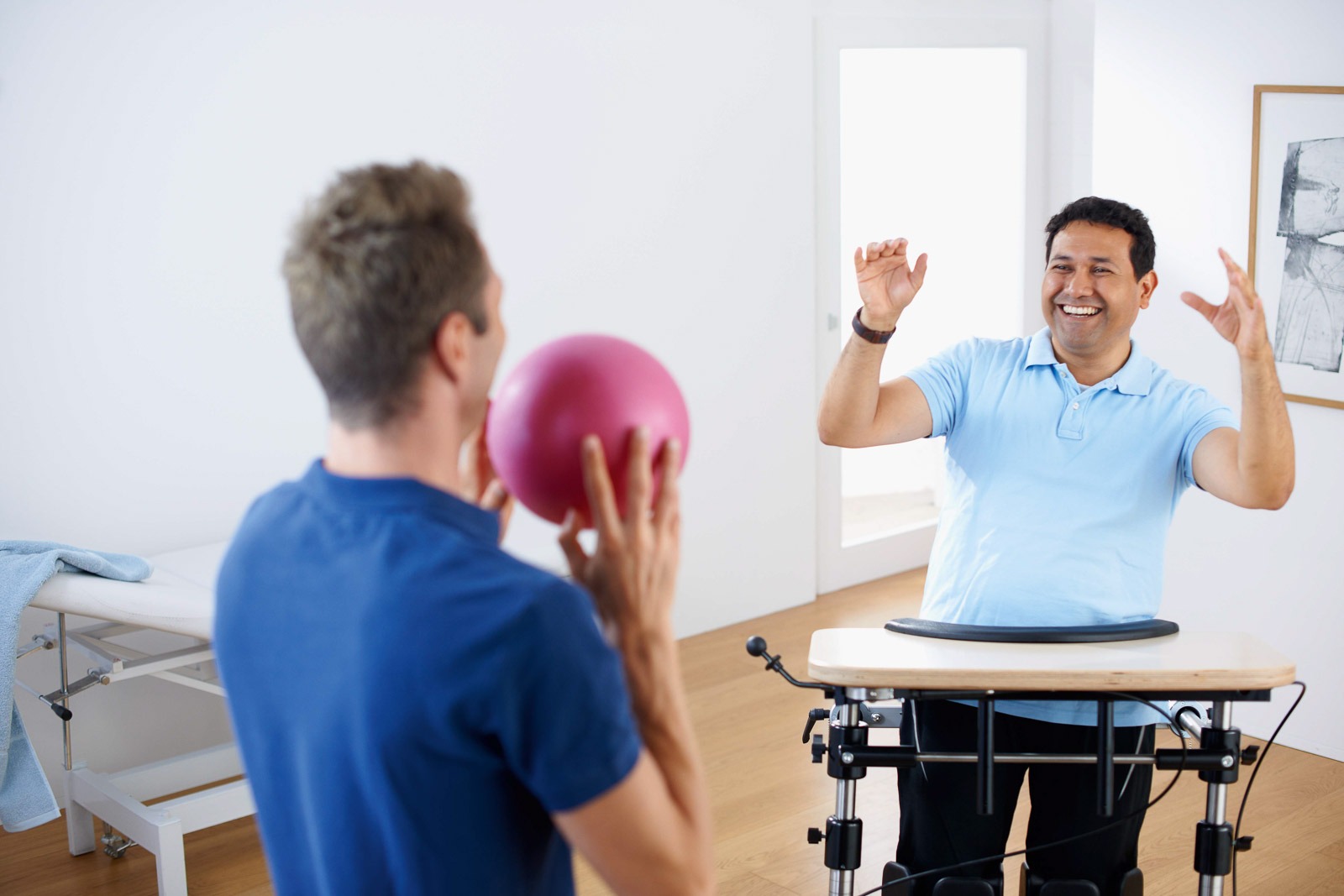
The THERA-Trainer balo was then presented in terms of its function, structure and application logic. The balo closes the gap between passive standing frames and complex gait robotics systems. It allows dynamic standing and balance training in various degrees of freedom (lateral and anteroposterior weight shifts) and provides real-time feedback of the body’s centre of gravity through sensor technology. Safety mechanisms such as the upright and support system also enable use with severely restricted patients who are unable to stand. The possibility of using the balo both statically and dynamically with variable degrees of freedom was emphasised as a significant advantage for gradual therapy progression.
Postural control: anticipatory and reactive training
One focus was on postural control as the basis of functional mobility. Alisa differentiated between anticipatory balance reactions, which are specifically trained via visually controlled weight shifts, and reactive balance responses, which are provoked by unexpected perturbations. The balo is particularly suitable for training anticipatory control; reactive parts were deliberately supplemented by therapeutically initiated disturbances. This made it possible to demonstrate a functionally relevant training of fall reactions, protective steps and trunk stability in a safe setting.
Practical examples and objectifiable therapy effects
The practical examples impressively demonstrated how the balo can be used in different clinical constellations, including multiple sclerosis, post-stroke, Parkinson’s disease and incomplete tetraplegia. Video clips and progress data showed how anteroposterior weight displacement, lateral stability and standing tolerance improved measurably within a few weeks. Supplementary therapeutic strategies such as forced-use approaches, dual tasking, additional cognitive tasks or the deliberate prevention of support strategies were shown as examples of the necessary active therapeutic control. The objective progression graphs emphasised the added value of quantifiable outcomes for therapy planning, motivation and interprofessional communication.
Postural control begins while standing – balance is not a by-product, but a central focus of therapy.
Integration into care concepts and everyday life
The discussion focussed on the integration of balo into individual, parallel and group settings, for example as part of circuit training or combined forms of therapy. Use in the home setting was also addressed. The ability to prescribe training as an aid, supported by standardised application templates, enables training to be continued outside the practice in suitable cases. The balo was thus categorised not only as a therapeutic instrument, but also as a bridge between outpatient care, training in everyday life and long-term self-efficacy.
Conclusion: Technology as an amplifier of therapeutic efficacy
The conclusion of the webinar was clear: the THERA-Trainer balo is a functional, evidence-based addition for balance and standing training in neurorehabilitation. Its added value lies in the combination of a safe setting, high training intensity, objectifiable feedback and broad therapeutic applicability. The critical factor remains the competent therapeutic embedding that integrates the balo into an individual, goal-oriented treatment concept.
Objectifiable progress creates motivation – visible for patients, relatives and caregivers.
Jakob Tiebel
Health Business Consultant
Jakob Tiebel is OT and studied applied psychology with a focus on health economics. He has clinical expertise from his previous therapeutic work in neurorehabilitation. He conducts research and publishes on the theory-practice transfer in neurorehabilitation and is the owner of an agency for digital health marketing.
References:
- Image source: Therapeuticum Gehrden
Related contents
Find related exciting contents in our media library.
Mehr laden
This is not what you are searching for? Knowledge

Meet our specialists.
Are you interested in our solutions? Schedule a meeting with a Consultant to talk through your strategy and understand how TEHRA-Trainer can help you to advance rehabilitation.