


SCIENCE
Every revolution counts
Efficacy of therapy with the THERA-Trainer tigo compared with conventional rehabilitation after ischaemic stroke – a prospective comparative study at the University Clinical Center Niš (2025, n = 40)

Jakob Tiebel
Health Business Consultant
Summary
A prospective comparative study conducted in 2025 at the Clinic for Physical Medicine and Rehabilitation, University Clinical Center Niš, investigated whether supplementary robot-assisted therapy with the THERA-Trainer tigo improves motor recovery after ischaemic stroke compared with conventional rehabilitation alone. The study included 40 patients with a first-time ischaemic stroke, confirmed by CT or MRI, presenting with mild to moderate symptoms and hemiparesis. The supplementary use of the tigo led to a statistically highly significant greater improvement in motor function in both the upper and lower extremities – with an identical overall duration of rehabilitation.
Background
Ischaemic stroke accounts for 75–80% of all strokes and is regarded as one of the leading causes of permanent disability in adulthood. Worldwide, 100–300 new cases per 100,000 inhabitants are recorded annually; specific mortality doubles with each decade of life beyond the age of 55. Even after optimal acute management – comprising thrombolysis, mechanical thrombectomy where appropriate, and secondary preventive antiplatelet therapy – a significant proportion of patients are left with a permanent motor deficit.
Functional recovery relies on neuroplasticity – the capacity of the nervous system to reorganise its structures and connections after injury. The national guidelines recommend early initiation of rehabilitation, identifying this as an essential component of successful treatment. Traditionally, rehabilitation has relied on kinesiotherapy and occupational therapy; however, in cases of severe paresis, these approaches are practically limited by the repetition number and the precision of manual movement guidance. Motor-assisted rehabilitation devices were developed specifically to close this gap: They enable early mobilisation even in cases of markedly impaired voluntary motor function, by providing controlled support to the movement.
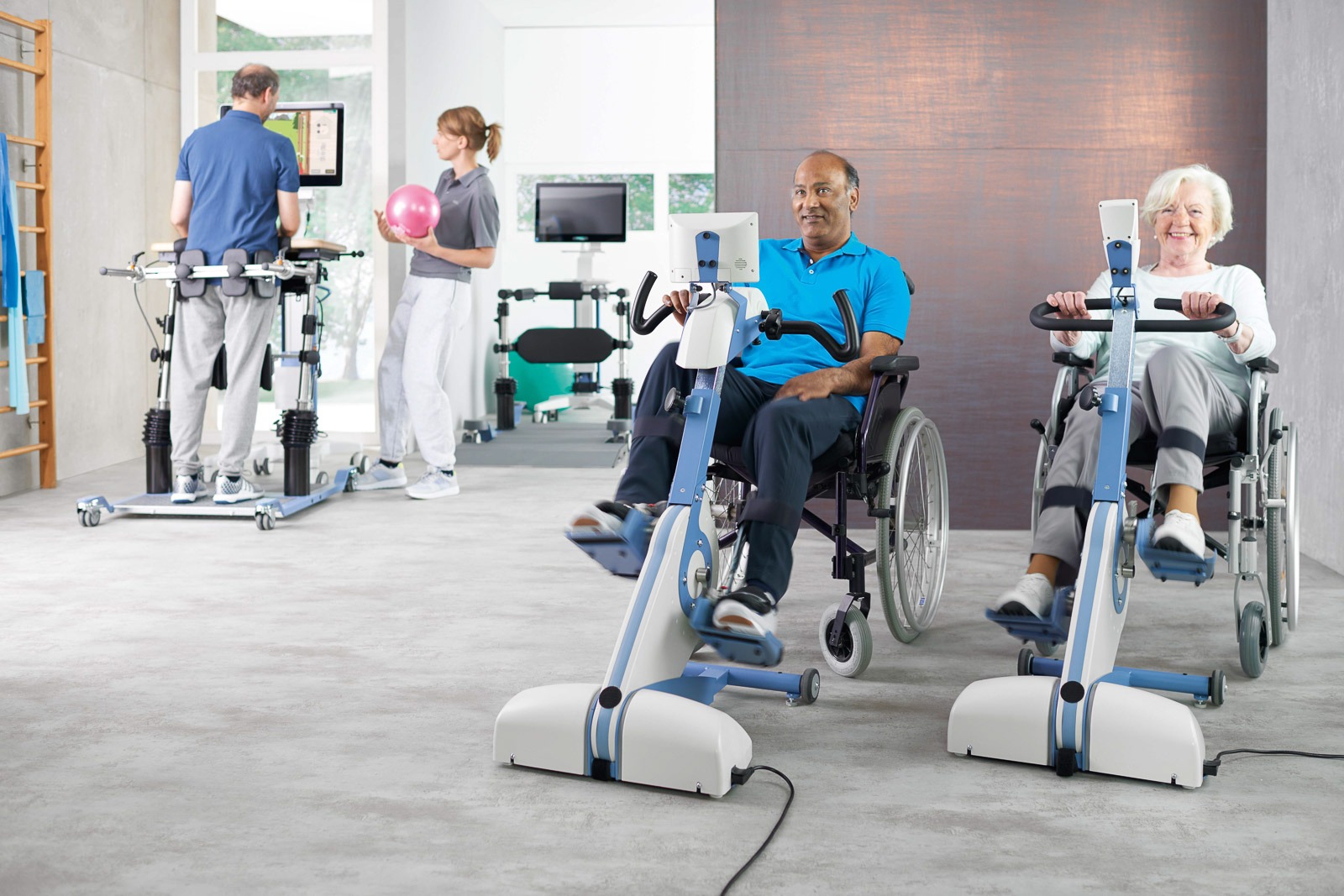
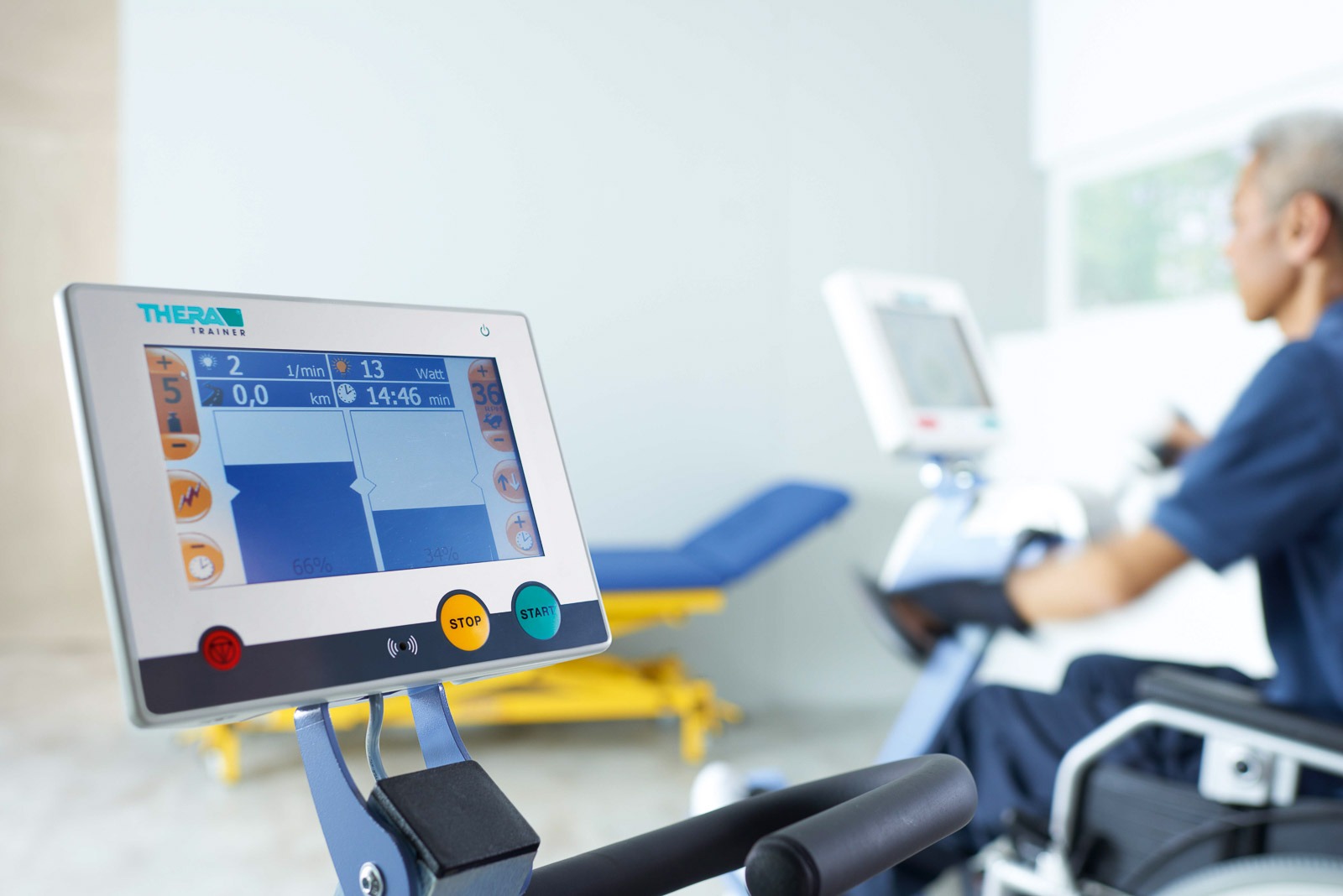
The THERA-Trainer tigo is a movement exerciser offering motor-assisted cyclical movement patterns for the upper and lower extremities. It enables passive, assistive and active movement, thereby targeting different disease phases and degrees of impairment, and can improve muscle strength, range of motion, peripheral circulation and neuromuscular activation. Because each rotation is standardised, repeatable and measurable, the intensity, frequency and duration of the therapy can be precisely dosed.
GET IN TOUCH
Functional recovery relies on neuroplasticity – the capacity of the nervous system to reorganise its structures and connections after injury. The national guidelines recommend early initiation of rehabilitation, identifying this as an essential component of successful treatment. Traditionally, rehabilitation has relied on kinesiotherapy and occupational therapy; however, in cases of severe paresis, these approaches are practically limited by the repetition number and the precision of manual movement guidance. Motor-assisted rehabilitation devices were developed specifically to close this gap: They enable early mobilisation even in cases of markedly impaired voluntary motor function, by providing controlled support to the movement.
The THERA-Trainer tigo is a movement exerciser offering motor-assisted cyclical movement patterns for the upper and lower extremities. It enables passive, assistive and active movement, thereby targeting different disease phases and degrees of impairment, and can improve muscle strength, range of motion, peripheral circulation and neuromuscular activation. Because each rotation is standardised, repeatable and measurable, the intensity, frequency and duration of the therapy can be precisely dosed.
GET IN TOUCH
Question
The aim of the study was to investigate the efficacy of therapy with the THERA-Trainer tigo compared with a purely conventional rehabilitation approach in terms of the restoration of motor function after ischaemic stroke.
Methodology
Study design: Prospective comparative study with a historical control group at the Clinic for Physical Medicine and Rehabilitation, University Clinical Centre Niš, conducted from January to December 2025.
Cohort. Originally 44 patients; following application of exclusion criteria, 40 patients remained (32 men, 8 women; mean age 66.82 ± 9.09 years). Patients included were those presenting with a first-ever, CT- or MRI-confirmed ischaemic stroke of mild to moderate clinical severity, right- or left-sided hemiparesis, and sufficient cognitive capacity to comprehend therapeutic instructions. Patients with a prior stroke, marked spasticity, behavioural or cognitive disorders, nosocomial infections or incomplete study completion were excluded.
Groups. Division into two equally sized groups (n = 20 each) according to rehabilitation period:
Control group: Retrospectively evaluated case notes of patients undergoing three weeks of conventional rehabilitation (kinesiotherapy and occupational therapy under physiotherapeutic guidance).
Experimental group: In addition to conventional rehabilitation, device-assisted therapy using the THERA-Trainer tigo, delivered over three weeks, five sessions per week, 30 minutes per session, involving controlled, repeatable and measurable active, assisted or passive crank/pedal rotation.
Both groups received an individually dosed programme corresponding to the severity and degree of mobility limitation; rehabilitation commenced approximately one month post-stroke in each case.
Outcome measures and assessment: Motor function was assessed using the Fugl-Meyer Assessment (FMA) for the upper and lower extremities – at admission (approximately one month post-stroke) and at discharge. Assessments were performed by the same assessor under standardised conditions on each occasion.
Statistics: Descriptive parameters (arithmetic mean, standard deviation, structural index), Student’s t-test for small dependent or independent samples, and Fisher’s exact test.
Cohort. Originally 44 patients; following application of exclusion criteria, 40 patients remained (32 men, 8 women; mean age 66.82 ± 9.09 years). Patients included were those presenting with a first-ever, CT- or MRI-confirmed ischaemic stroke of mild to moderate clinical severity, right- or left-sided hemiparesis, and sufficient cognitive capacity to comprehend therapeutic instructions. Patients with a prior stroke, marked spasticity, behavioural or cognitive disorders, nosocomial infections or incomplete study completion were excluded.
Groups. Division into two equally sized groups (n = 20 each) according to rehabilitation period:
Control group: Retrospectively evaluated case notes of patients undergoing three weeks of conventional rehabilitation (kinesiotherapy and occupational therapy under physiotherapeutic guidance).
Experimental group: In addition to conventional rehabilitation, device-assisted therapy using the THERA-Trainer tigo, delivered over three weeks, five sessions per week, 30 minutes per session, involving controlled, repeatable and measurable active, assisted or passive crank/pedal rotation.
Both groups received an individually dosed programme corresponding to the severity and degree of mobility limitation; rehabilitation commenced approximately one month post-stroke in each case.
Outcome measures and assessment: Motor function was assessed using the Fugl-Meyer Assessment (FMA) for the upper and lower extremities – at admission (approximately one month post-stroke) and at discharge. Assessments were performed by the same assessor under standardised conditions on each occasion.
Statistics: Descriptive parameters (arithmetic mean, standard deviation, structural index), Student’s t-test for small dependent or independent samples, and Fisher’s exact test.
Results
Group comparability: No statistically significant difference between the control group and the experimental group with regard to age (68.05 ± 9.63 vs. 65.6 ± 8.29 years; t = 0.27; p > 0.01) or gender distribution (Fisher’s exact test, p = 0.695). The total duration of rehabilitation also did not differ significantly (16.15 ± 4.3 days; t = 0.82; p > 0.01).
Motor function – upper extremity (Fugl-Meyer Assessment): At admission, both groups were comparable (control 40 ± 14.74; experimental 38.7 ± 11.27); at discharge, both groups demonstrated significant improvement (44.35 ± 13.78 and 50.05 ± 12.14 respectively; in each case p < 0.01). The mean improvement was 4.35 ± 1.93 points in the control group versus 11.35 ± 4.05 points in the experimental group – a highly significant difference in favour of the robot-assisted approach (t = 6.97; p < 0.01).
Motor function – lower extremity (Fugl-Meyer Assessment): There was also a significant improvement in both groups (control group 23.75 ± 5.91 → 26.3 ± 5.16; experimental group 20.9 ± 4.85 → 27.9 ± 4.24; p < 0.01 in each case). The mean improvement was markedly lower in the control group (2.55 ± 1.28 points) than in the experimental group (6.8 ± 2.04 points), t = 7.87, p < 0.01.
Key finding: The additional use of the THERA-Trainer tigo led to an approximately 2.5-fold greater improvement in motor function in both the upper and lower extremities compared with conventional rehabilitation alone – within an identical treatment duration.
Motor function – upper extremity (Fugl-Meyer Assessment): At admission, both groups were comparable (control 40 ± 14.74; experimental 38.7 ± 11.27); at discharge, both groups demonstrated significant improvement (44.35 ± 13.78 and 50.05 ± 12.14 respectively; in each case p < 0.01). The mean improvement was 4.35 ± 1.93 points in the control group versus 11.35 ± 4.05 points in the experimental group – a highly significant difference in favour of the robot-assisted approach (t = 6.97; p < 0.01).
Motor function – lower extremity (Fugl-Meyer Assessment): There was also a significant improvement in both groups (control group 23.75 ± 5.91 → 26.3 ± 5.16; experimental group 20.9 ± 4.85 → 27.9 ± 4.24; p < 0.01 in each case). The mean improvement was markedly lower in the control group (2.55 ± 1.28 points) than in the experimental group (6.8 ± 2.04 points), t = 7.87, p < 0.01.
Key finding: The additional use of the THERA-Trainer tigo led to an approximately 2.5-fold greater improvement in motor function in both the upper and lower extremities compared with conventional rehabilitation alone – within an identical treatment duration.
Discussion and therapeutic context
The results demonstrate a statistically significant additional benefit of electromechanical movement therapy over conventional rehabilitation alone after ischaemic stroke. These findings are consistent with the international literature, in which electromechanical rehabilitation techniques are described as at least equivalent to, and frequently superior to, conventional approaches.
Mechanism of action: The observed effect can be explained by the interplay of three factors, consistent with the concept of neuroplasticity: (1) highly repetitive, task-specific movement delivered with a consistency that cannot be achieved manually; (2) active patient participation in assisted mode, whereby the patient’s own movement intention is supplemented by motor-driven assistance; (3) peripheral and musculoskeletal secondary effects – contracture prophylaxis, improved circulation, preservation of joint integrity – which take effect even in passive mode.
Context of use: The practical benefit of the THERA-Trainer tigo unfolds across multiple dimensions:
It enables movement training for patients whose voluntary motor function is initially insufficient for active training.
It standardises repetition number, duration and intensity, enabling precise dosing and full documentation of therapy.
It relieves therapeutic staff of physically demanding manual guidance work and allows them to focus on more complex, individualised interventions – with potential implications for rehabilitation costs.
Interactive training parameters foster motivation and active patient participation – a key factor in therapy adherence.
Limitations: The authors explicitly cite the limited sample size, a single-centre design and the application of the therapy as an adjunct to conventional rehabilitation as limitations of the study, meaning that the contribution of the conventional component to recovery cannot be fully isolated. For a more precise assessment of efficacy, larger, multicentre studies with longer follow-up are required.
Mechanism of action: The observed effect can be explained by the interplay of three factors, consistent with the concept of neuroplasticity: (1) highly repetitive, task-specific movement delivered with a consistency that cannot be achieved manually; (2) active patient participation in assisted mode, whereby the patient’s own movement intention is supplemented by motor-driven assistance; (3) peripheral and musculoskeletal secondary effects – contracture prophylaxis, improved circulation, preservation of joint integrity – which take effect even in passive mode.
Context of use: The practical benefit of the THERA-Trainer tigo unfolds across multiple dimensions:
It enables movement training for patients whose voluntary motor function is initially insufficient for active training.
It standardises repetition number, duration and intensity, enabling precise dosing and full documentation of therapy.
It relieves therapeutic staff of physically demanding manual guidance work and allows them to focus on more complex, individualised interventions – with potential implications for rehabilitation costs.
Interactive training parameters foster motivation and active patient participation – a key factor in therapy adherence.
Limitations: The authors explicitly cite the limited sample size, a single-centre design and the application of the therapy as an adjunct to conventional rehabilitation as limitations of the study, meaning that the contribution of the conventional component to recovery cannot be fully isolated. For a more precise assessment of efficacy, larger, multicentre studies with longer follow-up are required.
Neuroplasticity requires repetition. The tigo delivers it – safely and at an individually adjustable training dose.
Conclusion
This prospective comparative study demonstrates that the adjunctive use of the THERA-Trainer tigo constitutes a significant additional component in rehabilitation after ischaemic stroke. Given the same duration of rehabilitation, movement therapy achieves a significantly greater improvement in motor function of the upper and lower extremities than conventional rehabilitation alone. For clinical practice, this represents an evidence-based, titratable and resource-efficient component of modern neurorehabilitation – with direct benefit to patients in the form of measurable motor recovery and functional restitution.
Upper and lower limbs benefit equally – with high statistical significance (p < 0.01).
Comments
The Niš study confirms what has been emerging in international literature for years: device-assisted movement therapy can effectively complement conventional rehabilitation after ischaemic stroke and support motor recovery.
The THERA-Trainer tigo can create particularly advantageous training opportunities for patients with pronounced paresis, in cases where active and sufficiently intensive practice would otherwise only be possible to a limited extent. In this sense, it acts as a therapeutic multiplier, enabling repetitive movement even in cases of limited voluntary activity and supplementing existing staffing resources in a targeted way.
The THERA-Trainer tigo can create particularly advantageous training opportunities for patients with pronounced paresis, in cases where active and sufficiently intensive practice would otherwise only be possible to a limited extent. In this sense, it acts as a therapeutic multiplier, enabling repetitive movement even in cases of limited voluntary activity and supplementing existing staffing resources in a targeted way.
Jakob Tiebel
Health Business Consultant
Jakob Tiebel is OT and studied applied psychology with a focus on health economics. He has clinical expertise from his previous therapeutic work in neurorehabilitation. He conducts research and publishes on the theory-practice transfer in neurorehabilitation and is the owner of an agency for digital health marketing.
References:
- Radovanović, V., et al. (2025). The Significance of Robot-Assisted Therapy on the Recovery of Motor Function in Patients After Ischemic Stroke. [Manuskript zur Veröffentlichung angenommen]. Acta Medica Medianae. Klinik für Physikalische Medizin und Rehabilitation, Universitätsklinikum Niš.