


TECHNOLOGY & DEVELOPMENT
Safe verticalisation, active training
Technology-assisted verticalisation and postural control are among the core components of modern rehabilitation after spinal cord injury. A recent article by Kuzmić and Ćurlin (2026) specifically places the THERA-Trainer balo within this therapeutic technology field.

Jakob Tiebel
Health Business Consultant
For people with spinal cord injury, the upright body position is far more than an intermediate therapeutic goal. Verticalisation and postural stability rank among the most important functional priorities, regardless of lesion level or severity. Reduced muscle strength, altered sensory function and spasticity can, at the same time, significantly impair postural control – with direct consequences for transfers, self-care and other activities of daily living.
This is precisely where Kuzmić and Ćurlin see technology-assisted systems playing a crucial role. Alongside robotics, exoskeletons, sensor technology and neurostimulation, they describe devices specifically designed to support safe standing and active control of body position. As a concrete example, the authors cite the THERA-Trainer balo.
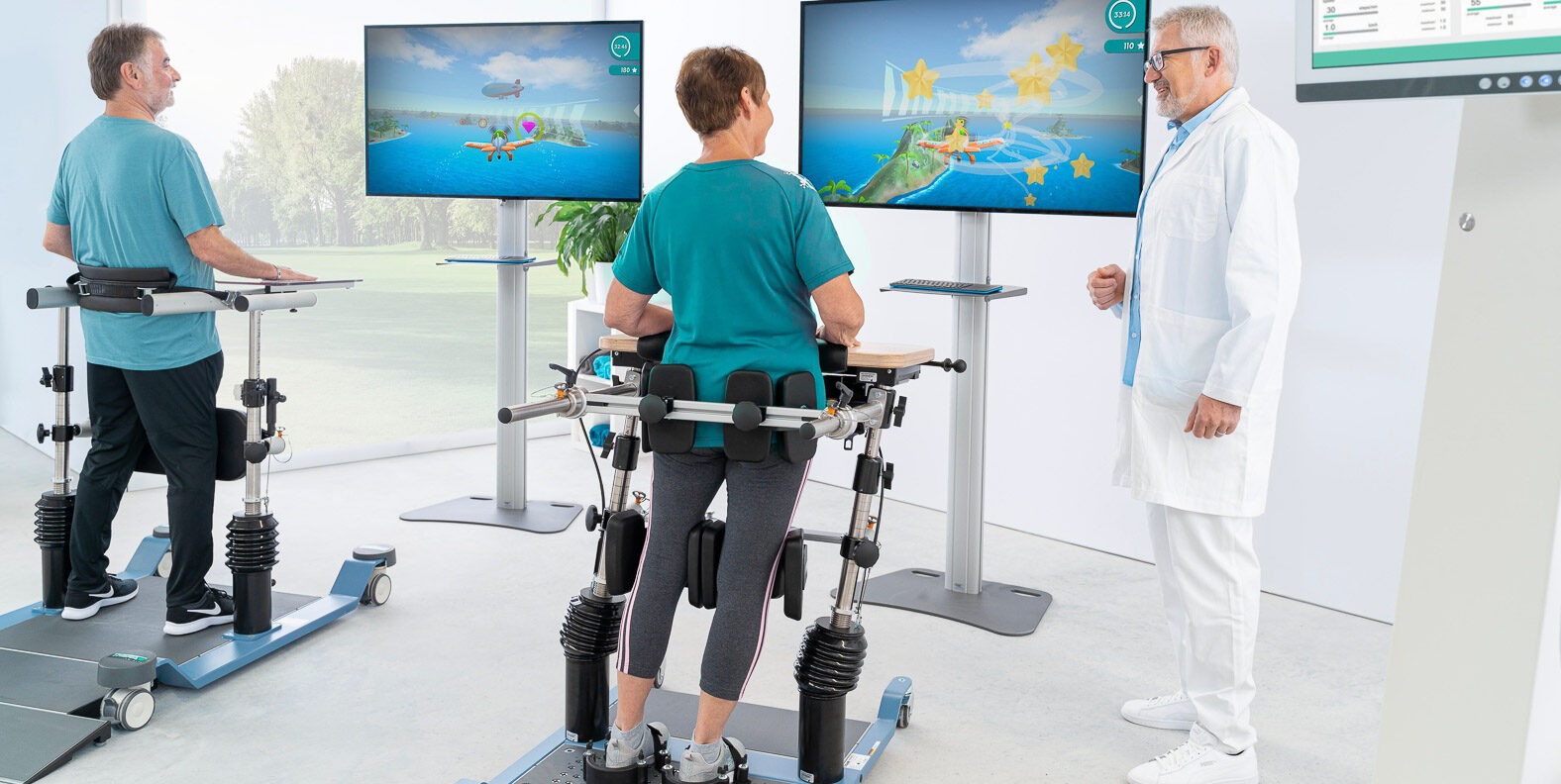
Its stable frame enables secure training in an upright position. The integrated balance unit allows for both static and dynamic standing, thereby establishing the conditions for controlled weight shifts and targeted training of postural control. The electric lift system further supports safe transfer from the wheelchair into the upright position.
The balo therefore combines two clinically relevant objectives in one system: safe patient verticalisation and active balance training. Rather than merely holding the patient in an upright position, the mechanical safety system can be utilised to permit movement within a protected setting, specifically challenging postural reactions.
This article therefore underscores a key developmental trend in neurorehabilitation: technology should not merely compensate but enable safe, individualised and, wherever possible, active training. Particularly in patients who are not yet able to stand independently, this principle allows the upright position to be combined with therapeutically relevant tasks at an early stage of rehabilitation.
GET IN TOUCH
The THERA-Trainer balo combines verticalisation with targeted postural training.
Jakob Tiebel
Health Business Consultant
Jakob Tiebel is OT and studied applied psychology with a focus on health economics. He has clinical expertise from his previous therapeutic work in neurorehabilitation. He conducts research and publishes on the theory-practice transfer in neurorehabilitation and is the owner of an agency for digital health marketing.
References:
- Kuzmić, A., & Ćurlin, M. (2026). Technological innovations in vertica - lization and postural control following spinal cord injury. Health Bulletin, 12(1), 117–128.