


TECHNOLOGY & DEVELOPMENT
From robot to routine
Why neurorehabilitation technology only becomes effective through proper implementation

Jakob Tiebel
Health Business Consultant
Robotics, sensor technology and digital therapy systems can make neurorehabilitation more intensive, more repetitive and more readily measurable. However, technological advancement alone does not determine whether this potential actually translates into benefits for patients.
A recent publication in npj Digital Medicine highlights the factors that determine whether rehabilitation technologies become a lasting part of clinical routine – providing important insights for device-assisted neurorehabilitation.
A recent publication in npj Digital Medicine highlights the factors that determine whether rehabilitation technologies become a lasting part of clinical routine – providing important insights for device-assisted neurorehabilitation.
The discussion surrounding rehabilitation technology is frequently dominated by one question: is the device effective? This question is undoubtedly central to robotic-assisted neurorehabilitation. In clinical care, however, this is followed by a second question that is at least equally important: Is an effective technology actually integrated into clinical practice in such a way that patients benefit from it on a regular basis, with sufficient intensity and with a justifiable use of resources?
This precise implementation gap was examined by Stockley and colleagues in a study published in 2026. Starting point: Rehabilitation technologies – including telerehabilitation, virtual reality, sensor technology, apps, robotics, exoskeletons and neuromodulation – hold the promise of improved access to rehabilitation, higher training intensities and additional opportunities for motivation and self-management. However, their use in routine clinical care remains inconsistent.
This precise implementation gap was examined by Stockley and colleagues in a study published in 2026. Starting point: Rehabilitation technologies – including telerehabilitation, virtual reality, sensor technology, apps, robotics, exoskeletons and neuromodulation – hold the promise of improved access to rehabilitation, higher training intensities and additional opportunities for motivation and self-management. However, their use in routine clinical care remains inconsistent.
When evidence alone is not enough
For their investigation, the researchers conducted interviews with 48 stakeholders from ten NHS sites across England, Scotland and Wales. Participants included not only therapists but also patients and family members, IT managers, senior leadership, innovation managers, governance experts, as well as developers and stakeholders from the regulatory environment.
In parallel, three literature reviews addressing implementation models, neurological rehabilitation and behavioural approaches were evaluated and integrated with the qualitative findings.
The result is the Rehabilitation Technology Implementation Model – RiTe. The model describes five closely interrelated domains that determine the successful implementation of a rehabilitation technology: Evidence, Technology, Users, Team and Organisation.
The crucial point here is not the individual category itself, but rather the systemic perspective. A technology may be clinically effective and technically well-developed, yet still fail as a result of inadequate training, unfavourable workflows, insufficient support from leadership, or complicated procurement and IT processes.
This represents a significant shift in perspective for neurorehabilitation. The actual clinical performance of a robotic system cannot be inferred from motor power, degrees of freedom, sensor technology or software functions alone. What ultimately matters is the therapy carried out with it under real-world conditions.
GET IN TOUCH
In parallel, three literature reviews addressing implementation models, neurological rehabilitation and behavioural approaches were evaluated and integrated with the qualitative findings.
The result is the Rehabilitation Technology Implementation Model – RiTe. The model describes five closely interrelated domains that determine the successful implementation of a rehabilitation technology: Evidence, Technology, Users, Team and Organisation.
The crucial point here is not the individual category itself, but rather the systemic perspective. A technology may be clinically effective and technically well-developed, yet still fail as a result of inadequate training, unfavourable workflows, insufficient support from leadership, or complicated procurement and IT processes.
This represents a significant shift in perspective for neurorehabilitation. The actual clinical performance of a robotic system cannot be inferred from motor power, degrees of freedom, sensor technology or software functions alone. What ultimately matters is the therapy carried out with it under real-world conditions.
GET IN TOUCH
Technology is only effective when it is applied in everyday clinical practice.
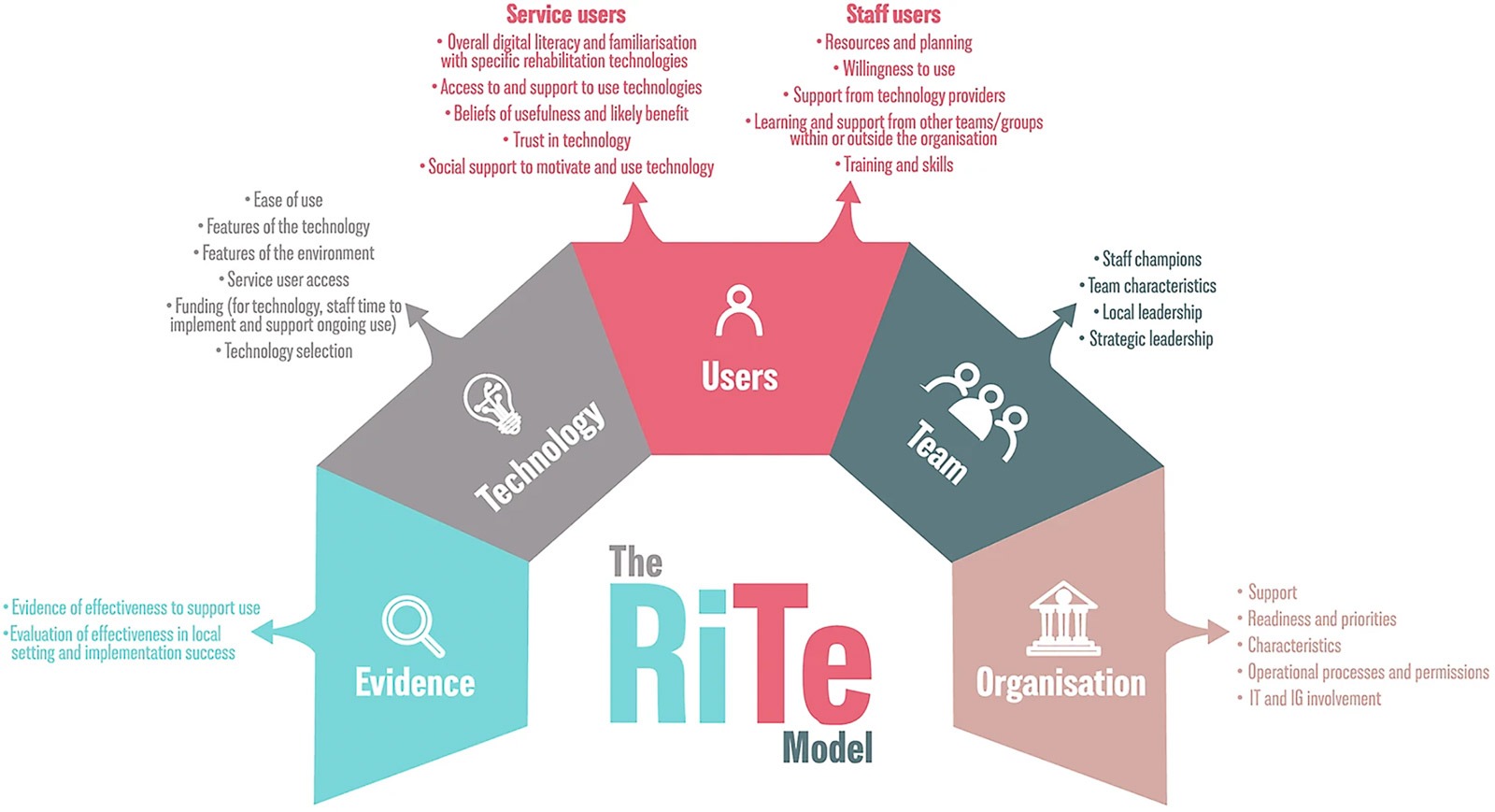
The Rehabilitation Technology (RiTe) Implementation Model.
Evidence: not only proving efficacy, but making the effect visible
The first RiTe domain concerns evidence. Before implementation, it should be established which clinical question a technology is intended to address and how robust the existing evidence is. After implementation, however, this task does not end. The authors explicitly call for continued monitoring of clinical outcomes, evaluation of costs and benefits, and observation of any adverse consequences arising from implementation.
This distinction is particularly relevant for robotic-assisted neurorehabilitation. The available evidence addresses whether a particular form of training can be effective under defined conditions. A healthcare facility must also establish whether these conditions can be achieved in everyday clinical practice: How many patients are actually being treated? How often? What is the recommended training duration and intensity? How much active participation is achieved? Which functional changes can be observed?
Classic evidence-based practice is therefore increasingly giving way to a combination of external evidence and local care data. For equipment manufacturers, this means: Training systems should not only facilitate therapy, but also ensure that its implementation is as transparent and assessable as possible.
This distinction is particularly relevant for robotic-assisted neurorehabilitation. The available evidence addresses whether a particular form of training can be effective under defined conditions. A healthcare facility must also establish whether these conditions can be achieved in everyday clinical practice: How many patients are actually being treated? How often? What is the recommended training duration and intensity? How much active participation is achieved? Which functional changes can be observed?
Classic evidence-based practice is therefore increasingly giving way to a combination of external evidence and local care data. For equipment manufacturers, this means: Training systems should not only facilitate therapy, but also ensure that its implementation is as transparent and assessable as possible.
Technology: the best function is the one that gets used
In the Technology domain, RiTe does not primarily focus on the degree of technical innovation. The key considerations are alignment with clinical need, ease of use, accessibility, funding and integration into existing treatment protocols and workflows. The environment – hospital, rehabilitation facility, outpatient care or the home setting – also alters the requirements placed on a system.
This has direct implications for rehabilitation robotics. Additional technical capabilities are only of clinical value if they enhance a therapeutic process. A highly complex system that requires lengthy setup times, can only be operated by a small number of specialists, or is rarely available during the daily routine may therefore, despite its impressive technical capabilities, deliver a low real-world therapy dose.
Conversely, seemingly mundane characteristics can suddenly become decisive performance features: rapid patient transfer, straightforward adjustment, intuitive operation, reliable safety functions and short turnaround times between patients. This influences how frequently a device can be deployed – and ultimately, therefore, how many repetitions and how much training time actually reach the patient.
This has direct implications for rehabilitation robotics. Additional technical capabilities are only of clinical value if they enhance a therapeutic process. A highly complex system that requires lengthy setup times, can only be operated by a small number of specialists, or is rarely available during the daily routine may therefore, despite its impressive technical capabilities, deliver a low real-world therapy dose.
Conversely, seemingly mundane characteristics can suddenly become decisive performance features: rapid patient transfer, straightforward adjustment, intuitive operation, reliable safety functions and short turnaround times between patients. This influences how frequently a device can be deployed – and ultimately, therefore, how many repetitions and how much training time actually reach the patient.
The best rehabilitation robot is not the most complex – it is the one that enables more effective therapy.
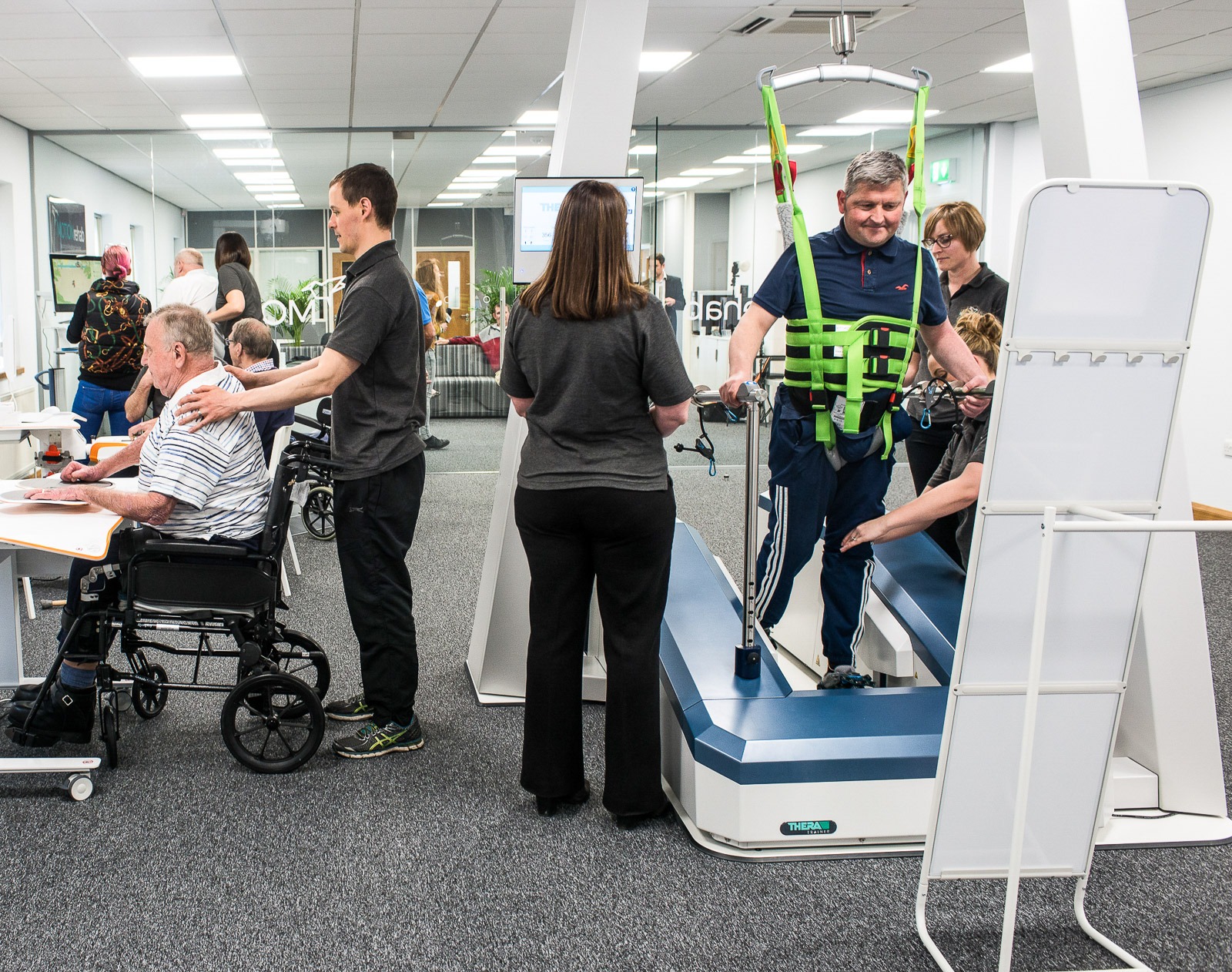
Robotic-assisted technologies at MOTIONrehab, UK
Users: technology must work for two user groups
A particular feature of rehabilitation technologies is that they always have at least two user groups: patients and healthcare staff. Among patients, motor, cognitive and sensory impairments influence usage, as do technical competence, expectations and confidence. In the case of staff, by contrast, key considerations include competence, the perceived therapeutic benefit and compatibility with their own professional way of working.
Stockley et al. also demonstrate that ongoing support is particularly important at critical junctures – during initial setup, when technical issues arise, following updates and during the onboarding of new staff.
This finding is particularly relevant to neurorehabilitation. A robotic system changes not only the patient’s movement, but also the therapist’s role. Physically demanding manual assistance can, in part, be replaced by technical assistance. This, in turn, presents new tasks: selecting patients, configuring systems, determining levels of support, interpreting training data and integrating device-assisted therapy with functional activities.
Robotics does not, therefore, replace clinical reasoning. It shifts part of this to a different level.
Interestingly, Stockley and colleagues observed differing perceptions in this regard: Therapists generally viewed technology as an adjunct to therapy. Some patients, by contrast, interpreted the technology itself as the treatment. The authors also identify this as a potential risk: if technology comes to be regarded as a substitute for rehabilitation, this risks excluding patients who are unable to engage with a particular system.
Stockley et al. also demonstrate that ongoing support is particularly important at critical junctures – during initial setup, when technical issues arise, following updates and during the onboarding of new staff.
This finding is particularly relevant to neurorehabilitation. A robotic system changes not only the patient’s movement, but also the therapist’s role. Physically demanding manual assistance can, in part, be replaced by technical assistance. This, in turn, presents new tasks: selecting patients, configuring systems, determining levels of support, interpreting training data and integrating device-assisted therapy with functional activities.
Robotics does not, therefore, replace clinical reasoning. It shifts part of this to a different level.
Interestingly, Stockley and colleagues observed differing perceptions in this regard: Therapists generally viewed technology as an adjunct to therapy. Some patients, by contrast, interpreted the technology itself as the treatment. The authors also identify this as a potential risk: if technology comes to be regarded as a substitute for rehabilitation, this risks excluding patients who are unable to engage with a particular system.
Team: robotics needs champions
According to RiTe, technology implementation is not a one-off decision made by a purchaser or a dedicated therapist. Of particular importance are a shared understanding within the team, local leadership and staff champions – experienced members of staff who integrate the technology in everyday practice, support colleagues and act as points of contact when problems arise. The visible support of management is equally crucial.
This explains a well-known phenomenon in clinical practice: two hospitals may use the same robotic system and achieve completely different results. In one facility, the device forms part of a defined treatment pathway; the team is familiar with the indications and training parameters, and utilisation is high. In the other, the same technology may be physically present in the therapy area, yet is only used sporadically.
This explains a well-known phenomenon in clinical practice: two hospitals may use the same robotic system and achieve completely different results. In one facility, the device forms part of a defined treatment pathway; the team is familiar with the indications and training parameters, and utilisation is high. In the other, the same technology may be physically present in the therapy area, yet is only used sporadically.
The difference does not lie in the device.
For successful robot-assisted neurorehabilitation, key questions need to be addressed prior to installation: Who decides on the indication? Who sets up the patient? Which professional groups can use the system? What are the therapeutic goals? How is training progression controlled? How are new members of staff trained? And which key metrics will be used after several months to determine whether the implementation is working?
The RiTe model significantly extends the traditional approach to product training. Instruction is essential – implementation goes considerably beyond this.
The RiTe model significantly extends the traditional approach to product training. Instruction is essential – implementation goes considerably beyond this.
Implementation determines both utilisation and clinical benefit.
Organisation: the robot must fit into the care system
Ultimately, organisation plays a decisive role. Data protection, IT, hygiene, procurement, maintenance, financing, spatial requirements and strategic priorities can either facilitate or hinder the introduction of a technology. The interviews show that a lack of knowledge regarding such processes can significantly delay implementation projects, or even lead to their discontinuation.
The RiTe model was developed largely on the basis of clinical experience within the NHS. In insurance-funded healthcare systems, additional factors may come into play – particularly requirements from health insurance providers and differing funding mechanisms.
This means that in terms of robotics, health economics also comes to the fore. The purchase price alone reveals little about a system’s economic value. Key considerations include actual usage, staffing requirements, training time, patient throughput, maintenance demands and clinical benefit.
A simple example illustrates this clearly. If technology makes it possible to train a high number of quality-controlled gait cycles, this initially appears therapeutically attractive. This potential only becomes economically relevant, however, when patients can be transferred into the system swiftly, staffing resource requirements remain manageable, and the device is utilised with sufficient frequency.
The RiTe model was developed largely on the basis of clinical experience within the NHS. In insurance-funded healthcare systems, additional factors may come into play – particularly requirements from health insurance providers and differing funding mechanisms.
This means that in terms of robotics, health economics also comes to the fore. The purchase price alone reveals little about a system’s economic value. Key considerations include actual usage, staffing requirements, training time, patient throughput, maintenance demands and clinical benefit.
A simple example illustrates this clearly. If technology makes it possible to train a high number of quality-controlled gait cycles, this initially appears therapeutically attractive. This potential only becomes economically relevant, however, when patients can be transferred into the system swiftly, staffing resource requirements remain manageable, and the device is utilised with sufficient frequency.
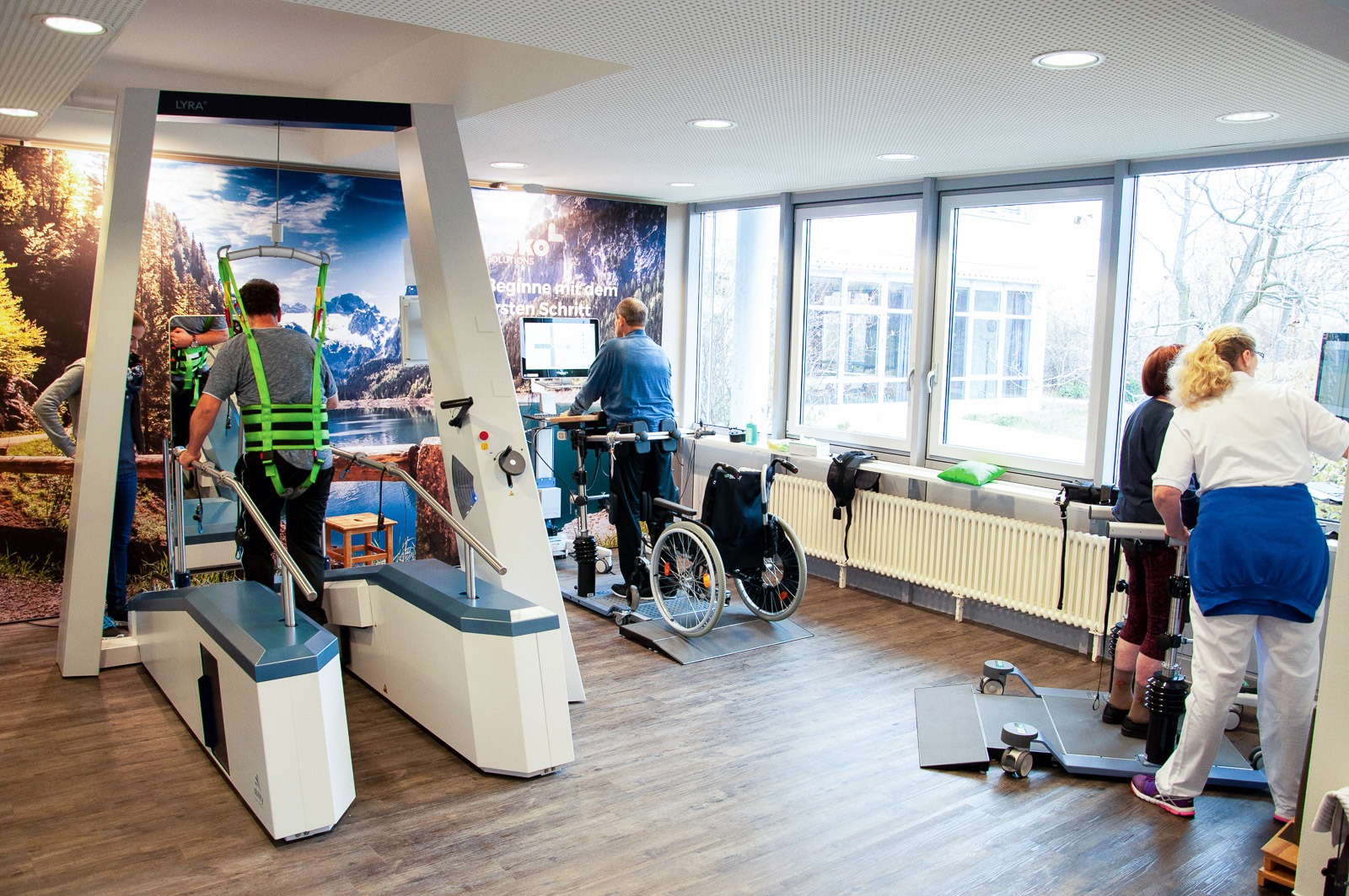
Therapy room in neurological rehabilitation at MEDIAN Klinik NRZ Magdeburg
From individual devices to a technology supported treatment pathway
This is precisely where the RiTe model proves particularly relevant to the THERA-Trainer approach. The portfolio encompasses not just a single robotic system, but motor-assisted movement training, dynamic standing and balance training, robotic-assisted gait training and software solutions spanning various phases of rehabilitation.
The THERA-Trainer lyra, for example, enables electromechanically assisted, repetitive gait training based on the end-effector principle; balo and coro address safe dynamic standing and postural control, while tigo and toro facilitate motor-assisted cycling.
Viewed through the lens of the RiTe model, however, the value of such a portfolio does not lie in assembling as many devices as possible in a therapy room. The technology becomes genuinely compelling when it gives rise to a clinically justifiable treatment pathway.
A severely affected patient may initially require motor-assisted activation and loading, followed by progressively increasing control of trunk and centre of gravity, dynamic standing and, ultimately, highly repetitive task-specific gait training. The technical intervention changes in line with the patient’s functional status – but the therapeutic goal remains focused on activity and mobility.
THERA-Trainer therefore describes a cross-device concept spanning cycling, standing and balancing, and gait training across the full continuum of rehabilitation phases – an approach increasingly adopted by clinics for group and circuit-based therapy sessions.
The THERA-Trainer lyra, for example, enables electromechanically assisted, repetitive gait training based on the end-effector principle; balo and coro address safe dynamic standing and postural control, while tigo and toro facilitate motor-assisted cycling.
Viewed through the lens of the RiTe model, however, the value of such a portfolio does not lie in assembling as many devices as possible in a therapy room. The technology becomes genuinely compelling when it gives rise to a clinically justifiable treatment pathway.
A severely affected patient may initially require motor-assisted activation and loading, followed by progressively increasing control of trunk and centre of gravity, dynamic standing and, ultimately, highly repetitive task-specific gait training. The technical intervention changes in line with the patient’s functional status – but the therapeutic goal remains focused on activity and mobility.
THERA-Trainer therefore describes a cross-device concept spanning cycling, standing and balancing, and gait training across the full continuum of rehabilitation phases – an approach increasingly adopted by clinics for group and circuit-based therapy sessions.
The next generation of rehabilitation robotics must be more than just technically superior
Perhaps the most important finding of the study by Stockley et al. is, indirectly, as follows: the future of rehabilitation technology will not be decided in development departments alone. Naturally, enhanced sensors, adaptive assistance, more powerful actuators, intelligent algorithms and immersive training environments remain key considerations. However, to achieve genuine clinical impact, innovation must be pursued with equal rigour across usability, workflow integration, training, data availability, service and implementation models.
From this, five strategic implications can be drawn: evidence should be more closely linked to real-world usage and outcome data; devices must be consistently designed to minimise procedural barriers; clinical application and continuous training are integral to the product itself, not merely an after-sales service; individual technologies should be integrated into indication- and phase-specific treatment pathways; and the success of an installation should be measured not at commissioning, but in terms of utilisation, therapy dosage, clinical outcomes and sustainability.
Consequently, the criteria for what makes a good rehabilitation robot are changing too. The system with the most features isn’t necessarily the best. The crucial factor is whether the right patient can train the right task at a sufficient dose using the device – and whether a clinic has the organisational capacity to deliver this reliably, day in, day out.
The real innovation, therefore, does not begin with switching on the robot. It begins at the point where technology becomes an integral part of good rehabilitation practice.
From this, five strategic implications can be drawn: evidence should be more closely linked to real-world usage and outcome data; devices must be consistently designed to minimise procedural barriers; clinical application and continuous training are integral to the product itself, not merely an after-sales service; individual technologies should be integrated into indication- and phase-specific treatment pathways; and the success of an installation should be measured not at commissioning, but in terms of utilisation, therapy dosage, clinical outcomes and sustainability.
Consequently, the criteria for what makes a good rehabilitation robot are changing too. The system with the most features isn’t necessarily the best. The crucial factor is whether the right patient can train the right task at a sufficient dose using the device – and whether a clinic has the organisational capacity to deliver this reliably, day in, day out.
The real innovation, therefore, does not begin with switching on the robot. It begins at the point where technology becomes an integral part of good rehabilitation practice.
Jakob Tiebel
Health Business Consultant
Jakob Tiebel is OT and studied applied psychology with a focus on health economics. He has clinical expertise from his previous therapeutic work in neurorehabilitation. He conducts research and publishes on the theory-practice transfer in neurorehabilitation and is the owner of an agency for digital health marketing.
References:
- Stockley, R. C., Gooch, H., Jarvis, K. A., et al. (2026). Understanding digital health technology implementation in rehabilitation and development of the Rehabilitation Technologies Implementation model. npj Digital Medicine, 9, 421.