


TECHNOLOGY & DEVELOPMENT
The original dynamic standing frame
More than 25 years of development, clinical evaluation and therapeutic maturity

Jakob Tiebel
Health Business Consultant
Classical standing frames were originally developed primarily for verticalisation. They bring people with limited mobility into an upright position and stabilise the body. However, static standing alone is not sufficient for relearning functional mobility and improving postural control. Postural control only develops when the centre of gravity is actively moved over the base of support, controlled and stabilised again following unexpected deviations.
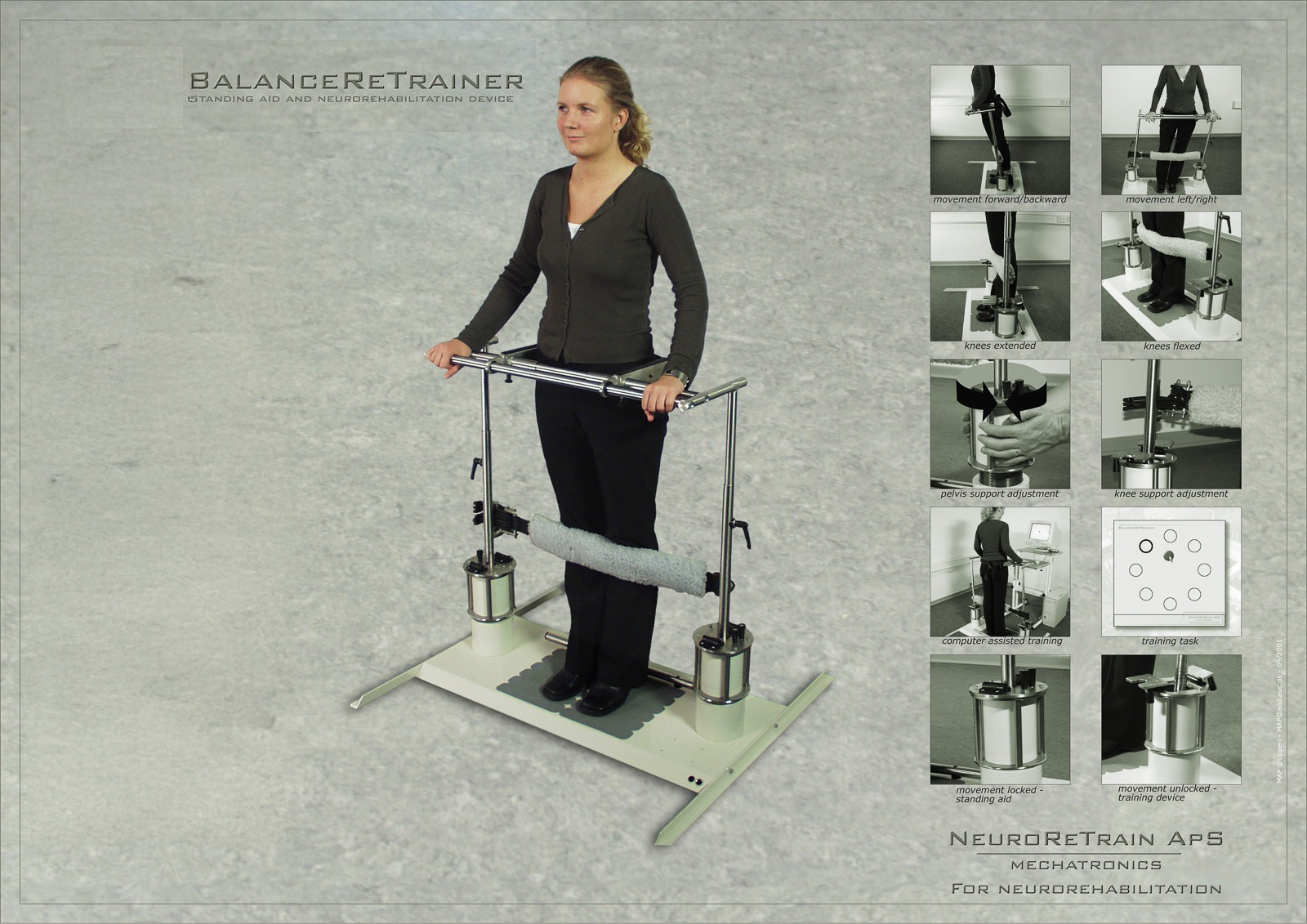
At this point, in the late 1990s, the development of today’s THERA-Trainer balo began. The aim was to develop a device that would create safety not through static verticalisation, but through controlled freedom of movement in a secured upright position. In other words, the person training should be able to move as actively as possible while standing, without being exposed to an uncontrolled risk of falling.
GET IN TOUCH
At this point, in the late 1990s, the development of today’s THERA-Trainer balo began. The aim was to develop a device that would create safety not through static verticalisation, but through controlled freedom of movement in a secured upright position. In other words, the person training should be able to move as actively as possible while standing, without being exposed to an uncontrolled risk of falling.
GET IN TOUCH
2000: The scientific origins
In 2000, Zlatko Matjačić, Inger Lange Johannesen and Thomas Sinkjær published the first scientific description of the so-called Multi-purpose Rehabilitation Frame. The system featured two mechanical degrees of freedom and enabled controlled movements of the legs and pelvis in the sagittal and frontal planes. At the same time, the degree of mechanical support could be varied in a targeted manner (Matjačić et al., 2000).
The authors had already formulated a principle that continues to characterise dynamic standing training to this day: as much stability as necessary, as much active movement as possible. Mechanical support was not used solely for safety, but could be deliberately reduced in order to gradually adapt the demands on postural control to the individual’s performance level.
The design therefore combined fall-safe standing with active weight shifting and transformed a conventional standing and positioning device into an active training platform. The conceptual separation of external safety and independent postural activity continues to form the scientific and technical basis of the THERA-Trainer balo.
The authors had already formulated a principle that continues to characterise dynamic standing training to this day: as much stability as necessary, as much active movement as possible. Mechanical support was not used solely for safety, but could be deliberately reduced in order to gradually adapt the demands on postural control to the individual’s performance level.
The design therefore combined fall-safe standing with active weight shifting and transformed a conventional standing and positioning device into an active training platform. The conceptual separation of external safety and independent postural activity continues to form the scientific and technical basis of the THERA-Trainer balo.
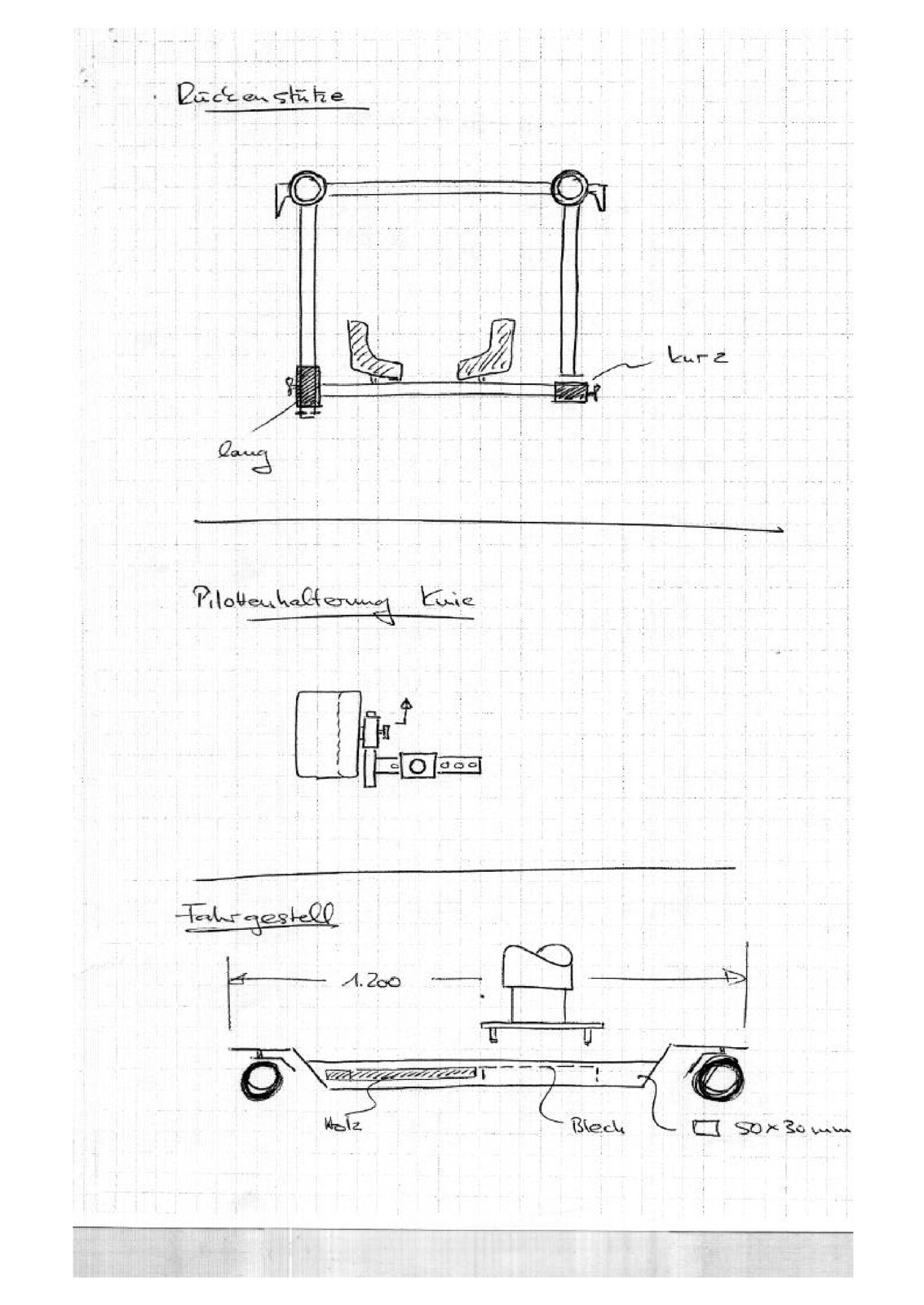
Early construction sketches show the basic principle of today’s THERA-Trainer balo
2003: From the prototype to the BalanceReTrainer
Three years later, Matjačić, Hesse and Sinkjær described the further-developed system for the first time as the BalanceReTrainer. In addition to the technical design, they presented training methods for people with neurological impairments. One patient with chronic hemiparesis and spatial neglect completed ten days of training. The biomechanical analysis subsequently showed a clear functional improvement in controlled weight shifting (Matjačić et al., 2003).
The key advance of this work was the combination of training and objective movement analysis. Weight shifting was not merely observed qualitatively, but recorded biomechanically. This created a basis for reproducible training tasks: direction of movement, range of movement and degree of support could be specifically prescribed and adjusted over the course of training.
This was particularly relevant for people with severe impairments. In a free-standing situation, at least one therapist must always take over a large part of the stabilisation. In the BalanceReTrainer, this safety function was provided mechanically. This allowed the therapist’s attention to be focused more strongly on movement initiation, symmetry, trunk control and task quality.
The key advance of this work was the combination of training and objective movement analysis. Weight shifting was not merely observed qualitatively, but recorded biomechanically. This created a basis for reproducible training tasks: direction of movement, range of movement and degree of support could be specifically prescribed and adjusted over the course of training.
This was particularly relevant for people with severe impairments. In a free-standing situation, at least one therapist must always take over a large part of the stabilisation. In the BalanceReTrainer, this safety function was provided mechanically. This allowed the therapist’s attention to be focused more strongly on movement initiation, symmetry, trunk control and task quality.
2003: Functional effects in people with amputation
Also in 2003, Matjačić and Burger investigated the system in 14 people with transtibial amputation. The participants trained for approximately 20 minutes on five consecutive days in the fall-safe BalanceReTrainer. Single-leg standing on the prosthesis, the Timed Up and Go test and the 10-metre walk test were recorded (Matjačić & Burger, 2003).
After training, the average standing time on the prosthetic limb increased from 2.98 to 4.30 seconds. The time in the Timed Up and Go test decreased from 6.15 to 5.40 seconds, and the time required to walk ten metres decreased from 5.51 to 4.50 seconds. Despite the short training duration, both a specific balance performance measure and functional mobility parameters therefore improved.
The findings broadened the range of applications beyond neurological rehabilitation. Dynamic postural control is also central following amputation because body weight must be safely transferred onto the prosthesis and subsequently shifted again. The BalanceReTrainer enabled precisely these loading and control processes to be trained with a high number of repetitions.
After training, the average standing time on the prosthetic limb increased from 2.98 to 4.30 seconds. The time in the Timed Up and Go test decreased from 6.15 to 5.40 seconds, and the time required to walk ten metres decreased from 5.51 to 4.50 seconds. Despite the short training duration, both a specific balance performance measure and functional mobility parameters therefore improved.
The findings broadened the range of applications beyond neurological rehabilitation. Dynamic postural control is also central following amputation because body weight must be safely transferred onto the prosthesis and subsequently shifted again. The BalanceReTrainer enabled precisely these loading and control processes to be trained with a high number of repetitions.
2005: From standing to preparation for walking
In 2005, Matjačić and colleagues expanded the training concept to include targeted stepping activities. The publication described a method for dynamic balance training during standing and stepping in the Original BalanceTrainer, which was already commercially available at the time from medica Medizintechnik GmbH, manufacturer of THERA-Trainer. In a two-week case study, a person with chronic hemiparesis trained for 30 minutes twice daily (Matjačić et al., 2005).
The study addressed a central relationship: walking requires not only rhythmic leg movements, but also continuous control of the trunk and centre of gravity. Before each step, weight must be shifted onto the stance leg, stabilised there and the other leg unloaded. Deficits in this preparation often limit step initiation and gait quality.
The BalanceTrainer was thus positioned as part of a functional continuum ranging from trunk stabilisation through targeted weight shifting and loading of the stance leg to unloading of the swing leg and, ultimately, initiation of a step.
This principle continues to characterise the THERA-Trainer balo: it is not intended solely for safe standing, but creates a training environment for key postural prerequisites for walking. Depending on the individual’s performance level, small shifts of the centre of gravity can initially be trained, followed by larger movement amplitudes and, building on these, targeted stepping and even reaching tasks.
The study addressed a central relationship: walking requires not only rhythmic leg movements, but also continuous control of the trunk and centre of gravity. Before each step, weight must be shifted onto the stance leg, stabilised there and the other leg unloaded. Deficits in this preparation often limit step initiation and gait quality.
The BalanceTrainer was thus positioned as part of a functional continuum ranging from trunk stabilisation through targeted weight shifting and loading of the stance leg to unloading of the swing leg and, ultimately, initiation of a step.
This principle continues to characterise the THERA-Trainer balo: it is not intended solely for safe standing, but creates a training environment for key postural prerequisites for walking. Depending on the individual’s performance level, small shifts of the centre of gravity can initially be trained, followed by larger movement amplitudes and, building on these, targeted stepping and even reaching tasks.
2006: Intensive training in sensorimotor neuropathy
In a randomised study in 2006, Matjačić and Zupan investigated 16 people with hereditary sensorimotor neuropathy. Both groups completed a programme of stretching, strengthening, as well as dynamic balance and mobility training. In the intervention group, training was performed in the BalanceTrainer; in the control group, comparable tasks were carried out with manual support from a physiotherapist (Matjačić & Zupan, 2006).
In the device group, the Berg Balance Scale, the Timed Up and Go test and the 10-metre walk test improved significantly. The study also demonstrated an organisationally relevant aspect: dynamic standing and stepping activities could be performed without permanent physical stabilisation by a therapist or carer.
This revealed a key potential of the system. The structural fall-safety mechanism enables a higher number of repetitions, longer periods of active training and more precise dosing. The therapist remains responsible for indication, set-up, progression and movement analysis, but does not need to manually stabilise the person training during every weight shift.
In the device group, the Berg Balance Scale, the Timed Up and Go test and the 10-metre walk test improved significantly. The study also demonstrated an organisationally relevant aspect: dynamic standing and stepping activities could be performed without permanent physical stabilisation by a therapist or carer.
This revealed a key potential of the system. The structural fall-safety mechanism enables a higher number of repetitions, longer periods of active training and more precise dosing. The therapist remains responsible for indication, set-up, progression and movement analysis, but does not need to manually stabilise the person training during every weight shift.
2009: Postural control becomes measurable by direction
In 2009, Cikajlo and Matjačić also investigated the BalanceTrainer as an experimental platform for the instrumental assessment of postural responses. In a study involving ten people after stroke and seven neurologically healthy comparison participants, unexpected movement impulses were applied from eight different directions and the resulting response and loading patterns were analysed (Cikajlo & Matjačić, 2009).
The study demonstrated that balance control can be considered in a direction-specific manner: while movements in one direction may be well controlled, lateral or diagonal demands can produce markedly different response patterns. The approach therefore provided an illustrative example of the potential of the BalanceTrainer as a research instrument for differentiated analysis of postural control.
However, this instrumental assessment function remained an experimental research approach and was not continued as a standard function of the THERA-Trainer balo. Instead, further product development focused on the underlying therapeutic principle: creating a safe training environment in which direction of movement, degree of support and task demands can be adapted to individual abilities and active postural control can be specifically promoted.
The study demonstrated that balance control can be considered in a direction-specific manner: while movements in one direction may be well controlled, lateral or diagonal demands can produce markedly different response patterns. The approach therefore provided an illustrative example of the potential of the BalanceTrainer as a research instrument for differentiated analysis of postural control.
However, this instrumental assessment function remained an experimental research approach and was not continued as a standard function of the THERA-Trainer balo. Instead, further product development focused on the underlying therapeutic principle: creating a safe training environment in which direction of movement, degree of support and task demands can be adapted to individual abilities and active postural control can be specifically promoted.
2010: Clinical evaluation in subacute stroke rehabilitation
In 2010, Goljar and colleagues investigated the training in a randomised controlled study involving people in the subacute phase after stroke. Of the 50 people enrolled, 39 completed the study. Conventional balance training was compared with device-assisted training in the BalanceTrainer. Both interventions improved balance and functional mobility (Goljar et al., 2010).
The significance of this study rests on the clinical validation of the training principle under controlled conditions. By this point, the BalanceTrainer had long ceased to be an experimental one-off design and had become a standardisable training environment that could be integrated into a regular neurological rehabilitation process.
Standardisation is particularly relevant in subacute rehabilitation. Performance levels can change within a short period of time. The degree of support, range of movement and task complexity must therefore be adjusted regularly. The mechanical design allows such progression without abandoning the fundamental fall-safety mechanism, even for patients who are unable to walk.
The significance of this study rests on the clinical validation of the training principle under controlled conditions. By this point, the BalanceTrainer had long ceased to be an experimental one-off design and had become a standardisable training environment that could be integrated into a regular neurological rehabilitation process.
Standardisation is particularly relevant in subacute rehabilitation. Performance levels can change within a short period of time. The degree of support, range of movement and task complexity must therefore be adjusted regularly. The mechanical design allows such progression without abandoning the fundamental fall-safety mechanism, even for patients who are unable to walk.
2012: Integration of virtual feedback
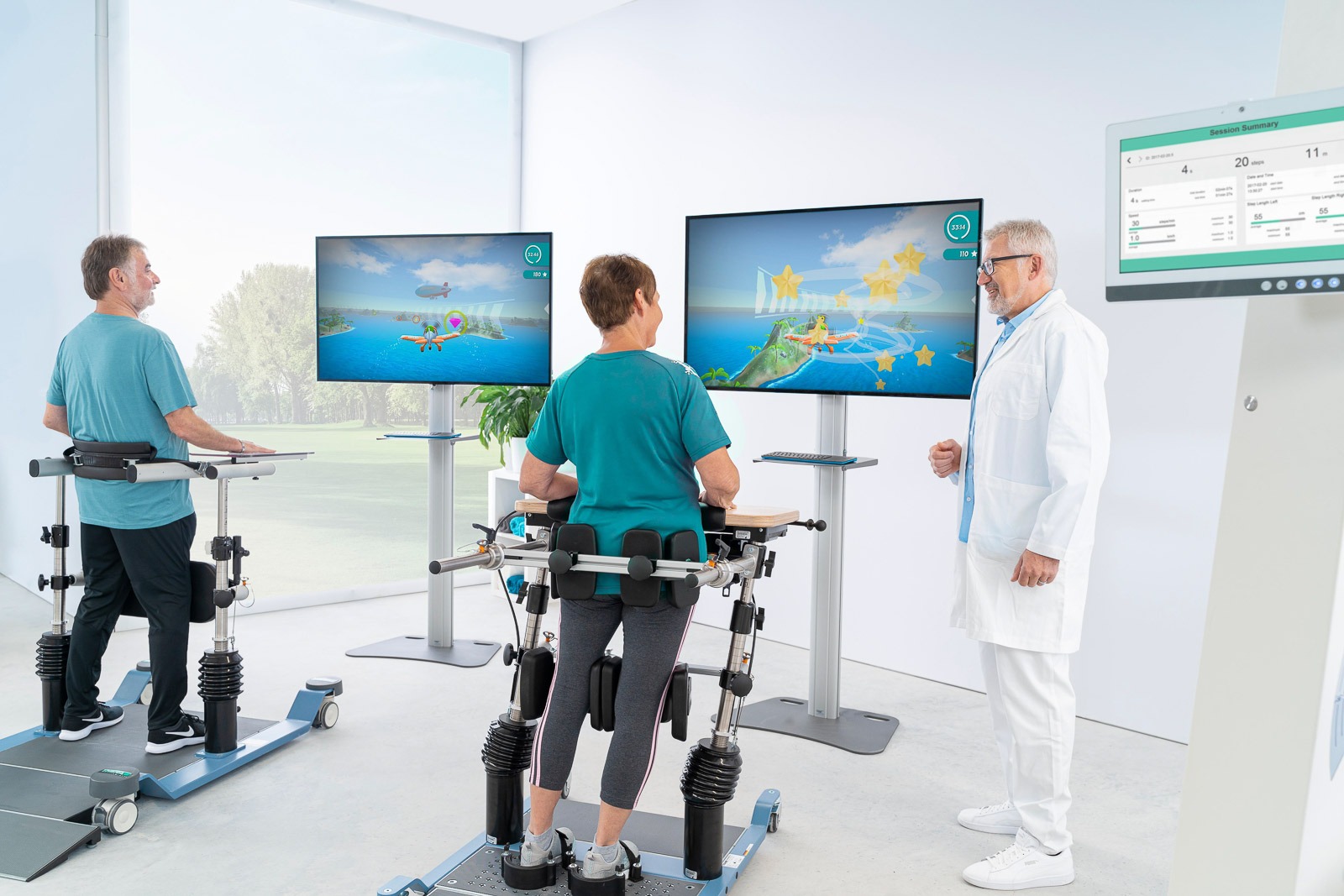
With the integration of virtual tasks in 2012, the mechanical training platform was enhanced with visual real-time feedback. In a pilot study involving six stroke patients, training was carried out over three weeks: two weeks in the clinic and one week in the home environment. Training took place five times per week for up to 20 minutes per session (Cikajlo et al., 2012).
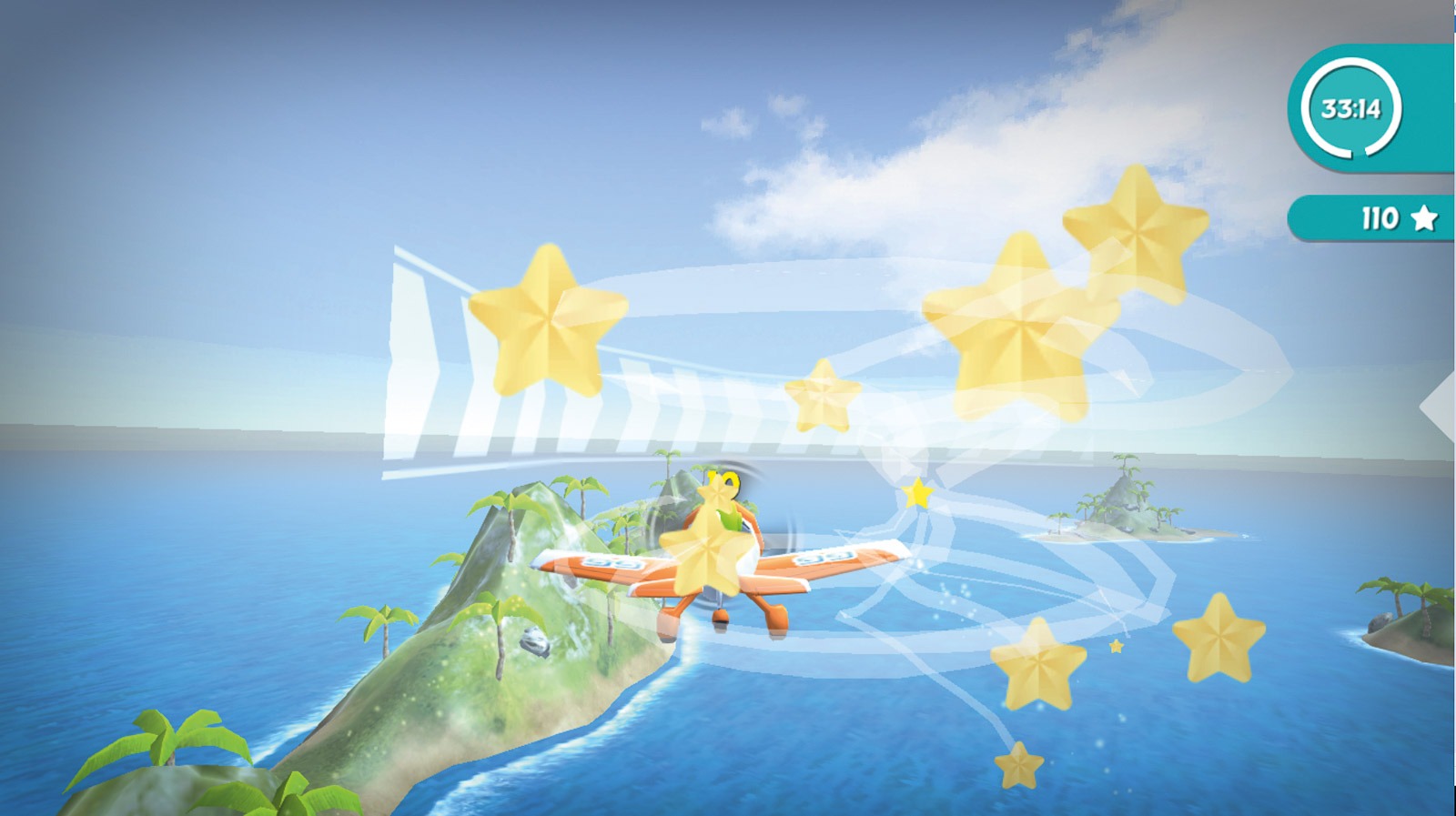
The virtual task translated the real weight shift into a visible response on the screen. This provided the person training with immediate information about direction of movement, dosing and achievement of the target. At the same time, the task created an external focus of attention: rather than the isolated movement of the body being the focus, the aim was to achieve a visible action goal.
The study documented improvements including in the Berg Balance Scale, the Timed Up and Go test, the 10-metre walk test and single-leg standing. It also showed that the dynamic training principle can be combined with digital and telerehabilitation approaches.
The virtual task translated the real weight shift into a visible response on the screen. This provided the person training with immediate information about direction of movement, dosing and achievement of the target. At the same time, the task created an external focus of attention: rather than the isolated movement of the body being the focus, the aim was to achieve a visible action goal.
The study documented improvements including in the Berg Balance Scale, the Timed Up and Go test, the 10-metre walk test and single-leg standing. It also showed that the dynamic training principle can be combined with digital and telerehabilitation approaches.
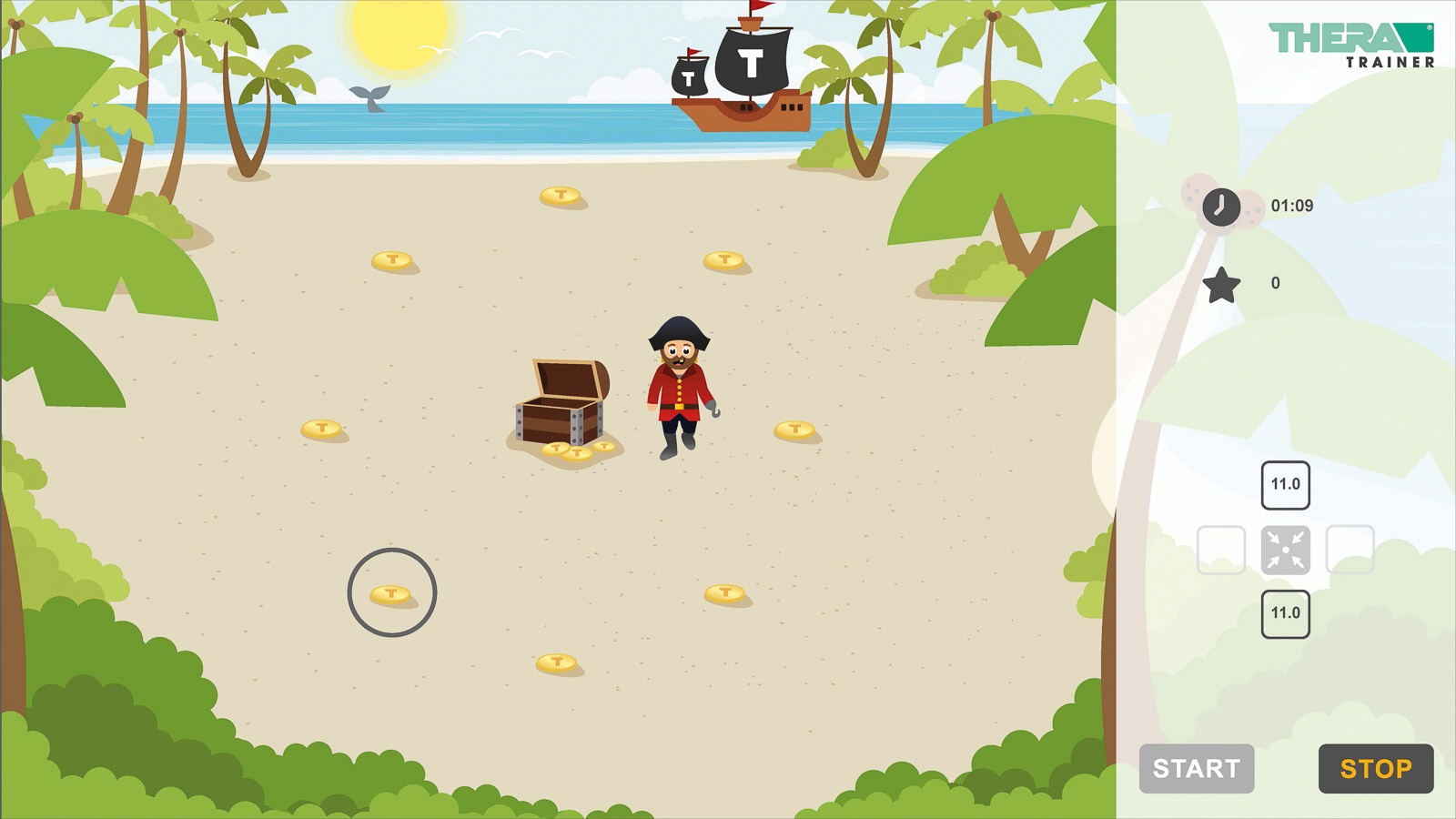
The development of the software over time: from simple direction-based feedback tasks to interactive virtual training applications.
From the BalanceReTrainer to the THERA-Trainer balo
The names and technical designs were continuously developed over the years. The scientific and technological origins can be traced clearly: the Multi-purpose Rehabilitation Frame evolved into the BalanceReTrainer and from there into the THERA-Trainer Standing & Balancing product line, represented today by the THERA-Trainer balo.
The current balo combines fall-safe upright positioning with a patented dynamic balance unit. This allows weight shifts in all directions and therefore targeted movement of the centre of gravity over the base of support. The feet, knees and pelvis can be individually secured according to the functional requirements. This also means that people who are not yet able to stand independently can be included in active training at an early stage.
What is crucial is the continuity of the underlying principle. The balo does not merely support the achievement of a vertical position, but enables a graded progression of:
• Trunk stability and axial control
• Active weight bearing
• Multidirectional shifting of the centre of gravity
• Anticipatory and reactive balance responses
• Reaching and grasping tasks and preparatory stepping activities
This means that the same device can be used in different phases of rehabilitation: from supported verticalisation through dynamic standing to the immediate preparation of functional mobility.
The current balo combines fall-safe upright positioning with a patented dynamic balance unit. This allows weight shifts in all directions and therefore targeted movement of the centre of gravity over the base of support. The feet, knees and pelvis can be individually secured according to the functional requirements. This also means that people who are not yet able to stand independently can be included in active training at an early stage.
What is crucial is the continuity of the underlying principle. The balo does not merely support the achievement of a vertical position, but enables a graded progression of:
• Trunk stability and axial control
• Active weight bearing
• Multidirectional shifting of the centre of gravity
• Anticipatory and reactive balance responses
• Reaching and grasping tasks and preparatory stepping activities
This means that the same device can be used in different phases of rehabilitation: from supported verticalisation through dynamic standing to the immediate preparation of functional mobility.
Why the balo is the Original
The claim to be the Original of dynamic standing training is based not solely on product tradition. It can be traced through a research and development history spanning more than 25 years.
The first paper in 2000 already described the essential design principles: controlled multidirectional movement and adjustable mechanical support. In the following years, the system was investigated in stroke, neglect, amputation and sensorimotor neuropathy. The research included technical development work, biomechanical analyses, clinical case studies, pilot studies and randomised controlled trials.
This breadth is exceptional for a rehabilitation medicine training device. Research has addressed not only whether people can stand in the device, but also which motor demands can be trained in it, how training affects functional performance, how postural responses can be objectively assessed and how digital feedback systems can be integrated.
From a scientific perspective, it is not possible to derive a general superiority over other forms of therapy for every indication. What can be stated with confidence, however, is that the THERA-Trainer balo is among the longest-standing, most systematically investigated and most clinically versatile dynamic standing trainers.
The first paper in 2000 already described the essential design principles: controlled multidirectional movement and adjustable mechanical support. In the following years, the system was investigated in stroke, neglect, amputation and sensorimotor neuropathy. The research included technical development work, biomechanical analyses, clinical case studies, pilot studies and randomised controlled trials.
This breadth is exceptional for a rehabilitation medicine training device. Research has addressed not only whether people can stand in the device, but also which motor demands can be trained in it, how training affects functional performance, how postural responses can be objectively assessed and how digital feedback systems can be integrated.
From a scientific perspective, it is not possible to derive a general superiority over other forms of therapy for every indication. What can be stated with confidence, however, is that the THERA-Trainer balo is among the longest-standing, most systematically investigated and most clinically versatile dynamic standing trainers.
More than a standing device
The particular quality of the balo lies in combining apparent opposites: safety and freedom of movement. Support and independent activity. Verticalisation and functional training. Mechanical reliability and digital feedback.
This means that training can begin early and develop alongside functional progress.
A person does not need to be able to stand safely already in order to work on postural control. At the same time, the device remains sufficiently challenging to train more complex weight shifts, grasping tasks and stepping activities later on.
This particular combination has made the THERA-Trainer balo a benchmark in dynamic standing training for more than 25 years: not because of a short-lived technological trend, but because of a consistently developed, scientifically investigated and clinically proven training principle.
This means that training can begin early and develop alongside functional progress.
A person does not need to be able to stand safely already in order to work on postural control. At the same time, the device remains sufficiently challenging to train more complex weight shifts, grasping tasks and stepping activities later on.
This particular combination has made the THERA-Trainer balo a benchmark in dynamic standing training for more than 25 years: not because of a short-lived technological trend, but because of a consistently developed, scientifically investigated and clinically proven training principle.
Jakob Tiebel
Health Business Consultant
Jakob Tiebel is OT and studied applied psychology with a focus on health economics. He has clinical expertise from his previous therapeutic work in neurorehabilitation. He conducts research and publishes on the theory-practice transfer in neurorehabilitation and is the owner of an agency for digital health marketing.

Otto Höbel
CTO THERA-Trainer

Dr. Jonathan Kopf
CEO THERA-Trainer
References:
- Cikajlo, I., & Matjačić, Z. (2009). Directionally specific objective postural response assessment tool for treatment evaluation in stroke patients. IEEE Transactions on Neural Systems and Rehabilitation Engineering, 17(1), 91–100. https://doi.org/10.1109/TNSRE.2008.2010477
- Cikajlo, I., Rudolf, M., Goljar, N., Burger, H., & Matjačić, Z. (2012). Telerehabilitation using virtual reality task can improve balance in patients with stroke. Disability and Rehabilitation, 34(1), 13–18. https://doi.org/10.3 109/09638288.2011.583308
- Goljar, N., Burger, H., Rudolf, M., & Stanonik, I. (2010). Improving balance in subacute stroke patients: A randomized controlled study. International Journal of Rehabilitation Research, 33(3), 205–210. https://doi.org/10.1097/ MRR.0b013e328333de61
- Matjačić, Z., & Burger, H. (2003). Dynamic balance training during standing in people with trans-tibial amputation: A pilot study. Prosthetics and Orthotics International, 27(3), 214–220. Dynamic balance training during standing in... : Prosthetics & Orthotics International
- Matjačić, Z., Hesse, S., & Sinkjær, T. (2003). BalanceReTrainer: A new standing-balance training apparatus and methods applied to a chronic hemiparetic subject with a neglect syndrome. NeuroRehabilitation, 18(3), 251–259. https://doi.org/10.3233/NRE-2003-18309
- Matjačić, Z., Johannesen, I. L., & Sinkjær, T. (2000). A multi-purpose rehabilitation frame: A novel apparatus for balance training during standing of neurologically impaired individuals. Journal of Rehabilitation Research and Development, 37(6), 681–691.
- Matjačić, Z., Rusjan, Š., Stanonik, I., Goljar, N., & Olenšek, A. (2005). Methods for dynamic balance training during standing and stepping. Artificial Organs, 29(6), 462–466. Methods for Dynamic Balance Training During Standing and Stepping
- Matjačić, Z., & Zupan, A. (2006). Effects of dynamic balance training during standing and stepping in patients with hereditary sensory motor neuropathy. Disability and Rehabilitation, 28(23), 1455–1459. Effects of dynamic balance training during standing and stepping in patients with hereditary sensory motor neuropathy