


TECHNOLOGY & DEVELOPMENT
Epidural spinal cord stimulation and robotic-assisted mobilisation in complete spinal cord injury
How a multimodal rehabilitation concept with spinal stimulation and intensive training can restore functional mobility even in cases of chronic complete spinal cord injury

Jakob Tiebel
Health Business Consultant
People with complete paraplegia have been regarded for decades in rehabilitation as a patient group with very limited chances of functional recovery. In the case of complete sensorimotor lesions in particular, regaining the ability to stand or walk is often considered barely realistic. All the more remarkable are the latest results from one clinical proof-of-concept study, which shows that under certain conditions, functional mobility can be relearned years after a spinal cord injury. The study focuses on an intensive, multimodal rehabilitation programme that combines epidural spinal cord stimulation (SCS) with targeted movement therapy, mental training, robotic-assisted gait training and structured trunk rehabilitation. The THERA-Trainer plays a key role in this, as it was used both in the preparation phase and during the post-operative rehabilitation.
A new approach to an old challenge
Only around five to eight per cent of people with a complete sensorimotor spinal cord injury regain a certain ability to walk. Traditional rehabilitation approaches quickly reach their limits here. The study now presented therefore takes a different approach: it relies on the interplay of several therapeutic levers to make existing but functionally “dormant” neuronal connections below the lesion usable again.
Three people with chronic complete thoracic spinal cord injury took part in the programme. All of them had been completely dependent on a wheelchair for several years. Following a preparatory training phase (prehabilitation), they were implanted with an epidural spinal cord stimulator. This was followed by a seven-month, highly intensive rehabilitation phase with daily training.
Three people with chronic complete thoracic spinal cord injury took part in the programme. All of them had been completely dependent on a wheelchair for several years. Following a preparatory training phase (prehabilitation), they were implanted with an epidural spinal cord stimulator. This was followed by a seven-month, highly intensive rehabilitation phase with daily training.
Prehabilitation: preparation for re-uprighting
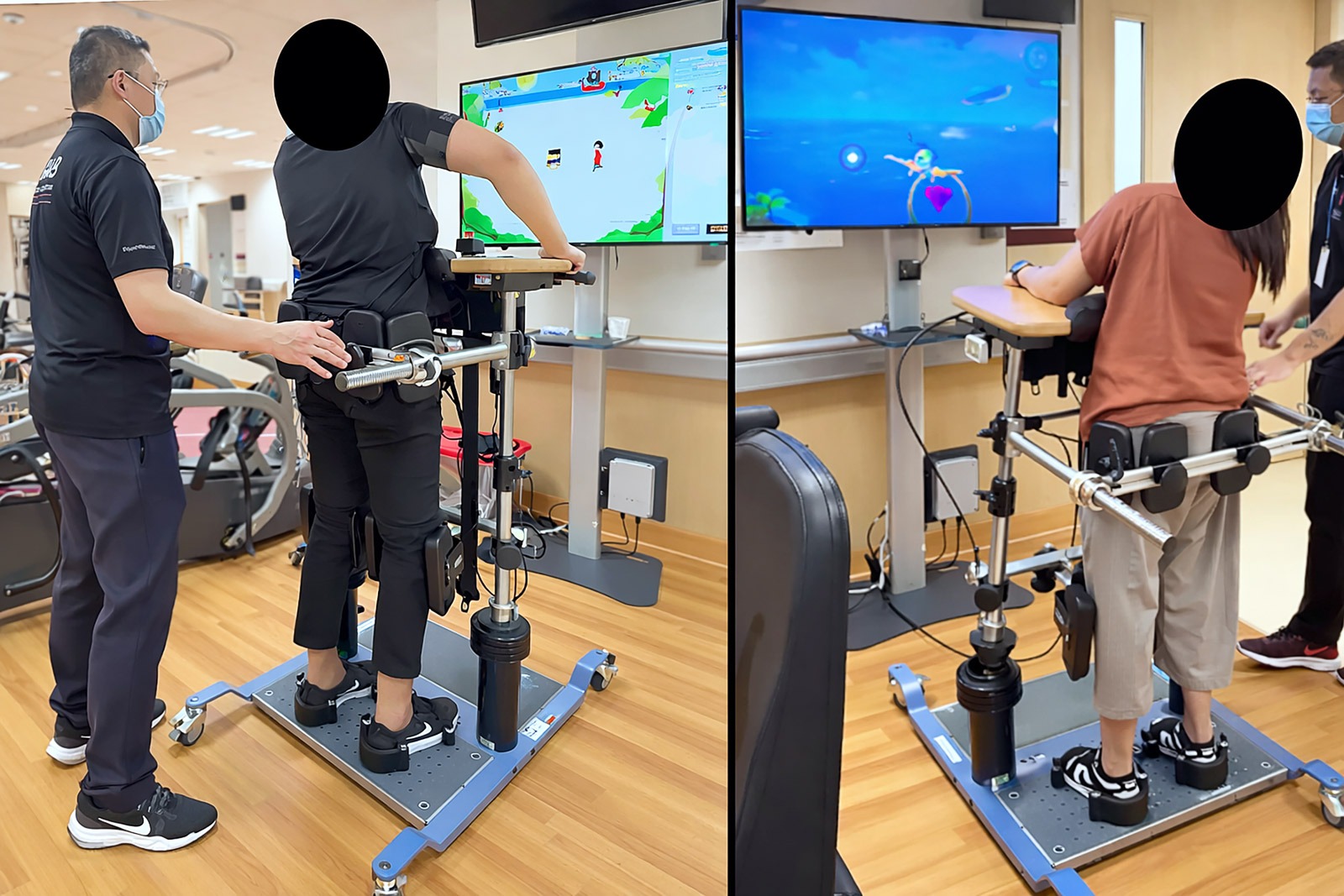
Even before spinal cord stimulation was implanted, the THERA-Trainer balo played a central role. The aim of this phase was to prepare the participants physically and mentally for the subsequent intensive gait and standing training.
The following aspects were specifically trained with the standing frame:
• Verticalisation and weight bearing to get the circulation used to the upright position
• Active trunk control, which is essential for later transfers and walking
• Dynamic weight shifts, supported by interactive training programmes
This phase is particularly crucial for people who have not stood for years. The THERA-Trainer enabled safe, controlled standing with a high level of therapeutic activation at the same time – without excessive demands and with a clear structure.
The following aspects were specifically trained with the standing frame:
• Verticalisation and weight bearing to get the circulation used to the upright position
• Active trunk control, which is essential for later transfers and walking
• Dynamic weight shifts, supported by interactive training programmes
This phase is particularly crucial for people who have not stood for years. The THERA-Trainer enabled safe, controlled standing with a high level of therapeutic activation at the same time – without excessive demands and with a clear structure.
After implantation: movement made possible again
After implantation of the spinal cord stimulator, the actual core phase of the programme began. The electrical stimulation made it possible for the participants to voluntarily control individual muscle groups in their legs for the first time – but only in combination with active training.
This showed the great advantage of structured device use: THERA-Trainer-based therapy was not used here in isolation, but was combined with other elements in a targeted manner:
• Trunk rehabilitation to create the basis for balance and standing stability
• Task-specific training, such as sit-to-stand exercises
• Robotic-assisted gait training and later free walking with aids
The THERA-Trainer acted as a link between stabilisation and mobilisation. In particular, repeated, safe standing and controlled weight-bearing proved to be a critical intermediate step on the way to walking.
This showed the great advantage of structured device use: THERA-Trainer-based therapy was not used here in isolation, but was combined with other elements in a targeted manner:
• Trunk rehabilitation to create the basis for balance and standing stability
• Task-specific training, such as sit-to-stand exercises
• Robotic-assisted gait training and later free walking with aids
The THERA-Trainer acted as a link between stabilisation and mobilisation. In particular, repeated, safe standing and controlled weight-bearing proved to be a critical intermediate step on the way to walking.
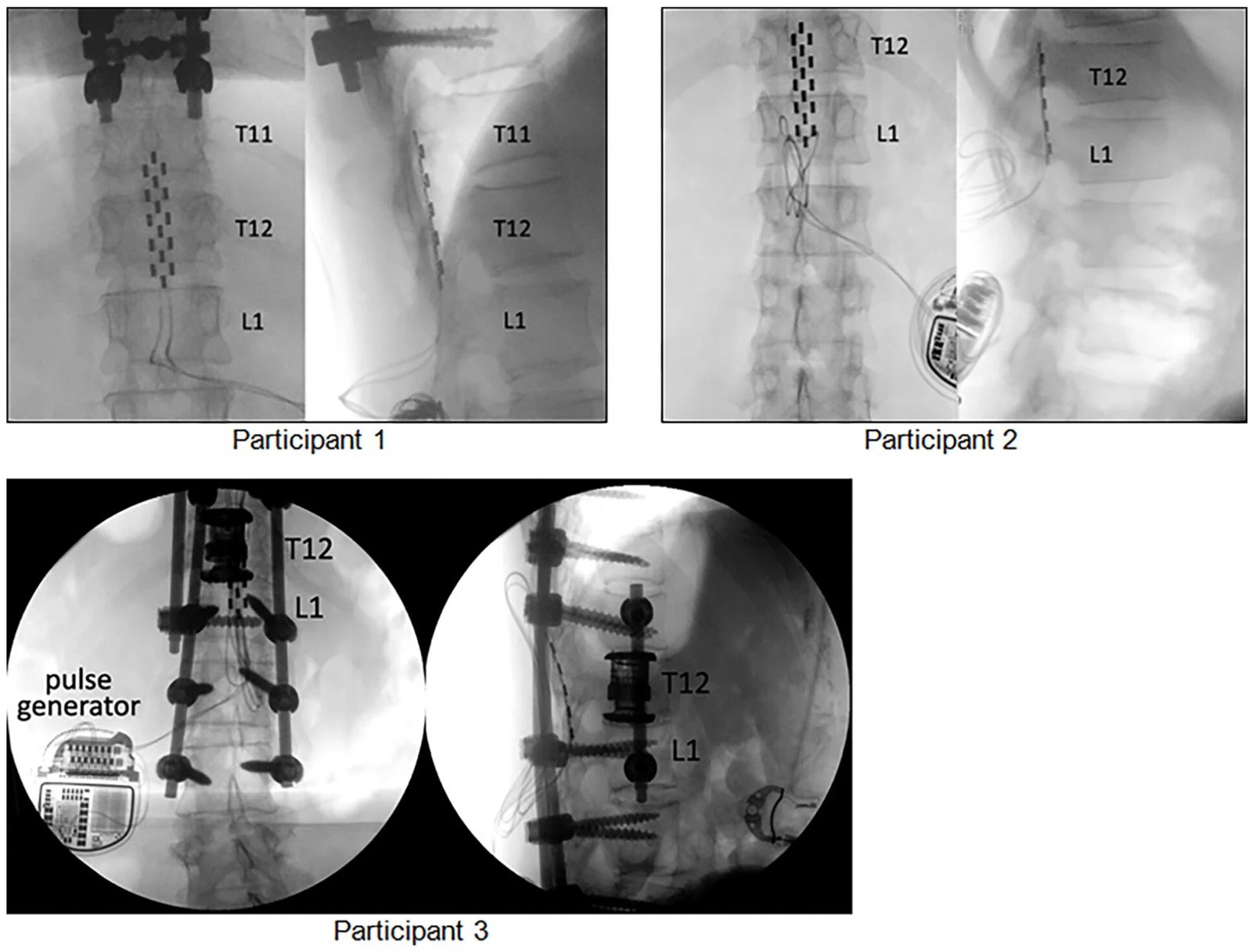
Intraoperative X-ray of the final placement of the spinal cord stimulation (SCS) implants in the three participants.
Measurable progress – with high clinical relevance
The results after seven months of intensive rehabilitation: all three participants experienced significant improvements in their functional mobility. They were able to switch from sitting to standing independently and walk with a rollator under supervision – skills that they did not have before starting the programme.
The improvements are particularly relevant in practice:
• Trunk stability, a central predictor of functional walking
• Sit-to-stand performance, a key movement in everyday life
• Walking ability, measured with established clinical scales
This progress was not achieved through technique alone, but through consistent, high-dose exercise therapy – made possible and structured by the targeted use of training devices such as the THERA-Trainer balo.
The improvements are particularly relevant in practice:
• Trunk stability, a central predictor of functional walking
• Sit-to-stand performance, a key movement in everyday life
• Walking ability, measured with established clinical scales
This progress was not achieved through technique alone, but through consistent, high-dose exercise therapy – made possible and structured by the targeted use of training devices such as the THERA-Trainer balo.
Structured standing and trunk training with the THERA-Trainer formed the necessary basis for later sit-to-stand and gait training.
Implications
The study makes it clear: in complex neurorehabilitative programmes, technology is particularly effective when it is functionally embedded. The THERA-Trainer fulfilled several key tasks:
• It enabled early, safe verticalisation
• It created the basis for active trunk and balance control
• It provided specific preparation for dynamic gait loads
It was therefore not just an “aid”, but an integral part of a learning-oriented rehabilitation pathway. This approach offers an important message for therapy: functional training can be useful even for the most severe neurological impairments – if it is implemented in a structured, progressive and patient-centred manner.
• It enabled early, safe verticalisation
• It created the basis for active trunk and balance control
• It provided specific preparation for dynamic gait loads
It was therefore not just an “aid”, but an integral part of a learning-oriented rehabilitation pathway. This approach offers an important message for therapy: functional training can be useful even for the most severe neurological impairments – if it is implemented in a structured, progressive and patient-centred manner.
In complex neurorehabilitative programmes, technology is particularly effective when it is functionally embedded.
Limitations and outlook
The authors of the study rightly emphasise the limitations: three participants, no control arm, high expenditure of resources. Nevertheless, the work provides valuable evidence that functional progress is possible even in cases of complete paraplegia – provided that rehabilitation is understood as an active, long-term learning process.
In practice, this means that devices such as the THERA-Trainer can achieve their full effect if they are not used in isolation but as part of a holistic concept.
In practice, this means that devices such as the THERA-Trainer can achieve their full effect if they are not used in isolation but as part of a holistic concept.
Jakob Tiebel
Health Business Consultant
Jakob Tiebel is OT and studied applied psychology with a focus on health economics. He has clinical expertise from his previous therapeutic work in neurorehabilitation. He conducts research and publishes on the theory-practice transfer in neurorehabilitation and is the owner of an agency for digital health marketing.
References:
- Wee SK, Valerie ZYN, Phua MW, et al. Synergistic integration of epidural spinal cord stimulation with robotic therapy and neurorehabilitation to facilitate functional recovery in chronic sensorimotor complete spinal cord injury: A case series. Advances in Rehabilitation Science and Practice. 2025;14. doi:10.1177/27536351251343738
Related contents
Find related exciting contents in our media library.
Mehr laden
This is not what you are searching for? Knowledge

Meet our specialists.
Are you interested in our solutions? Schedule a meeting with a Consultant to talk through your strategy and understand how TEHRA-Trainer can help you to advance rehabilitation.