


SCIENCE
Review of the DGNR Congress 2025
All under one roof: evidence, practice and innovation

Jakob Tiebel
Health Business Consultant
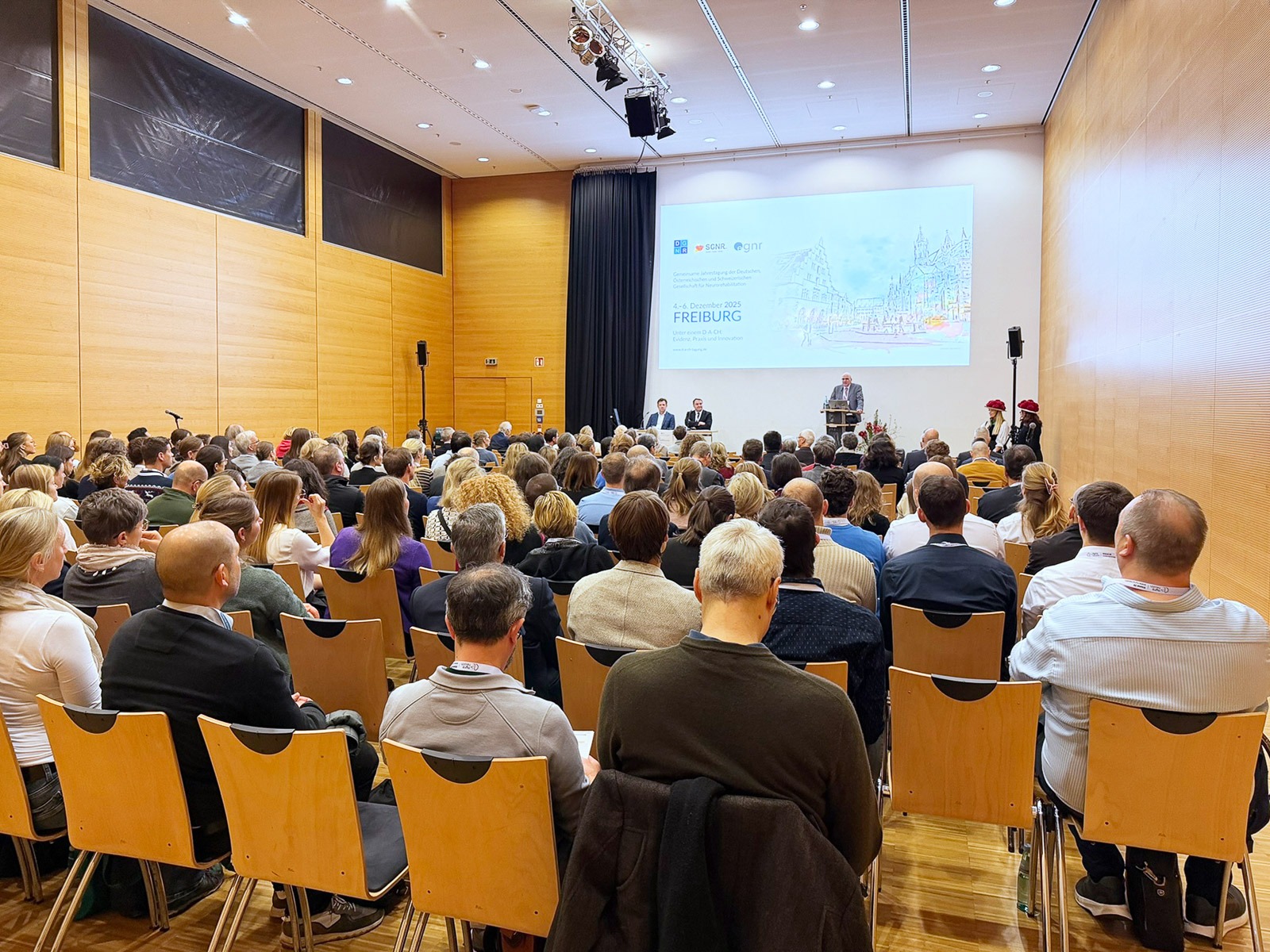
The joint annual conference of the German Society for Neurorehabilitation (DGNR), the Swiss Society for Neurorehabilitation (SGNR) and the Austrian Society for Neurorehabilitation (ÖGNR) took place in Freiburg from 4 to 6 December 2025. Under the headline slogan “All under one roof: evidence, practice and innovation”, the congress brought together specialists from Germany, Switzerland and Austria, as well as all professional groups involved in neurorehabilitation – clinicians, researchers and healthcare experts – for an interprofessional and transnational exchange.
In view of the growing global significance of neurological diseases as the principal cause of disability in activities of daily living, the need for coordinated, evidence-based and forward looking neurorehabilitation was emphatically underscored. Plenary lectures, scientific abstracts, seminars and practice-oriented workshops provided a comprehensive overview of the current state of science and innovative approaches in diagnostics, therapy and care.
The conference focused on key topics in modern neurorehabilitation, including advanced brain imaging, rehabilitation technology, digitalisation and artificial intelligence, as well as the implementation of major study results in clinical practice. Other focal points included evidence-based guidelines, long-term perspectives of neurological diseases, new therapeutic approaches for cognitive disorders and fatigue, as well as personalised rehabilitation strategies.
Particular attention was paid to the translation of care, i.e. the transfer of scientific findings into everyday clinical practice. Practical solutions were discussed in numerous contributions – from the development of adaptive therapy technologies and neuromodulative procedures to the integration of psychological comorbidities and functional communication therapy.
The joint conference provided compelling evidence of the innovative capacity and interdisciplinary approach characterising neurorehabilitation in German-speaking regions. What became clear was that progress in neurorehabilitation is inextricably linked to a cooperative approach that brings together medical knowledge, technological development and framework conditions regarding health economy and policy.
The DGNR, SGNR and ÖGNR conference management team would like to thank all participants for their committed contributions, scientific expertise and the constructive exchange. The 2025 conference not only provided key impetus for the further development of neurorehabilitation, but also made it clear that more can be achieved together all under one roof – based on evidence, practice and innovation.
The conference focused on key topics in modern neurorehabilitation, including advanced brain imaging, rehabilitation technology, digitalisation and artificial intelligence, as well as the implementation of major study results in clinical practice. Other focal points included evidence-based guidelines, long-term perspectives of neurological diseases, new therapeutic approaches for cognitive disorders and fatigue, as well as personalised rehabilitation strategies.
Particular attention was paid to the translation of care, i.e. the transfer of scientific findings into everyday clinical practice. Practical solutions were discussed in numerous contributions – from the development of adaptive therapy technologies and neuromodulative procedures to the integration of psychological comorbidities and functional communication therapy.
The joint conference provided compelling evidence of the innovative capacity and interdisciplinary approach characterising neurorehabilitation in German-speaking regions. What became clear was that progress in neurorehabilitation is inextricably linked to a cooperative approach that brings together medical knowledge, technological development and framework conditions regarding health economy and policy.
The DGNR, SGNR and ÖGNR conference management team would like to thank all participants for their committed contributions, scientific expertise and the constructive exchange. The 2025 conference not only provided key impetus for the further development of neurorehabilitation, but also made it clear that more can be achieved together all under one roof – based on evidence, practice and innovation.
Congress highlights
The joint annual conference of the DGNR, SGNR and ÖGNR 2025 in Freiburg was held under the forward-looking headline slogan “All under one roof: evidence, practice and innovation”. The interprofessional and transnational exchange provided substantial impetus for the further development of neurorehabilitation – from clinical practice to healthcare research and technology integration.
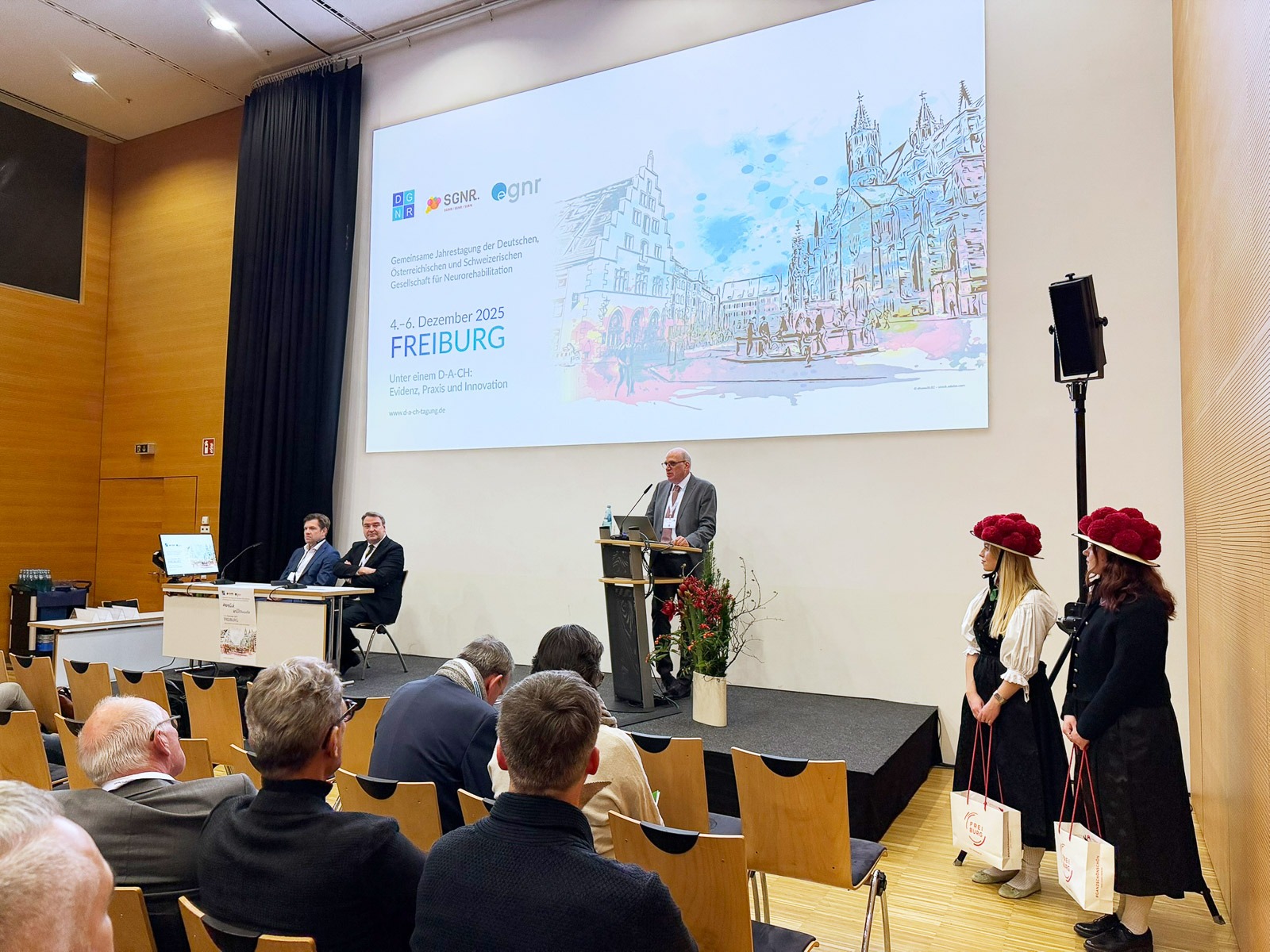
What really counts in rehabilitation? Professor Derick T. Wade at the opening of the congress
The opening keynote address by Professor Derick T. Wade (Oxford, UK), which focused on the core principles of effective rehabilitation, provided an impressive start to the conference. Based on historical observations, he showed that the transformative effect of rehabilitation is not due to technological or medical breakthroughs, but to people’s ability to adapt – supported by a systematic, person-centred clinical approach. In his view, rehabilitation therefore needs to be consistently biopsychosocial, goal-oriented and adaptive. His concept of a “cognitive clinical approach” emphasises the need for holistic problem analysis and individual goal planning as the key to successful neurorehabilitation.
What really counts in rehabilitation? Professor Derick T. Wade at the opening of the congress
The opening keynote address by Professor Derick T. Wade (Oxford, UK), which focused on the core principles of effective rehabilitation, provided an impressive start to the conference. Based on historical observations, he showed that the transformative effect of rehabilitation is not due to technological or medical breakthroughs, but to people’s ability to adapt – supported by a systematic, person-centred clinical approach. In his view, rehabilitation therefore needs to be consistently biopsychosocial, goal-oriented and adaptive. His concept of a “cognitive clinical approach” emphasises the need for holistic problem analysis and individual goal planning as the key to successful neurorehabilitation.
Effective rehabilitation is not achieved through technology, but through systematic, person-centred clinical thinking.
The future of neurorehabilitation lies in combining global evidence with local, practicable care.
Setting the global course: the Lancet Commission on Neurorehabilitation
With the introduction of the new Lancet Neurology Commission on Neurorehabilitation, Professor Thomas Platz (Greifswald) presented a global lighthouse project. The aim of the commission is to develop pragmatic and practicable recommendations for improving neurorehabilitative care on the basis of global epidemiological data, health economic analyses and systematic evidence assessments. The transdisciplinary initiative includes an international care survey, implementation analyses and the development of prioritised intervention roadmaps – supported by the WHO, WFNR, WSO and other international stakeholders. The results will serve as a basis for decisions on investments in neurorehabilitation worldwide.
Technological platforms for personalised rehabilitation
Dr Chris Easthope Awai (Vitznau) and his team presented an innovative “i-health” system that implements personalised neurorehabilitation through high-density, multimodal data collection and AI-supported analysis processes in the clinic. The architecture includes digital assessments, wearable sensor technology, real-time data processing and seamless integration into clinical information systems. Initial results from >2,500 patient days show a high level of clinical acceptance, reduced documentation times and a growing interest in data-based decision-making – strong evidence of the feasibility of digitalised neurorehabilitation.
Criticism of trunk training: evidence-based reassessment
In the highly acclaimed seminar “The trunk myth”, Sabine Lamprecht and Simon Schlick scrutinised the traditional importance of trunk training in neurorehabilitation. Based on current evidence – including a Cochrane review (Thijs et al., 2023) – it was shown that the therapeutic benefits of trunk training for stroke, ataxia and arm rehabilitation have been systematically overestimated. The discussion marked a paradigm shift towards more specific, functionally oriented therapeutic approaches and emphasised the importance of differentiated, evidence-based indications.
New S3 TheMoS guideline on mobility rehabilitation after stroke
Another milestone was set with the presentation of the upcoming S3 TheMoS (Therapy of Mobility after Stroke) guideline by PD Dr Christian Dohle. Based on the ReMoS guideline and developed in accordance with the AWMF guidelines, the new guideline systematically focuses on therapeutic care in out patient and (semi-)inpatient settings for the first time. The recommendations are based on GRADE methodology and are accompanied by a structured implementation concept for professionals and those affected. Publication is planned for the end of Q1/2026.
With the introduction of the new Lancet Neurology Commission on Neurorehabilitation, Professor Thomas Platz (Greifswald) presented a global lighthouse project. The aim of the commission is to develop pragmatic and practicable recommendations for improving neurorehabilitative care on the basis of global epidemiological data, health economic analyses and systematic evidence assessments. The transdisciplinary initiative includes an international care survey, implementation analyses and the development of prioritised intervention roadmaps – supported by the WHO, WFNR, WSO and other international stakeholders. The results will serve as a basis for decisions on investments in neurorehabilitation worldwide.
Technological platforms for personalised rehabilitation
Dr Chris Easthope Awai (Vitznau) and his team presented an innovative “i-health” system that implements personalised neurorehabilitation through high-density, multimodal data collection and AI-supported analysis processes in the clinic. The architecture includes digital assessments, wearable sensor technology, real-time data processing and seamless integration into clinical information systems. Initial results from >2,500 patient days show a high level of clinical acceptance, reduced documentation times and a growing interest in data-based decision-making – strong evidence of the feasibility of digitalised neurorehabilitation.
Criticism of trunk training: evidence-based reassessment
In the highly acclaimed seminar “The trunk myth”, Sabine Lamprecht and Simon Schlick scrutinised the traditional importance of trunk training in neurorehabilitation. Based on current evidence – including a Cochrane review (Thijs et al., 2023) – it was shown that the therapeutic benefits of trunk training for stroke, ataxia and arm rehabilitation have been systematically overestimated. The discussion marked a paradigm shift towards more specific, functionally oriented therapeutic approaches and emphasised the importance of differentiated, evidence-based indications.
New S3 TheMoS guideline on mobility rehabilitation after stroke
Another milestone was set with the presentation of the upcoming S3 TheMoS (Therapy of Mobility after Stroke) guideline by PD Dr Christian Dohle. Based on the ReMoS guideline and developed in accordance with the AWMF guidelines, the new guideline systematically focuses on therapeutic care in out patient and (semi-)inpatient settings for the first time. The recommendations are based on GRADE methodology and are accompanied by a structured implementation concept for professionals and those affected. Publication is planned for the end of Q1/2026.
Digitalisation only delivers its benefits when data is translated into clinically meaningful decisions.
Conclusion:
The DGNR Congress 2025 clearly demonstrated how closely evidence, practice and innovation need to be interlinked in modern neurorehabilitation. The initiatives, guidelines and technological developments presented point the way to highly specialised, interdisciplinary and future-oriented care – both nationally and internationally.
The DGNR Congress 2025 clearly demonstrated how closely evidence, practice and innovation need to be interlinked in modern neurorehabilitation. The initiatives, guidelines and technological developments presented point the way to highly specialised, interdisciplinary and future-oriented care – both nationally and internationally.
Jakob Tiebel
Health Business Consultant
Jakob Tiebel is OT and studied applied psychology with a focus on health economics. He has clinical expertise from his previous therapeutic work in neurorehabilitation. He conducts research and publishes on the theory-practice transfer in neurorehabilitation and is the owner of an agency for digital health marketing.
References:
Related contents
Find related exciting contents in our media library.
Mehr laden
This is not what you are searching for? Knowledge

Meet our specialists.
Are you interested in our solutions? Schedule a meeting with a Consultant to talk through your strategy and understand how TEHRA-Trainer can help you to advance rehabilitation.