


THERAPY & PRACTICE
When movement becomes possible again
Therapeutic case vignette on the conservative management of a fall-related axillary nerve injury using the THERA-Trainer in a 75-year-old female patient over a rehabilitation period of one year.

Jakob Tiebel
Health Business Consultant
A 75-year-old female patient presented following a fall with pronounced functional impairment of the right shoulder. Over the following weeks, active mobility progressively declined. Clinical examination revealed marked atrophy of the deltoid muscle, a prominent shoulder contour and an almost complete inability to actively raise the arm. The findings were consistent with an axillary nerve injury, which primarily innervates the deltoid and teres minor muscles and therefore plays a key role in shoulder abduction and stabilisation.
Even at the age of 75, nerve recovery is still possible.
Isolated lesions of the axillary nerve are comparatively rare and represent a particular therapeutic challenge in older patients. Age-associated sarcopenia, reduced neuromuscular reserve and potentially slower reinnervation can complicate functional recovery.
In the present case, however, a consistently conservative treatment approach was pursued. Over a period of twelve months, a marked restoration of shoulder function was achieved.
Even at the age of 75, nerve recovery is still possible.
Isolated lesions of the axillary nerve are comparatively rare and represent a particular therapeutic challenge in older patients. Age-associated sarcopenia, reduced neuromuscular reserve and potentially slower reinnervation can complicate functional recovery.
In the present case, however, a consistently conservative treatment approach was pursued. Over a period of twelve months, a marked restoration of shoulder function was achieved.
Early rehabilitation: maintaining mobility and promoting neuromuscular activity
At the start of treatment, manual muscle testing showed deltoid muscle strength of 1/5: a muscle contraction was discernible; however, active movement of the arm was not yet possible. Accordingly, early rehabilitation initially focused on maintaining passive mobility, preventing secondary shoulder stiffness and providing targeted neuromuscular stimulation.
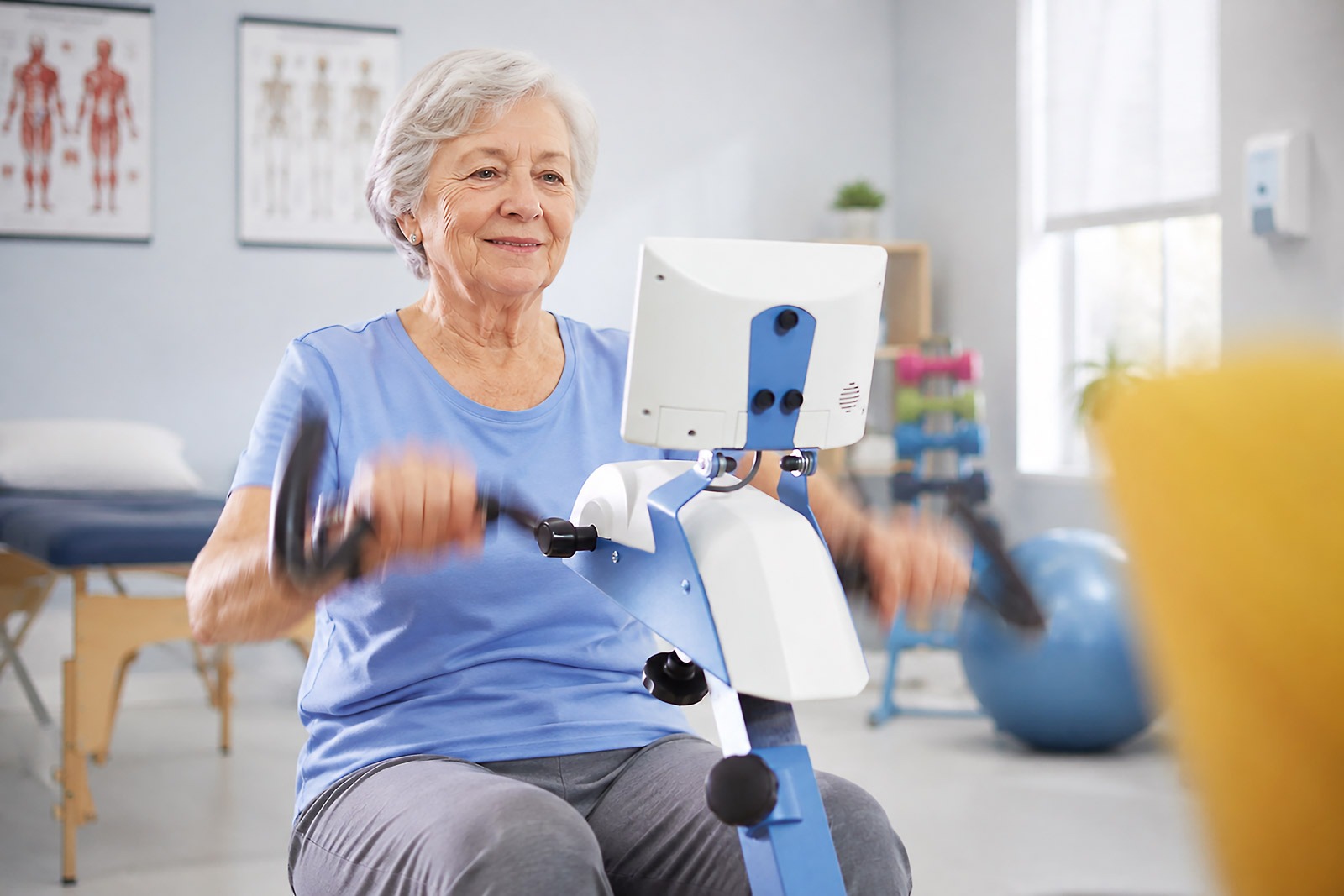
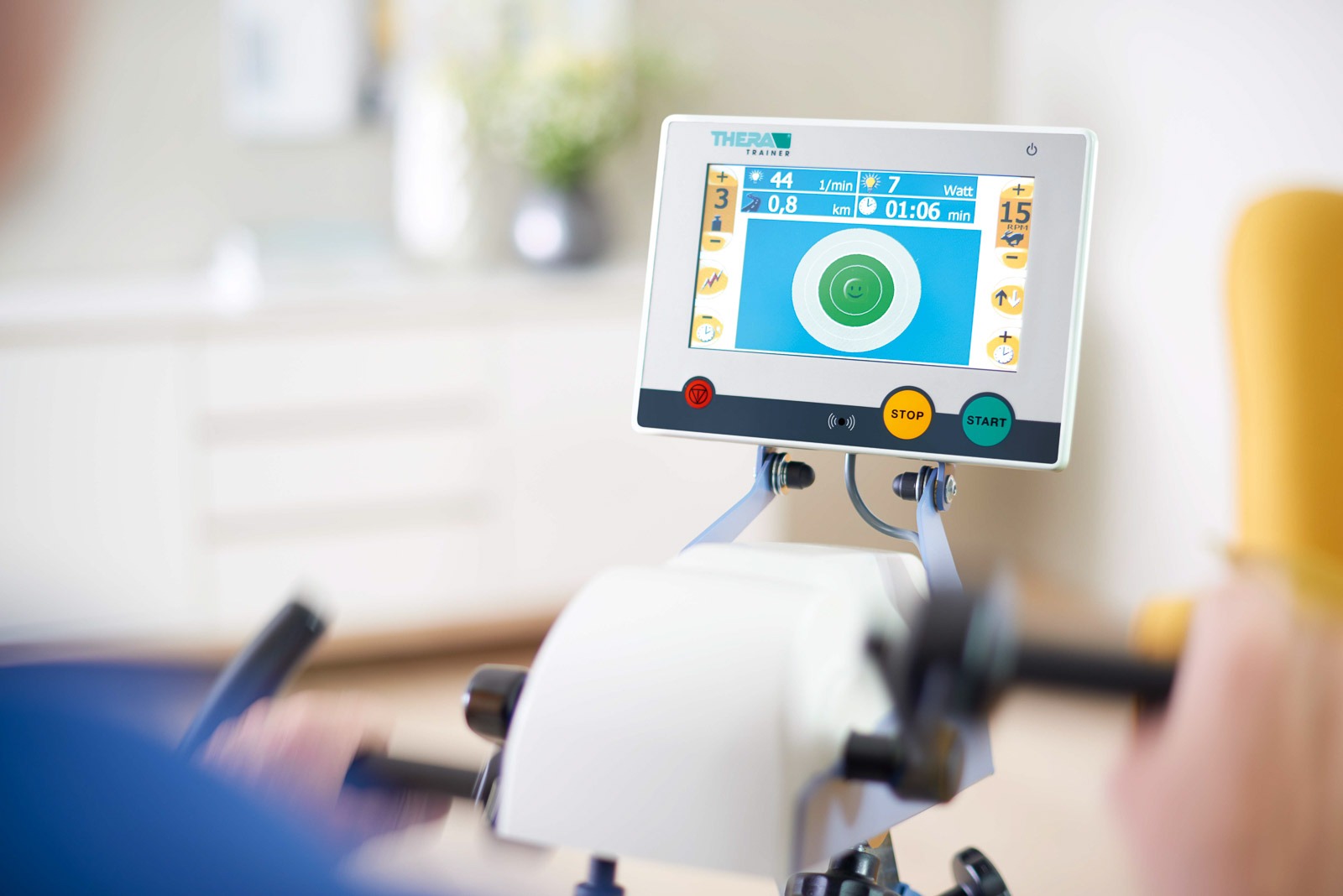
The treatment programme included passive and assisted mobilisation of the shoulder joint, together with biphasic electrical stimulation of the affected musculature, each administered for approximately 15 minutes. In addition, upper-body training using the THERA-Trainer tigo was incorporated into the programme.
GET IN TOUCH
Upper-body training was employed to maintain mobility of the shoulder girdle, facilitate repetitive movement patterns and support neuromotor re-education. At the same time, the training provided an opportunity to maintain physical activity and cardiovascular exercise despite the significant impairment of the upper extremity.
For the patient, the guided and continuously repeatable movement was of particular importance. While independent lifting of the arm was not initially possible, the affected extremity could nonetheless be integrated into a cyclical movement pattern. This allowed the shoulder to be moved regularly through a controlled range of motion without requiring sufficient strength for free active arm movements at this stage.
The training formed part of a multimodal physiotherapeutic treatment concept and was combined with passive mobilisation, electrical stimulation, transcutaneous electrical nerve stimulation (TENS), pain management and, later, an increasing proportion of active exercises. As reinnervation progressed, the focus gradually shifted from preserving mobility towards active movement control and muscle strengthening.
After approximately five months, pain had markedly diminished and mobility of the shoulder joint had been largely preserved. Clinically relevant shoulder stiffness was successfully avoided. This established favourable conditions for the more active rehabilitation phase that followed.
The treatment programme included passive and assisted mobilisation of the shoulder joint, together with biphasic electrical stimulation of the affected musculature, each administered for approximately 15 minutes. In addition, upper-body training using the THERA-Trainer tigo was incorporated into the programme.
GET IN TOUCH
Upper-body training was employed to maintain mobility of the shoulder girdle, facilitate repetitive movement patterns and support neuromotor re-education. At the same time, the training provided an opportunity to maintain physical activity and cardiovascular exercise despite the significant impairment of the upper extremity.
For the patient, the guided and continuously repeatable movement was of particular importance. While independent lifting of the arm was not initially possible, the affected extremity could nonetheless be integrated into a cyclical movement pattern. This allowed the shoulder to be moved regularly through a controlled range of motion without requiring sufficient strength for free active arm movements at this stage.
The training formed part of a multimodal physiotherapeutic treatment concept and was combined with passive mobilisation, electrical stimulation, transcutaneous electrical nerve stimulation (TENS), pain management and, later, an increasing proportion of active exercises. As reinnervation progressed, the focus gradually shifted from preserving mobility towards active movement control and muscle strengthening.
After approximately five months, pain had markedly diminished and mobility of the shoulder joint had been largely preserved. Clinically relevant shoulder stiffness was successfully avoided. This established favourable conditions for the more active rehabilitation phase that followed.
Functional development over twelve months
Over the subsequent course of treatment, voluntary muscle activity increased steadily, resulting in a marked functional improvement of the affected shoulder over the twelve-month rehabilitation period. Active shoulder flexion improved from an initial 0° to approximately 90°, whilst active abduction increased from 0° to around 60°. In parallel, manual muscle testing showed an improvement in deltoid muscle strength from an initial 1/5 to 2+/5–3/5. This enabled increasingly active movements, including movements against gravity.
The pronounced deltoid muscle atrophy observed at baseline also showed a noticeable regression during the course of rehabilitation. At the same time, neuromuscular control of the shoulder girdle improved, allowing the arm to be used in an increasingly targeted and functional manner.
These improvements ultimately became evident in the patient’s everyday life. She regained the ability to independently perform basic activities using the affected upper extremity, including tasks such as combing her hair.
Notably, no pronounced secondary complications, such as clinically relevant shoulder stiffness or persistent severe pain, occurred during the rehabilitation process. Overall, the progressive neuromuscular recovery was reflected not only in measurable improvements in range of motion and muscle strength, but also in a tangible restoration of independence in activities of daily living.
The pronounced deltoid muscle atrophy observed at baseline also showed a noticeable regression during the course of rehabilitation. At the same time, neuromuscular control of the shoulder girdle improved, allowing the arm to be used in an increasingly targeted and functional manner.
These improvements ultimately became evident in the patient’s everyday life. She regained the ability to independently perform basic activities using the affected upper extremity, including tasks such as combing her hair.
Notably, no pronounced secondary complications, such as clinically relevant shoulder stiffness or persistent severe pain, occurred during the rehabilitation process. Overall, the progressive neuromuscular recovery was reflected not only in measurable improvements in range of motion and muscle strength, but also in a tangible restoration of independence in activities of daily living.
The patient was able once again to comb her own hair and perform routine tasks.
Clinical classification
This case demonstrates that even in cases of pronounced axillary nerve palsy in older age, relevant functional recovery may be achievable over an extended rehabilitation period. Crucially, it was not any single therapeutic intervention, but rather the sustained combination of joint preservation, neuromuscular stimulation, repetitive movement and subsequent active strengthening.
Upper body training using the THERA-Trainer tigo integrated seamlessly into this concept, particularly during the early and intermediate phases of rehabilitation. It enabled repetitive, controlled movement cycles at a time when free active arm movements were still barely achievable, thereby supporting the transition from passive mobilisation towards increasingly independent motor activity.
This case vignette therefore illustrates an important principle of conservative rehabilitation for peripheral nerve injuries. Neurological regeneration takes time – throughout this period, mobility, muscular status and functional activity must be preserved as consistently as possible and progressively rebuilt.
In this context, device-assisted, adaptable movement training can constitute a valuable component of a long-term physiotherapy treatment plan.
Upper body training using the THERA-Trainer tigo integrated seamlessly into this concept, particularly during the early and intermediate phases of rehabilitation. It enabled repetitive, controlled movement cycles at a time when free active arm movements were still barely achievable, thereby supporting the transition from passive mobilisation towards increasingly independent motor activity.
This case vignette therefore illustrates an important principle of conservative rehabilitation for peripheral nerve injuries. Neurological regeneration takes time – throughout this period, mobility, muscular status and functional activity must be preserved as consistently as possible and progressively rebuilt.
In this context, device-assisted, adaptable movement training can constitute a valuable component of a long-term physiotherapy treatment plan.
The THERA-Trainer tigo as a cornerstone of early rehabilitation – positively impacting joint preservation, movement and muscle strengthening.
Jakob Tiebel
Health Business Consultant
Jakob Tiebel is OT and studied applied psychology with a focus on health economics. He has clinical expertise from his previous therapeutic work in neurorehabilitation. He conducts research and publishes on the theory-practice transfer in neurorehabilitation and is the owner of an agency for digital health marketing.
References:
- Originalarbeit Ayub, S., Sheerani, M., Mirza, S., Thourani, N., & Dodani, P. (2026). Axillary nerve injury (C5–C6) with deltoid and teres minor weak ness in a 75-year-old female managed by physiotherapy. The Healer Journal of Physiotherapy and Rehabilitation Sciences, 6(1), 6–10. https://doi.org/10.55735/j9skcw87