


Discover how the THERA-Trainer senso and the LEARNING WHEEL model support motor learning and fall prevention in rehabilitation. Explore real-life examples, evidence-based principles, and practical insights for everyday transfer. Learn how therapy can feel both effective and engaging.

In neurorehabilitation, the focus is on relearning and optimising motor skills. Motor learning plays a central role in relation to the achievement of defined therapy goals. However, motor learning is challenging to implement due to a high level of complexity and lack of an application description. To solve this problem, the LEARNING WHEEL was developed as an evidence-based reference model for motor learning. It allows therapists to use participation-oriented clinical reasoning based on ICF and guidelines in order to develop tailored therapies while taking into account resources, wishes and environmental factors.
At the centre of the LEARNING WHEEL are the motor goals at the activity or participation level (referred to by the German acronym MOZArT) – the nucleus around which everything revolves. The eight most important principles of motor learning (forms of learning, learning phases, transfer, motivation, learning strategies, intensity, feedback and instruction) are arranged equally in the middle circle and do not follow any fixed hierarchy. The outer rings include the methods for implementing these principles, supported by clinical reasoning and targeted information gathering through assessments [5].
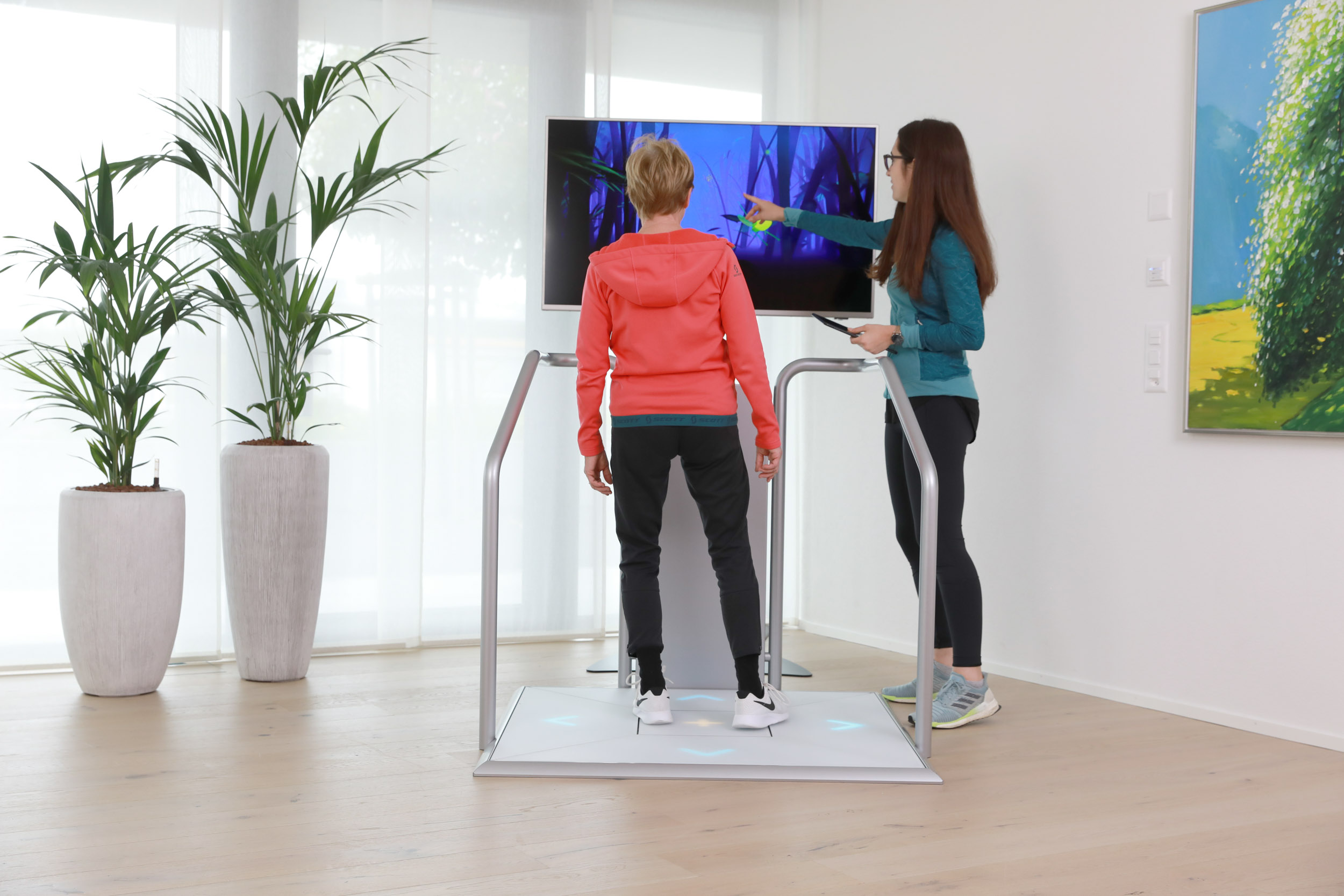
The THERA-Trainer senso is a research-based training device used in neurorehabilitation and training for older people. It is an interactive system that offers a wide range of exercises to improve physical and cognitive skills. The focus is on promoting balance, coordination, responsiveness and cognitive functions [6].
The senso consists of a platform with built-in sensors that detect movement and touch. Users are instructed to perform various tasks via visual and auditory feedback. These tasks may include tapping moving light points, balancing on the platform, or recognising shapes and colours.
The device enables personalised therapy and training since the exercises can be adapted to individual abilities and needs. The senso is often used by therapists in clinical settings, rehabilitation centres or care homes to improve patients’ physical fitness, balance and cognitive functions, and to reduce the risk of falls.
1. Implicit (unconscious learning): asks what?
What is the task? Unconscious movement control. Requires relatively few cognitive resources;
2. Explicit (conscious learning): asks how?
How should the task be carried out? Conscious movement control. Requires more cognitive resources
Ms Müller was required to constantly shift attention back and forth between the screen (task in the game) and the balance/step requirements. The requirements are therefore very close to everyday life (this point will be developed further under the transfer of learning principle). Due to the simultaneous recall of the cognitive task (play) and the motor task (movement), Inge was able to evoke dual-task situations typical of everyday life and which caused Ms Müller difficulties, particularly in complex situations, and posed a fall risk.
1. Cognitive learning phase: understanding the task requires a high level of attention for movement performance;
2. Associative learning phase: less attention for movement performance, partially successful movement, fewer mistakes;
3. Autonomous learning phase: automatism, only minimal attention for movement performance, skilfully performed movement, hardly any mistakes, dual-task capacity during movement performance.
After some initial difficulties, Ms Müller made good progress. During the second learning phase, Inge was able to observe that she paid less and less attention to going through the movements. She became more confident with her movements and made significantly fewer mistakes in the therapeutic games. This was also evident in the training evaluations.
The improvement in Ms. Müller’s dual-task capacity was an essential characteristic of the third (autonomous) learning phase, which is considered a sign of the automation of a movement. Ms Müller could now concentrate fully on the task on the screen during training. In the autonomous phase, it was primarily speed and precision that determined Ms Müller’s training successes (this point will be discussed in more detail under the intensity learning principle).
Trial+Error: Making mistakes and learning from them (consciously and unconsciously), errorless learning, part/whole practice etc., the targeted use of learning strategies promotes ML.
As training progressed, it became increasingly a question of the timing of targeted movements (e.g. a step at the right time of the game on the front quadrant of the standing space). Movements had to be performed at precisely time X in order to come to a stop exactly on time at target location Y of the floor plate (temporal and spatial components).
In the meantime, Ms. Müller had progressed so far, and her movements were so well practised, that the main focus had shifted to errorless learning. She could solve the movements that were demanded of her, even under additional cognitive strain. She could only improve in the games and in her cognitive-motor skills if she could perform the exercises without errors.
In relation to the therapy goals, Inge sees senso training as fulfilling both the desire to improve safety when walking (part-practice) and anticipatory postural adjustments when standing (whole practice).
1. Intrinsic motivation: self-motivated, promoted by autonomy, increased expectations and self-efficacy;
2. Extrinsic motivation: motivated from outside, reward-driven, influenced by the therapeutic relationship and background conditions such as family.
The senso offers a range of attractive game options that can be adapted to individual performance levels, and that can automatically adjust their level of difficulty (this point will be discussed in more detail under the intensity learning principle).
Research on senso has shown that exercise for older people can be viewed as a fun and intrinsically motivating intervention to promote physical and mental activity under dual-task conditions [10]. To be on the safe side, Inge also used an assessment that helped her evaluate the exertion and enjoyment of training with Ms Müller.
Inge regularly discussed how the training tasks relate to the real world with Ms Müller so that she could understand the purpose of the training and how she could repeat similar exercises in everyday life (this point will be discussed in more detail under the transfer of learning principle).
1. External focus of attention (EFA): the instruction directs attention to the effect that the movement has on the environment;
2. Internal focus of attention (IFA): the instruction directs attention to one’s own body movements or body feeling.
Inge wanted Ms Müller’s attention to be focused on the effects of her movements on the environment. Inge therefore followed the constrained action theory, according to which an EFA reduces the need for conscious movement control and thus favours automatic control processes [11].
In addition, Inge gave Ms. Müller an instruction with an internal focus during training. Due to the hip fracture, Ms Müller repeatedly adopted a bent posture during the exercises. This is what Inge wanted to avoid or promote awareness in Ms Müller of her posture. Since body posture cannot be detected by the sensors in the senso, Inge was responsible for this type of instruction.
1. External feedback: feedback from an external source of information e.g. PT, device, or similar;
2. Self-feedback: Feedback that the person receives or gives to him/herself during a movement. Self-assessment. Feedback is essential for ML. Particularly the ability to provide adequate self-feedback is crucial.
Self-feedback is not directly requested by the senso. This is where Inge’s therapeutic competence comes into focus. Ms Müller’s subjective assessment was very important to Inge, which is why she had certain aspects of the training session assessed by Ms Müller herself after each unit had been completed. For example, Inge used the BORG scale to subjectively determine the feeling of exertion. This helped her to regulate the load level and training duration.
This is the sum of repetition, shaping, training on the challenge point [25]. Intensity is a very relevant aspect for ML. Note: Intensity is more than just the number of repetitions!
If Ms Müller was having a good day, she could perform the exergames accurately and quickly. The level of difficulty then increased directly in the training situation. In other words, automatic shaping was carried out, giving Inge the confidence and certainty that Ms Müller was always training at her individual performance limit. So the exercises were neither too easy nor too difficult. Even if Ms Müller was not having good day, the training session did not become a demotivating experience with all the exercises suddenly becoming too difficult for her. Quite the opposite. She entered a kind of “flow state” and was fully immersed in the training, which by this stage had its own dynamism.
Shaping also had a critical advantage for Inge. She was able to use the training evaluations to precisely track how Ms Müller’s performance was progressing. For example, Inge was able to identify that Ms Müller had significant drops in performance during longer training sessions. They therefore reduced the duration of the sessions and then gradually increased them as training continued. At the same time, this finding had an important implication for everyday life. Because here, too, Ms Müller was able to describe to Inge that she would quickly become tired and unsteady during prolonged daily activities. They therefore agreed that Ms Müller would take more frequent breaks, not only during training but also in everyday life, to reduce the risk of falls.
What is meant here is the transfer of learning to the application situation (everyday life); the more the task and the environment of the therapy situation resemble the application situation, the higher the transfer tendency. Transfer is one of the key themes for successful therapy.
Senso training formed an integral part of standing postural control therapy in the treatment of Ms Müller. Use of the LEARNING WHEEL enabled Inge to conceptualise the principles of motor learning in a meaningful way, and the frame of reference also enabled her to locate the opportunities and limitations of technology. She succeeded in creating an animating therapy environment that continued to motivate Ms Müller to maintain her commitment to and compliance with her training exercises.
The use of targeted training of cognitive-motor dual-task situations enabled Inge to offer Ms Müller some fun ways of training certain aspects of postural control. To ensure that the training tasks connected with the wider environment, Inge additionally considered the issue of transfer and did not rely blindly on spontaneous transfer effects of standing and walking. She also added specific exercise situations in everyday life to the senso training programme.


- APTA Strategic Plan 2022-2025. APTA 2022; Im Internet: https://www.apta.org/apta-and-you/leadership-and-governance/vision-mission-and-strategic-plan/strategic-plan; Stand: 09.07.2023
- Kleynen M, Beurskens A, Olijve H, et al. Application of motor learning in neurorehabilitation: a framework for health-care professionals. Physiother Theory Pract 2018; 36: 1–20. doi:10.1080/09593985.2018.1483987
- Winstein C, Lewthwaite R, Blanton SR, et al. Infusing Motor Learning Research Into Neurorehabilitation Practice: A Historical Perspective With Case Exemplar From the Accelerated Skill Acquisition Program. Journal of Neurologic Physical Therapy 2014; 38: 190–200. doi:10.1097/NPT.0000000000000046
- Majsak M. Concepts and Principles of Neurological Rehabilitation In Fell D. Lifespan Neurorehabilitation: A Patient-Centered Approach from Examination to Intervention and Outcomes. F.A. Davis; 2018
- Huber M, Janssen C, Erzer Lüscher F, et al. Motorisches Lernen in der Neuroreha. 1. Auflage. Thieme Verlag; 2022
- Dividat Homepage Dividat | Senso: Kognitiv-motorisches Training
- Schweighofer N, Wang C, Mottet D, et al. Dissociating motor learning from recovery in exoskeleton training post-stroke. Journal of NeuroEngineering and Rehabilitation 2018; 15: 89. doi:10.1186/s12984-018-0428-1
- Valenzuela T, Okubo Y, Woodbury A, et al. Adherence to Technology-Based Exercise Programs in Older Adults: A Systematic Review. J Geriatr Phys Ther 2018; 41: 49–61. doi:10.1519/JPT.0000000000000095
- Oesch P, Kool J, Fernandez-Luque L, et al. Exergames versus self-regulated exercises with instruction leaflets to improve adherence during geriatric rehabilitation: a randomized controlled trial. BMC Geriatr 2017; 17: 77. doi:10.1186/s12877-017-0467-7
- Tiebel J. Interaktiv kognitiv-motorisches Training mit dem Dividat Senso - Einfluss des Schwierigkeitsgrades unterschiedlicher Spieleanwendungen auf Motivation, emotionales Spielerlebnis sowie physische und kognitive Beanspruchung. 2020
- Piccoli A, Rossettini G, Cecchetto S, et al. Effect of Attentional Focus Instructions on Motor Learning and Performance of Patients with Central Nervous System and Musculoskeletal Disorders: a Systematic Review. JFMK 2018; 3: 40. doi:10.3390/jfmk3030040
- Jäggi S, Wachter A, Adcock M, et al. Feasibility and effects of cognitive-motor exergames on fall risk factors in typical and atypical Parkinson’s inpatients: a randomized controlled pilot study. Eur J Med Res 2023; 28: 30. doi:10.1186/s40001-022-00963-x
- Lang CE, Holleran CL, Strube MJ, et al. Improvement in the Capacity for Activity Versus Improvement in Performance of Activity in Daily Life During Outpatient Rehabilitation. J Neurol Phys Ther 2023; 47: 16–25. doi:10.1097/NPT.0000000000000413
Related contents
Find related exciting contents in our media library.

Meet our specialists.
Are you interested in our solutions? Schedule a meeting with a Consultant to talk through your strategy and understand how TEHRA-Trainer can help you to advance rehabilitation.
You need to load content from reCAPTCHA to submit the form. Please note that doing so will share data with third-party providers.
More InformationYou are currently viewing a placeholder content from Turnstile. To access the actual content, click the button below. Please note that doing so will share data with third-party providers.
More Information