



Discover how the PROWALKS study combines treadmill training and behavioural interventions to significantly increase daily steps in stroke patients—paving the way for personalised, evidence-based rehabilitation strategies.

People with chronic stroke reach an average of only 4,000 steps per day and rarely meet the recommended guidelines for physical activity
(Moore et al. 2010). This low level of activity increases the risk of recurrent strokes and more severe disabilities. Studies show that step-activity behavioural interventions combined with high-intensity treadmill training can significantly increase daily step count (Bravata et al. 2007). The PROWALKS study investigated these approaches with the aim of optimising walking activity through personalised rehabilitation measures.
A secondary analysis of the PROWALKS study was published at the end of 2024 and provides new insights into the personalisation of rehabilitation measures to improve walking ability in the daily lives of chronic stroke patients. The analyses were conducted by a multidisciplinary team of researchers and clinicians, including experts in neurology, physiotherapy and statistics. A consortium of the University of Delaware in the USA led the work.
The researchers specifically investigated, using the available datasets, how stroke patients with different clinical profiles respond to measures aimed at improving walking capacity and daily performance. Eight clinical variables were considered, including walking capacity, balance, cognitive abilities and socioeconomic conditions.
The participants had non-cerebellar strokes that had occurred at least 6 months before patient enrolment in the study. They were between 21 and 85 years old, had walking speeds of 0.3–1.0 m/s and took fewer than 8,000 steps per day.
Using latent variable mixture models (LVMMs), a statistical technique for identifying hidden subgroups in heterogeneous datasets, homogeneous patient groups (“classes”) were identified. LVMMs enable the discovery of patterns in data that would not be visible using conventional statistical analysis methods. LVMMs used the relationship between observable variables (e.g. walking capacity) and underlying latent variables (e.g. cognitive abilities and socioeconomic conditions) to form hidden groups with similar characteristics.
The LVMM produced three clearly defined patient groups with specific baseline characteristics and different responses to the interventions.
Class 1: Lowest walking capacity, lowest balance self-efficacy, weakest cognition and highest area deprivation.
Class 2: Moderate walking capacity, moderate cognition and balance, as well as moderate socioeconomic conditions.
Class 3: Highest walking capacity, highest balance self-efficacy, strong cognitive performance and lowest area deprivation.
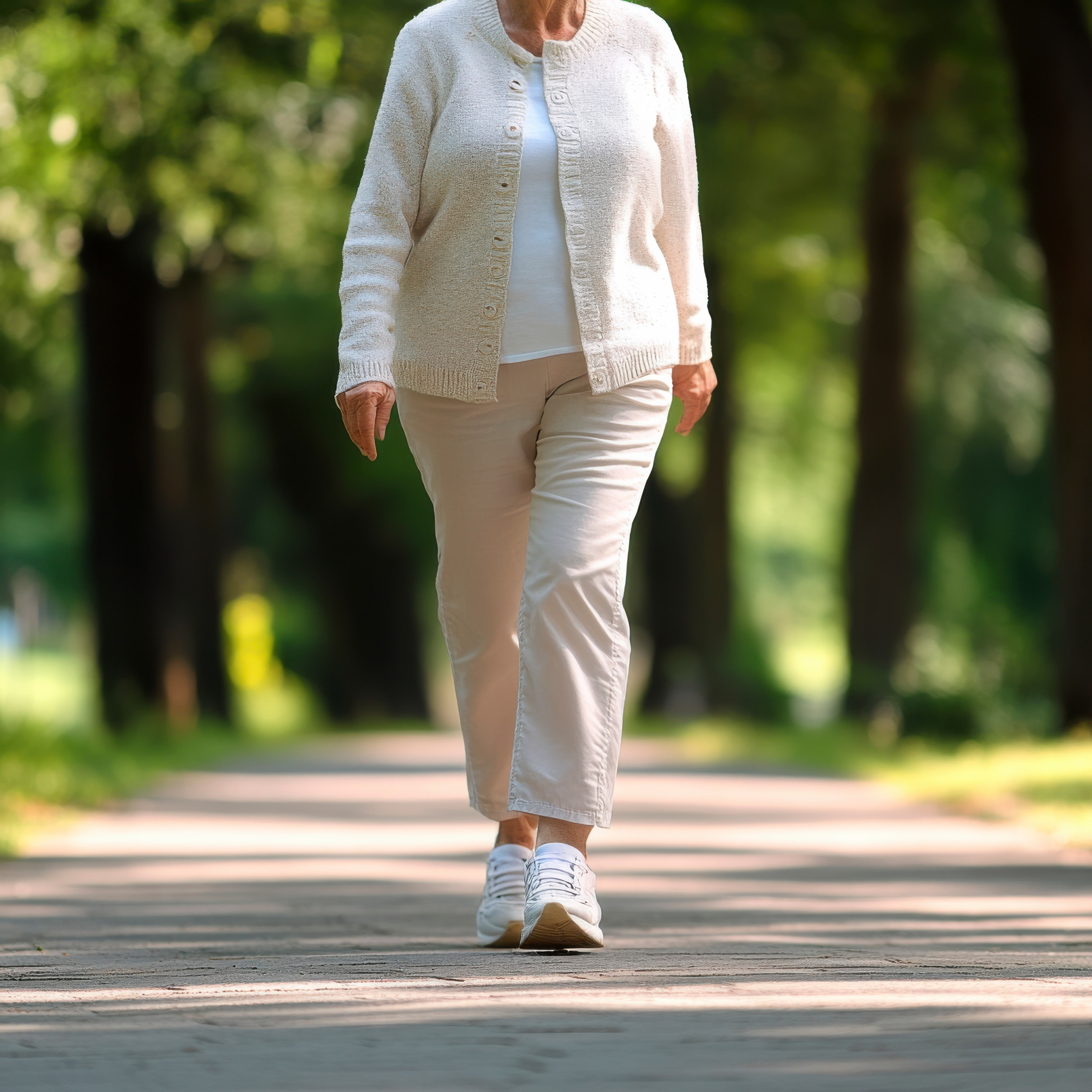
In the PROWALKS study, three different intervention approaches were investigated to promote walking activity in stroke patients and increase their daily step counts.
1. High-intensity treadmill training (FAST)
High-intensity, or fast, treadmill training (FAST) focuses on improving walking speed and cardiorespiratory fitness. It included:
High intensity: The participants trained on a treadmill at a speed close to their maximum walking speed.
Progressive load: The training intensity was gradually increased to maximise walking capacity.
Objective: The objective was to increase walking speed and endurance in order to improve mobility and efficiency when walking in daily life.
The aim of step activity monitoring (SAM) was to motivate participants to increase their daily step count. The approaches include:
Behaviour-based objective: Participants set step goals based on their current walking activity.
Feedback and self-monitoring: Using pedometers or activity trackers, participants received feedback on their daily activity.
Motivation strategies: Coaching and support promoted patient involvement and help to achieve their goals.
3. Combined intervention (FAST+SAM)
The combined intervention (FAST+SAM) combined the benefits of high-intensity treadmill walking and step activity monitoring. This approach offered:
Physical training: Treadmill walking (FAST) was used to improve physical walking capacity.
Motivational support: The behavioural component (SAM) encouraged participants to apply the skills acquired in training to their daily lives.
Synergy effects: The combination aimed to improve walking ability, endurance and daily activity simultaneously.
The efficacy of the three tested intervention approaches varied significantly between the identified classes of stroke patients. The results show that each class responded specifically to different approaches, which underscores the importance of individualised rehabilitation.
Class 1: Patients with the lowest walking capacity and high support needs
This group comprised patients with the lowest walking capacity, lowest balance self-efficacy, and severely impaired cognition. In addition, they were more severely affected by socioeconomic disadvantage than other classes.
SAM (step-activity behavioural intervention): Participants in this group recorded the best results with an average increase of 1,624 additional steps per day. Simple monitoring and motivation to increase step count appears to be particularly effective for this group, as it directly addresses daily activity.
FAST+SAM (combined intervention): The combination of treadmill training and behavioural monitoring also led to a substantial improvement with 1,150 additional steps per day. This approach is particularly effective as it promotes both walking ability and activity.
FAST (high-intensity treadmill training): This intervention focused purely on walking ability and was at least helpful for this group with a slight increase of 314 steps per day. These results illustrate that these patients have little motivation to increase their activity through treadmill training alone.
This group was characterised by a medium walking capacity, average cognition and balance, as well as moderate socioeconomic conditions.
SAM (step-activity behavioural intervention): The participants in this group achieved the greatest progress with SAM, with an increase in daily step count of 2,002 steps per day. These impressive results underscore that a focused behavioural intervention is sufficient to motivate this group and significantly increase their activity.
FAST+SAM (combined intervention): Although FAST+SAM also achieved positive results, the increase with 867 additional steps per day was significantly less than with SAM alone. The combined intervention could be less effective for this group, as it does not provide significant added value beyond SAM.
FAST (high-intensity treadmill training): In this group, FAST even led to a decrease in step activity by an average of 219 steps per day. This shows that high-intensity treadmill training without behavioural support is not only ineffective but may also have demotivating effects.
Patients in class 3 had the highest walking capacity, highest balance self-efficacy and strongest cognitive performance. The socioeconomic conditions of this group were also generally more favourable.
FAST+SAM (combined intervention): This group benefited the most from the combined intervention with an increase in daily step count of 1,532 steps per day. The combination of treadmill training and activity monitoring is particularly effective for these patients, as it addresses both the physical and motivational component.
SAM (step-activity behavioural intervention): SAM also led to an increase in the number of steps, however, the increase was significantly lower with 661 additional steps per day compared to FAST+SAM. For this group, a purely behavioural intervention is not sufficient to exploit the full potential.
FAST (high-intensity treadmill training): FAST alone led to a moderate increase of 390 steps per day. Although the intervention in this group was not completely ineffective, it is clearly inferior to the combined intervention.
The PROWALKS study provides valuable insights for optimising rehabilitation after a stroke. The use of clinical profiles to individualise interventions has the potential to sustainably reduce low physical activity and its negative consequences in people with chronic stroke.
The results of the PROWALKS study provide clear evidence that stroke rehabilitation is still far from achieving its full potential. As already discussed in the review article Walk the Talk: Current Evidence for Walking Recovery After Stroke (https://doi.org/10.1161/STROKEAHA.122.03895), a purely training-based approach to improving walking capacity is insufficient to enhance daily performance and quality of life for patients on a long-term basis.
The PROWALKS study impressively demonstrates that improvements in walking capacity, for example through high-intensity treadmill training, do not necessarily lead to increased activity in daily life. This shows that it is not enough to merely make patients physically fitter. Without a targeted behavioural and psychological intervention aimed at promoting the motivation and ability to integrate into daily life, the performance, i.e. the actual application of the skills acquired in training, falls short of expectations.
For the sake of clarity, it should be noted that this is by no means intended to bring into question a highly repetitive exercise approach, which has been proven effective and is supported by the best evidence in neurological rehabilitation for the restoration and improvement of walking ability. Quite the opposite. Current research in this field even suggests that we may still be approaching training control and progression with insufficient intensity and progression. It remains undisputed that intensive, repetition-based training continues to form the foundation of gait rehabilitation.
However, doing one thing must not mean neglecting the other. The challenge lies in combining intensive training with effective approaches to promote the transfer to daily life. After all, we cannot avoid the critical point of transferring training progress into the patients’ everyday reality.
The new results reveal a critical need for action: rehabilitation programmes must be thoroughly reconsidered and restructured. The combination of intensive physical training and behavioural therapeutic approaches is no longer an option – it is a necessity. Only through this integration can the discrepancy between capacity and performance be overcome. It is time to address the transfer of training progress into the lived experience of patients in a systematic and evidence-based way.
Future rehabilitation must therefore be more strongly oriented towards the participation level, where daily activities and quality of life are front and centre. The challenge is not only to develop new intervention methods, but also to fundamentally change the paradigm of rehabilitation, moving away from a purely capacity-oriented approach towards a holistic, patient-centred perspective. Only in this way can we ensure that the progress made does not fizzle out in everyday clinical practice, but actually brings about sustainable change in the lives of those affected.
- McCartney KM, Pohlig RT, Miller A, Thompson ED, Reisman D. Matching Clinical Profiles with Interventions to Optimize Daily Stepping in People with Stroke. medRxiv [Preprint]. 2024 Nov 15:2024.11.14.24317334. doi: 10.1101/2024.11.14.24317334. PMID: 39606374; PMCID: PMC11601677.
- Bravata DM, Smith-Spangler C, Sundaram V, Gienger AL, Lin N, Lewis R, et al. Using pedometers to increase physical activity and improve health: a systematic review. JAMA. 2007;298(19):2296–2304. doi: 10.1001/jama.298.19.2296.
- Moore JL, Roth EJ, Killian C, Hornby TG. Locomotor training improves daily stepping activity and gait efficiency in individuals Poststroke who have reached a “plateau” in recovery. Stroke. 2010;41(1):129–135. doi: 10.1161/STROKEAHA.109.563247
- Thompson ED, Pohlig RT, McCartney KM, Hornby TG, Kasner SE, Raser-Schramm J, Miller AE, Henderson CE, Wright H, Wright T, Reisman DS. Increasing Activity After Stroke: A Randomized Controlled Trial of High-Intensity Walking and Step Activity Intervention. Stroke. 2024 Jan;55(1):5-13. doi: 10.1161/STROKEAHA.123.044596. Epub 2023 Dec 22. PMID: 38134254; PMCID: PMC10752299.
- Wright H, Wright T, Pohlig RT, Kasner SE, Raser-Schramm J, Reisman D. Protocol for promoting recovery optimization of walking activity in stroke (PROWALKS): a randomized controlled trial. BMC Neurol. 2018 Apr 12;18(1):39. doi: 10.1186/s12883-018-1044-1. PMID: 29649992; PMCID: PMC5898044.
Related contents
Find related exciting contents in our media library.

Meet our specialists.
Are you interested in our solutions? Schedule a meeting with a Consultant to talk through your strategy and understand how TEHRA-Trainer can help you to advance rehabilitation.
You need to load content from reCAPTCHA to submit the form. Please note that doing so will share data with third-party providers.
More InformationYou are currently viewing a placeholder content from Turnstile. To access the actual content, click the button below. Please note that doing so will share data with third-party providers.
More Information