


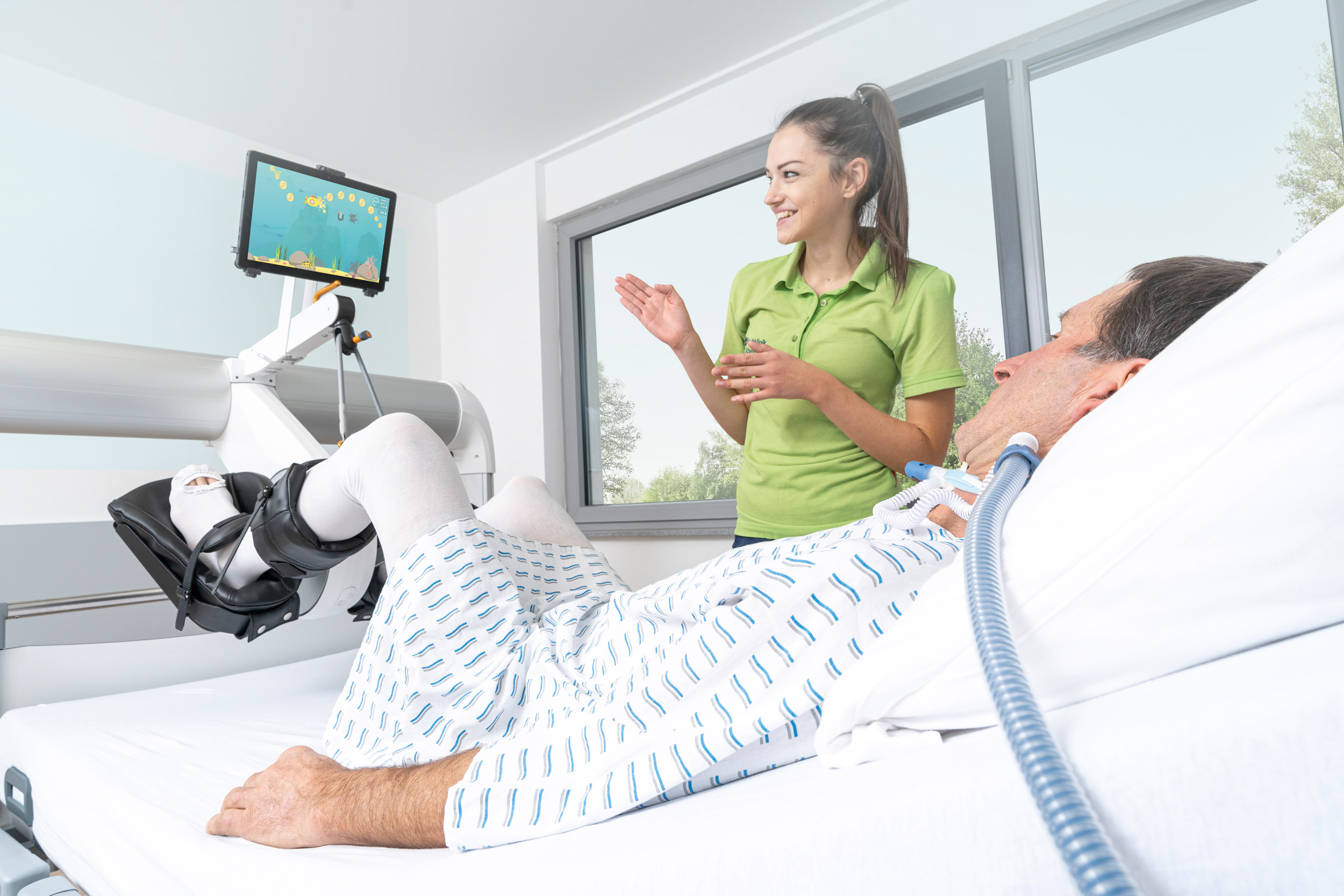
Discover how interdisciplinary teams in ICUs are applying early mobilisation to accelerate recovery, reduce complications, and support critically ill patients. Explore two inspiring case reports and gain insight into practical implementation.

• 2.1 fewer ventilation days
• 2.7 fewer days in ICU
• length of hospital stay reduced by 3.7 days
• 12% more muscle power
• 13% more independent in terms of care
Included were 39 studies with a total of 3,837 patients.
The issue of safety is also a barrier for more complex intensive care patients who need to be treated with extracorporeal membrane oxygenation (ECMO). Although research suggests good feasibility with low risk [2]. Even in far less complex cases, accesses such as oral intubation can be a barrier to mobilisation from bed in clinical practice [3]. A systematic review with meta-analysis [4] shows that early mobilisation is safe to carry out. In 22,351 mobilisations, there were only 2.6% adverse events such as blood pressure changes and oxygen saturation drops. Only 0.3% entailed a consequence, such as an increase in blood pressure-raising medication. This 0.3% already includes complications with airway access. In a little over 22,000 mobilisations, there was an accidental extubation in only two cases – this corresponds to just 0.01%. This is unpleasant and possibly dramatic for the individual. In the overall picture, however, the opportunities and advantages of early mobilisation outweigh the disadvantages, which have a low probability of occurrence.
A shorter time span between knowledge and transfer to everyday clinical practice (knowledge-to-action gap) would be welcome. Unfortunately, it takes an average of 17 years for evidence in medicine to be consistently implemented in practice [5].
To stimulate the discourse and accelerate the transfer, I would like to present our implementation efforts on the following pages using practical examples. This is without any claim to achieving perfection and exhausting all possibilities.
Ms G. was found unconscious at the bottom of her stairs after the fire and rescue service had gained entry to her flat in the early evening. A neighbour had raised the alarm. The pattern of injury and body temperature suggested that Ms G. had fallen down about 8 steps and must have been lying on the ground for quite a while before the emergency services arrived. Her body temperature was initially at 25 degrees, her heart rate had slowed down and her blood pressure was low.
Intubated and completely immobilised, the patient arrived at the hospital by helicopter in the late afternoon.
• minor trauma from “long lie”
• head laceration
• multiple rib fractures on the right, bilateral pleural effusion, bibasilar atelectasis
• hypertension
• decompensation with shortness of breath associated with pleural effusions
• multiple bilateral thoracocentesis. Effusions of unclear cause with chronic inflammation
• medicated and regularly monitored
Admission to intensive care occurred in the late evening. The patient was intubated and required circulatory support medication..
In the morning around 8:30 am, the patient was back to normal temperature, but still needed circulatory support medication, was still intubated and required assisted ventilation. Stimulation.
• speaking to the patient, personal introduction and explaining the situation and goals of the therapy session;
• activating, body-oriented movement of the extremities;
• promoting vigilance by jointly washing the face using a cold flannel and wiping the mouth with a damp swab.
After activation, the patient was placed at the edge of the bed with the support of the nursing staff and a physiotherapist. In addition to further activation measures, communication with Ms G. was further intensified. The aim was for Ms G. to feel well cared for, protected and safe, in addition to the cognitive stimulation. Building on this, exercises were completed to improve sitting stability. After a few minutes, Ms G. required only minimal support to sit. It was clear from her behaviour that she was in pain. In addition to the respiratory pain from the rib fractures, she reported pain throughout her body, presumably from the fall. A painkiller was administered – also as a basis for the next step, respiratory therapy.
The focus now turned towards respiratory therapy – the aim being to open the areas of atelectasis (collapsed lung areas) and optimally prepare the patient for extubation. This released secretions from the lungs, which could then be coughed up and suctioned. Ms G. was then transferred back to bed and placed in the cardiac chair position. With improved alertness, protective reflexes and respiratory gases, the patient was extubated a short time later.
During the second early mobilisation (on the same day), Ms G. was awake and followed simple prompts. She was not oriented in all spheres but remained friendly and approachable. With support, she was mobilised to the edge of the bed once again and performed the first exercises with a breathing trainer. She then stood in front of the bed with support on both sides. After a short break sitting down, she was able to walk the first 20 metres on the high walking frame with a lot of support. To do this, she only needed 3 litres of oxygen administered through a nasal cannula. Afterwards, Ms G. remained sitting mobilised in a wheelchair. This is beneficial in this situation for both lung function and cognition.
Ms G. was then transferred to a normal ward on the same day.
Mr H. is 19 years old and had been ill for 12 days. At first with a headache, then from the second day onwards with a fever and increasing listlessness, as well as a cough. Further deterioration of his general condition led to hospitalisation. The initial therapy with oxygen and non-invasive ventilation (NIV) with a mask was no longer sufficient, so intubation (insertion of a breathing tube) was indicated. Progressive lung failure occurred even under intensified mechanical ventilation. Contact was made with an ECMO centre and the subsequent implantation of an ECMO by specialists. Mr H. was then admitted to the intensive care unit for further therapy.
• severe ARDS (lung failure) with septic shock associated with:
• pneumococcal pneumonia (bacterial pneumonia)
• influenza A detection (flu)
• ventilation requirement
• VV ECMO (veno-venous ECMO = pure lung replacement)
• prone therapy
• pleural empyema on the right (collection of pus in the pleural space)
• surgical therapy: VATS (video-assisted thoracoscopic surgery = minimally invasive surgery in the thorax) on the right, pleurolysis, haematoma evacuation
• repeat VATS for haematothorax (blood in the thoracic cavity)
• acute renal failure requiring dialysis
Secondary diagnoses:
• prior Covid-19 infection with only minor impairment of general condition
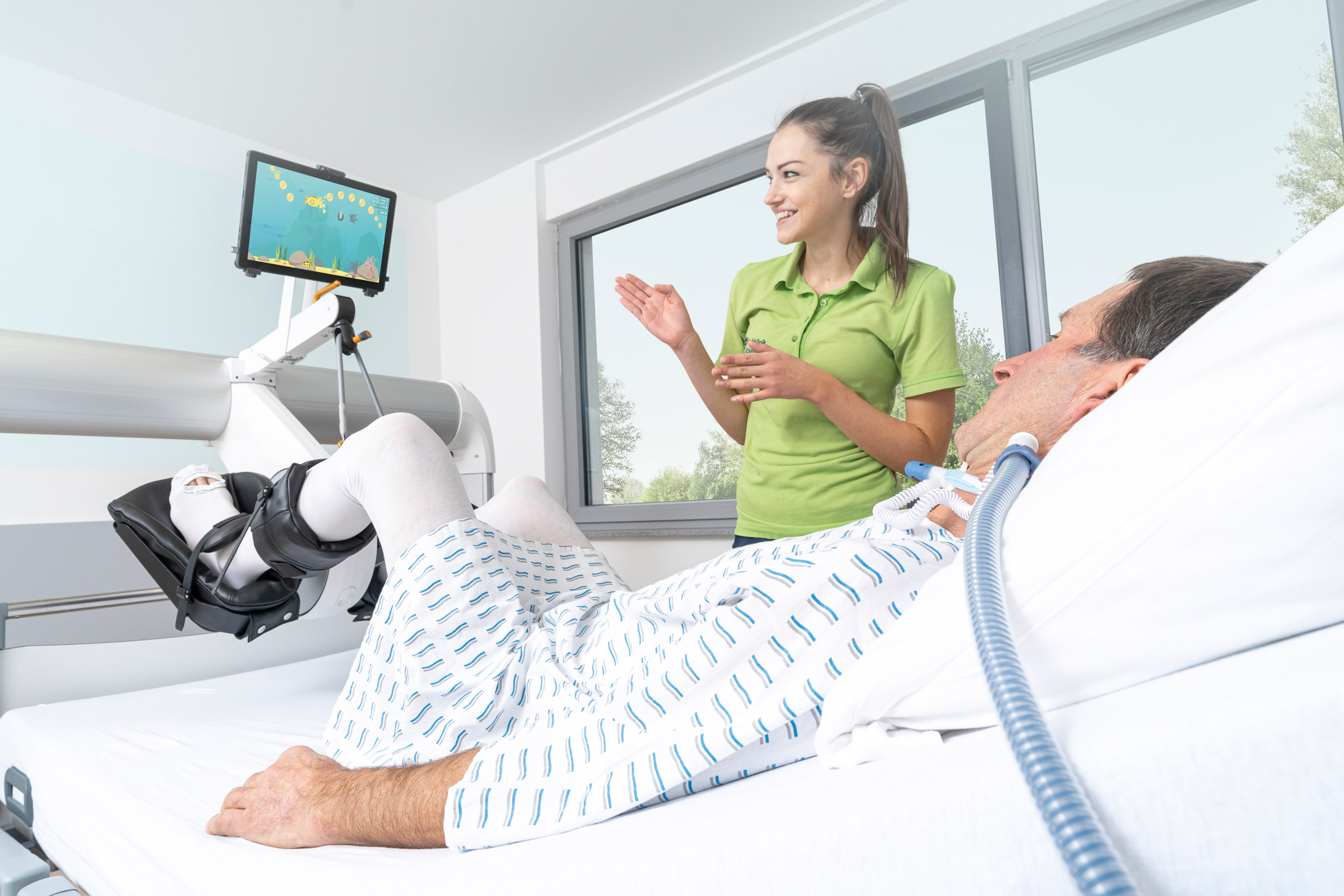
Due to the pronounced lung failure, Mr H. was initially placed in the prone position but could be mobilised. In the morning around 8:30 am at the interdisciplinary meeting, the patient was still in the prone position. A minimally invasive video-assisted surgery (VATS) to relieve the purulent collection in the area of the right lung was planned for that day. An initial early mobilisation in bed from prone position with a focus on respiratory therapy was arranged and carried out.
At the interdisciplinary early consultation on the following day, there were no contraindications for mobilisation of the patient. The goal was that the patient should be able to stand in front of the bed and take his first steps on the spot by the end of the week. Remaining prone for 16 hours and a sedation interruption were planned to allow mobilisation to the edge of the bed. In order to be able to provide Mr H. with optimal psychological support in his situation, his mother was brought in for mobilisation. As a trusted person, his mother was able to provide practical support for this strenuous process. Mr H. was awake on the breathing tube at the time of early mobilisation and communicated by making small movements with his head. He seemed oriented and motivated. The situation and therapy goals were clarified and agreed together with his mother. The patient cooperated well with the preparatory assistive movement of the extremities. He was also able to spontaneously support the transfer to the edge of the bed. Mr H. seemed tense and frightened in view of the overall situation and the number of staff in attendance. At this time, an intensive care nurse, a doctor, the patient’s mother and two physiotherapists were in the room to facilitate mobilisation under ventilation, ECMO and dialysis therapy.
Mr H. needed to be stabilised in his seat. He was supported in straightening up, and respiratory therapy measures were carried out. Massive amounts of secretions were loosened, coughed up and suctioned. The transfer back to bed took place after a few minutes – Mr H. needed to cough a lot and this affected the ECMO therapy. The patient was also exhausted. A short time later, he was placed in the prone position again to optimise the situation of his lungs.
The following day, the aim was to mobilise the patient to the edge of the bed. In addition to respiratory therapy, the patient’s independence in terms of movement transitions and sitting stability was to be enhanced – this was the outcome of the early consultation.
Unfortunately, Mr H. was not awake during the sedation interruption and was – even after intensive stimulation with cold stimuli – so lacking in awareness that mobilisation was not possible.
Mr H. was mobilised at the edge of the bed with the support of nursing and physiotherapy staff. Exercises were carried out to improve spatial perception. As a consequence, Mr H. regained a feeling for gravity.
Support in the seat could be reduced. Furthermore, attempts were made to support Mr H. in his orientation and to explain his current situation to him. His mother was not only an enormous help but also the main communicator. The last step was breathing therapy, along with the application of a hot towel roll. After about 15 minutes of sitting on the edge of the bed, Mr H. was exhausted and the mobilisation was stopped.
After just over a week, the agreed early mobilisation goal finally came into focus: Mr H. was ready to be mobilised to the standing position. The breathing tube was still the biggest hurdle. Nevertheless, the goal was achievable. In the presence of his mother, Mr H. managed to stand in front of the bed three times. His knees were still unstable, but the first attempts to stand were successful. First steps on the spot were possible with support. Mr H. repeatedly gave a “thumbs up” sign and was pleased with his success. In addition, as treatment progressed, Mr H. received regular training with the bed bike to optimally support muscle development and strength in terms of standing and walking ability. In the days that followed, there was sustained improvement in his lung situation. Mr H. was extubated and verbal communication was finally possible. Mr H. stood in front of the bed and could be transferred to the wheelchair by taking steps. A milestone had been reached.
The following day, Mr H. was transferred to a normal ward.
The case studies show that, in the context of early mobilisation in intensive care, adaptations to support each patient on an individual basis are essential. In the interdisciplinary team, the relevant therapy concept must be firmly integrated into everyday practice and its importance must also be considered beyond the boundaries of physiotherapy. Only through close interdisciplinary cooperation with a focus on patient well-being and great commitment from all sides is successful implementation possible. If the transfer from knowledge to action is successful, sustainable added value can be created, above all for patients, but also for clinics and the healthcare system.
- Wang J, Ren D, Liu Y et al (2020). Effects of early mobilization on the prognosis of critically ill patients: A systematic review and meta-analysis; DOI: 10.1016/j.ijnurstu.2020.103708
- Baasner A, Koeppen M, Rosenberger P, (2022) Blutungsrisiko im Kanülenbereich bei physiotherapeutischer Mobilisation unter extrakorporaler Membranoxygenierung- Eine retrospektive Analyse bei Patient*innenmit akutem Lungenversagen; https://doi.org/10.1007/s00063-022-00965-x
- Morris Z, Wooding S, Grant J, (2011) The answer is 17 years, what is the question: understanding time lags in translational research; https://doi.org/10.1258/jrsm.2011.110180
- Nydahl P, Sricharoenchai T, Chandra S, et al. (2017). Safety of Patient Mobilization and Rehabilitation in the Intensive Care Unit. Systematic Review with Meta-Analysis; https://doi.org/10.1513/AnnalsATS.201611-843SR
- Nydahl P, Hermes C, Schuchhardt D et al. (2014),.Frühmobilisierung in Deutschland ; DOI: 10.1055/s-0034-1395432
Related contents
Find related exciting contents in our media library.

Meet our specialists.
Are you interested in our solutions? Schedule a meeting with a Consultant to talk through your strategy and understand how TEHRA-Trainer can help you to advance rehabilitation.
You need to load content from reCAPTCHA to submit the form. Please note that doing so will share data with third-party providers.
More InformationYou are currently viewing a placeholder content from Turnstile. To access the actual content, click the button below. Please note that doing so will share data with third-party providers.
More Information