


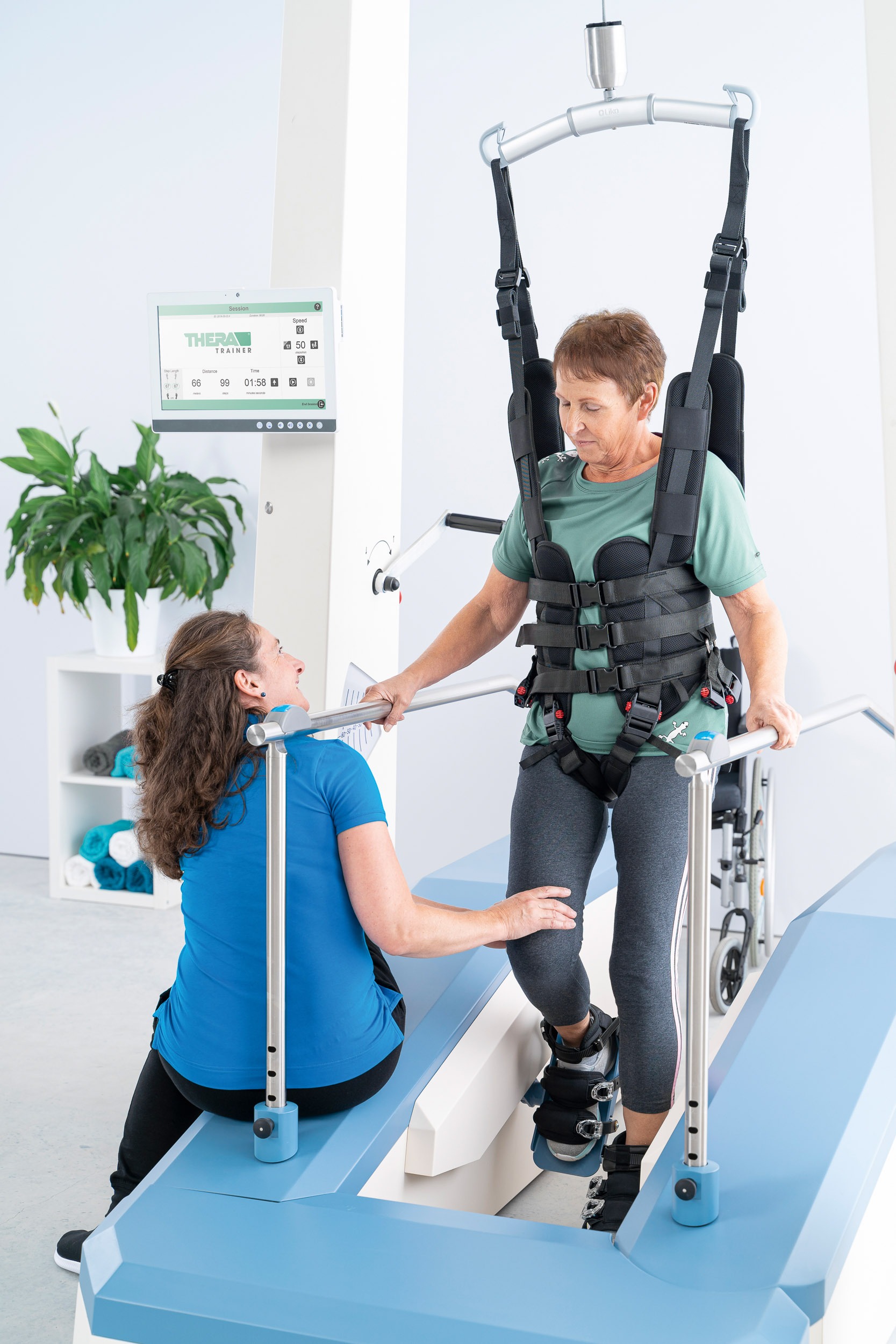
Robot-assisted gait training (RAGT) improves walking recovery after stroke. Learn how end-effector devices outperform traditional therapy and why training intensity and step dose are key to success in modern neurorehabilitation.

In recent years, the field of stroke rehabilitation has changed considerably with the advent of robot-assisted therapy, which, in contrast to traditional rehabilitation methods, marks a paradigm shift. In view of the urgent need for more targeted, more intensive task-orientated rehabilitation strategies, robot-assisted gait training (RAGT) has proven to be a particularly effective method and has become established in clinical practice.
The integration of RAGT with traditional physiotherapy promises to improve post-stroke outcome by addressing both the physical and neurological aspects of gait rehabilitation, providing a more comprehensive approach to stroke rehabilitation.
The rationale for integrating RAGT into stroke rehabilitation is based on the scientific principles of neuroplasticity and motor learning. Neuroplasticity describes the brain’s remarkable ability to reorganise itself by forming new neuronal connections in response to learning or after injury. In the context of stroke rehabilitation, this plasticity is crucial for the recovery of motor functions that have been lost or impaired by brain injury [1-3].
RAGT utilises this principle by providing consistent and repetitive training, which is essential for stimulating and strengthening these new neural pathways. Such repetitive practice of walking movements using robotic support helps to retrain the brain and gradually restore the neural circuits for motor function. This is particularly important in stroke rehabilitation, where the aim is to relearn and improve motor skills such as walking [1-3].
The basic aim of RAGT in the field of stroke rehabilitation is to create a training environment characterised by high intensity, repetitive exercises and task-related activities. This approach is based on the principles of motor learning, which state that high-intensity training is crucial to sufficiently challenge the motor system and achieve significant improvements. A high number of repetitions is important for anchoring motor skills, as continuous practice improves execution [9-11].
Another advantage of RAGT over traditional gait rehabilitation methods is the ability to ensure consistent and controlled training. The robotic devices can precisely control movement patterns, speed and resistance, ensuring that patients perform the exercises with the correct form and intensity. This level of control is difficult to achieve with manual therapy alone. In addition, RAGT enables intensive training without physical strain for therapists and with a reduced risk of injury for patients. This is particularly important for patients with severe impairments who require comprehensive support during training [9-12].
In everyday clinical practice, the question often arises as to which patients benefit most from which method of improving walking ability after a stroke. A network meta-analysis conducted by Mehrholz and colleagues in 2018 aimed not only to summarise the current evidence on gait rehabilitation after a stroke, but also to statistically compare all approaches to gait rehabilitation for the first time. The evaluation included 95 randomised controlled trials with a total of 4,458 patients. For the primary and secondary endpoints of walking speed and walking distance (endurance), gait training with end-effector-assisted devices and treadmill training with body weight support in particular achieved significant improvements. No difference was identified between the safety of the individual interventions [13].
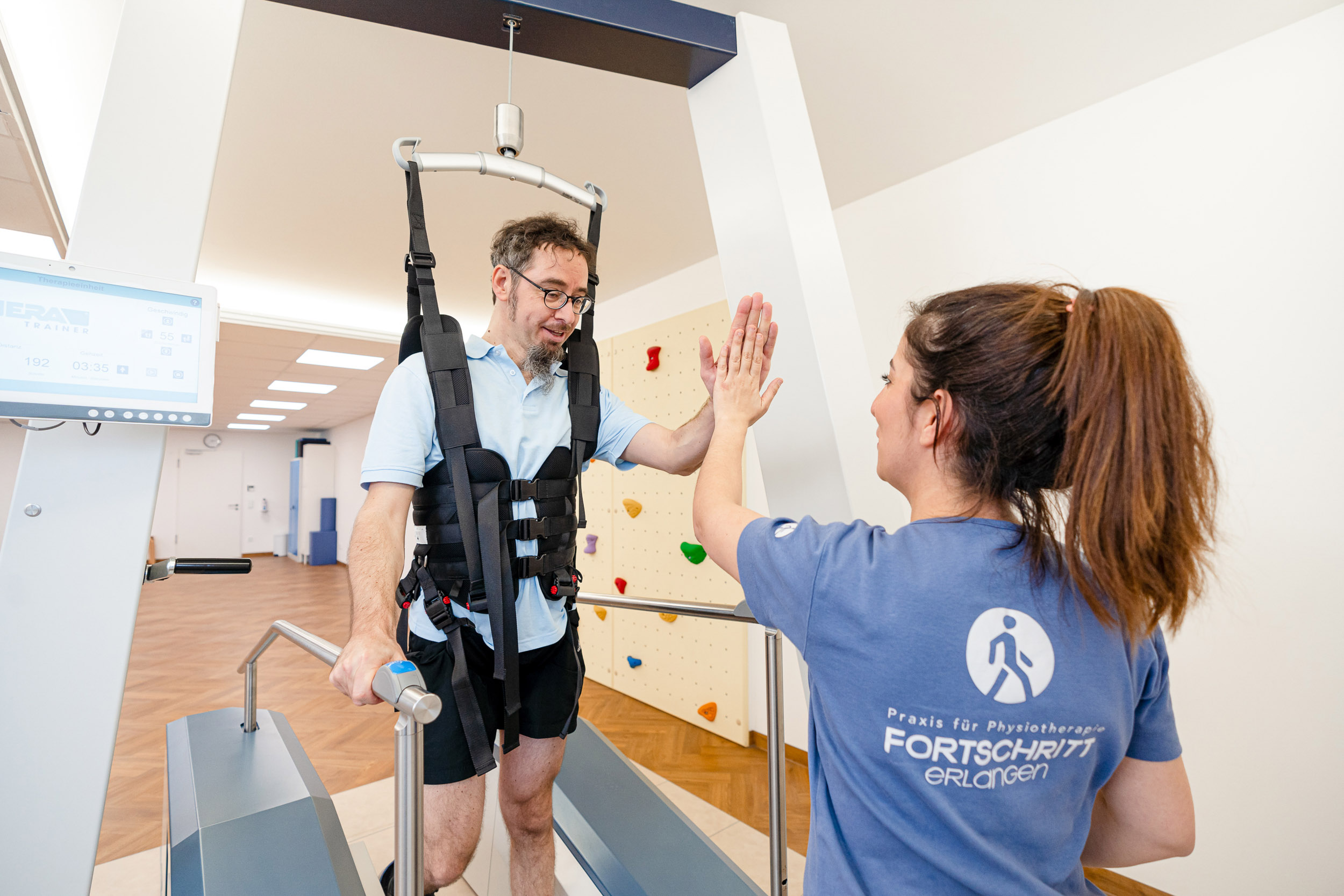
High-intensity gait training is recommended in stroke rehabilitation to improve walking speed, walking distance and balance. However, identifying effective and efficient implementation methods still remains somewhat of a challenge in practice.
In stroke rehabilitation, research continues to identify gaps between scientific knowledge and clinical practice. Studies and meta-analyses on gait rehabilitation describe the significantly positive effects and impacts of gait rehabilitation interventions characterised by a high number of steps and high aerobic (i.e. cardiovascular) intensities. Studies on these interventions show significantly improved walking speed, endurance and walking economy in people who have had a stroke. In particular, gait training performed at 60% to 80% of the predicted heart rate (HR) reserve can result in 2000 to 6000 steps per physiotherapy session.
A high-quality study by Hornby et al. (2019, 2022) shows that high-intensity gait training at 70-80% of heart rate reserve results in significant improvements in walking speed and gait endurance, regardless of the exercise variation. At least 70 steps per minute are necessary to achieve significant progress. The PHYS-STROKE study (Nave et al. 2019) supports these findings by showing that low-intensity gait training did not lead to significant improvements. This emphasises the importance of higher training intensities and a minimum number of steps in neurological gait therapy [19-21].
Media and marketing often convey an image in which robotic exoskeletons enable people with brain damage or spinal cord injuries to resume everyday activities. However, these representations may not correspond to the actual technological or clinical reality. A detailed look at the current use of exoskeletons in rehabilitation shows both their advantages and their limitations. Despite the publication of 17 reviews in 2021 dealing with exoskeletons, the methodological quality of the studies was mostly inadequate, especially with regard to the description of patients and interventions. Most of the studies focussed on patients with spinal cord injury who were already able to walk and considered exoskeletons primarily as an aid in everyday life or as part of gait training in rehabilitation. While some studies suggest that exoskeletons may be particularly useful as a mobility aid at home, others show that current devices are limited for home use due to their weight, the need for support devices and the restricted range of motion. Studies on improving walking ability after stroke are still scarce and there is a lack of evidence of relevant clinical improvements. Individual studies show that although significant improvements in walking speed, step length and cadence were observed within the groups, there were often no significant differences between the groups. This suggests that although wearable exoskeletons can improve specific aspects of gait in individuals, their superiority over other forms of rehabilitation is not clear. Future developments must strive for close collaboration between engineers, clinicians and patients to improve the practicality of exoskeletons, while a sound cost-benefit analysis remains essential [23-27].
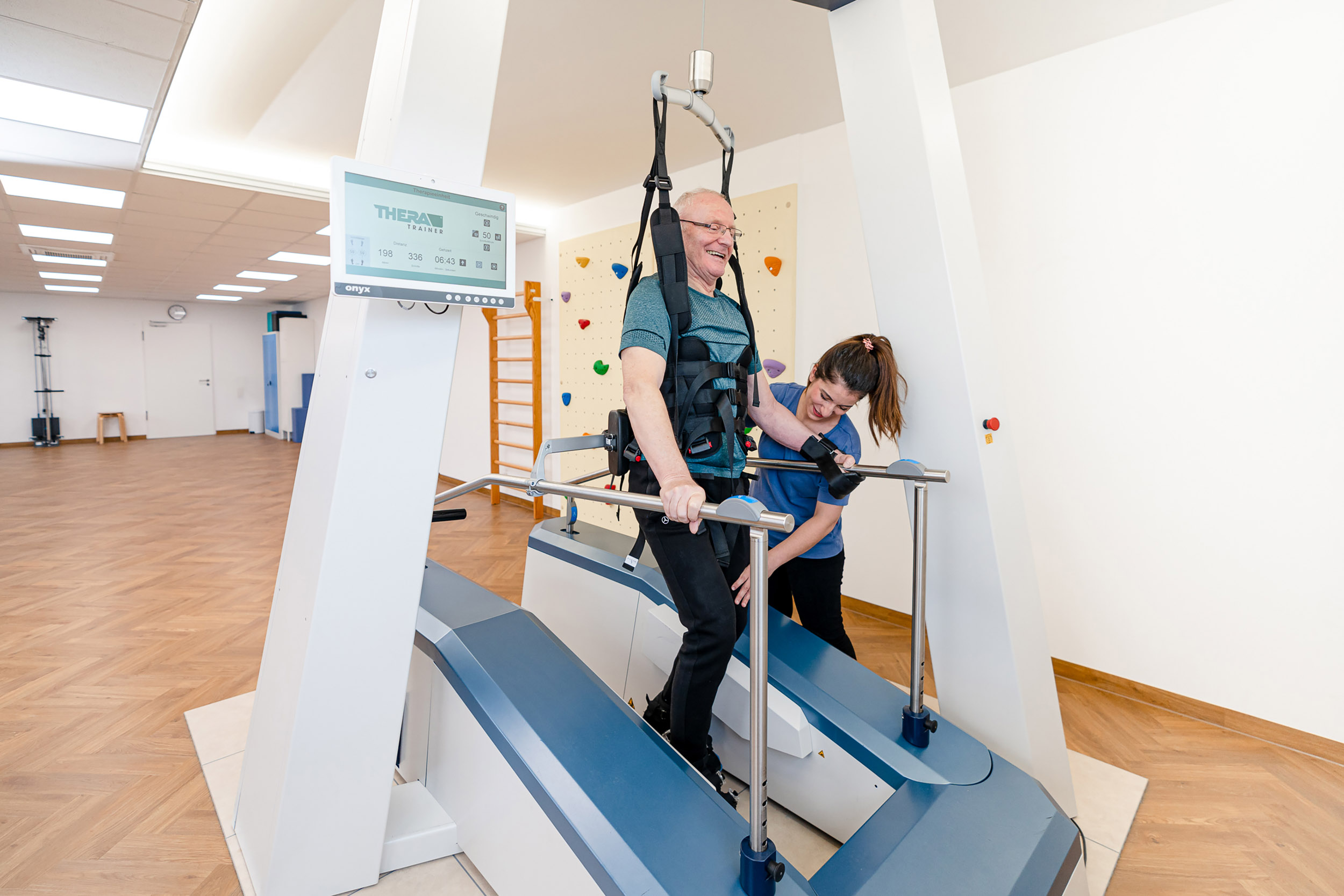
Current studies show that end-effector robots achieve significant progress in gait function and balance by simulating walking movements in non-ambulatory patients in a repetitive and energy-efficient manner, thereby improving endurance, gait speed and stability. These stationary gait training systems effectively promote cortical activation and the recovery of motor functions through intensive, targeted rehabilitation that supports neuroplasticity and muscle training. In later rehabilitation phases, therapy should ideally transition seamlessly to treadmill training with or without partial body weight support and targeted everyday gait training.
However, the success of the therapy depends not only on the selection of the appropriate intervention, but also to a large extent on ensuring sufficient intensity and dose. Current research findings show that modern neurorehabilitation may require higher intensities, more progressive training protocols and a more targeted focus on minimum step counts and biological markers such as heart rate for adequate load control.
Although wearable exoskeletons improve mobility and provide realistic exercise opportunities, they do not currently demonstrate superior efficacy compared to other gait rehabilitation methods. This emphasises the need for further comparative studies to assess their relative effectiveness. Some studies suggest that an integrated approach combining proven and new therapies could potentially optimise rehabilitation outcomes.
Despite the robust evidence for the effectiveness of individual interventions, there are limitations such as small sample sizes and sometimes contradictory results. Future research should focus on larger, diverse patient groups, detailed subgroup analyses and long-term effects, and include direct comparisons between robotic systems and traditional therapies. Clarifying open questions on intensity and dose-response relationships is also crucial in order to refine robot-assisted gait training protocols and optimise their integration into clinical practice, which could ultimately lead to improved recovery outcomes for stroke survivors.
- El Naamani K., Abbas R., Sioutas G.S., Tjoumakaris S.I., Gooch M.R., Herial N.A., Rosenwasser R.H., Jabbour P.M. Endovascular Robotic Interventions. Neurosurg. Clin. N. Am. 2022;33:225–231.
- Kim H., Park G., Shin J.-H., You J.H. Neuroplastic Effects of End-Effector Robotic Gait Training for Hemiparetic Stroke: A Randomised Controlled Trial. Sci. Rep. 2020;10:12461.
- Swinnen E., Beckwée D., Meeusen R., Baeyens J.-P., Kerckhofs E. Does Robot-Assisted Gait Rehabilitation Improve Balance in Stroke Patients? A Systematic Review. Top. Stroke Rehabil. 2014;21:87–100.
- Chang W.H., Kim Y.-H. Robot-Assisted Therapy in Stroke Rehabilitation. J. Stroke. 2013;15:174–181.
- Loro A., Borg M.B., Battaglia M., Amico A.P., Antenucci R., Benanti P., Bertoni M., Bissolotti L., Boldrini P., Bonaiuti D., et al. Balance Rehabilitation through Robot-Assisted Gait Training in Post-Stroke Patients: A Systematic Review and Meta-Analysis. Brain Sci. 2023;13:92.
- Nedergård H., Arumugam A., Sandlund M., Bråndal A., Häger C.K. Effect of Robotic-Assisted Gait Training on Objective Biomechanical Measures of Gait in Persons Post-Stroke: A Systematic Review and Meta-Analysis. J. Neuroeng. Rehabil. 2021;18:64.
- Chang W.H., Kim T.-W., Kim H.S., Hanapiah F.A., Kim D.H., Kim D.Y. Exoskeletal Wearable Robot on Ambulatory Function in Patients with Stroke: A Protocol for an International, Multicentre, Randomised Controlled Study. BMJ Open. 2023;13:e065298.
- Moucheboeuf G., Griffier R., Gasq D., Glize B., Bouyer L., Dehail P., Cassoudesalle H. Effects of Robotic Gait Training after Stroke: A Meta-Analysis. Ann. Phys. Rehabil. Med. 2020;63:518–534.
- Eng J.J., Tang P.F. Gait Training Strategies to Optimize Walking Ability in People with Stroke: A Synthesis of the Evidence. Expert. Rev. Neurother. 2007;7:1417–1436.
- Mikołajewska E. Bobath and Traditional Approaches in Post-Stroke Gait Rehabilitation in Adults. Biomed. Hum. Kinet. 2017;9:27–33.
- Chen B.-L., Guo J.-B., Liu M.-S., Li X., Zou J., Chen X., Zhang L.-L., Yue Y.-S., Wang X.-Q. Effect of Traditional Chinese Exercise on Gait and Balance for Stroke: A Systematic Review and Meta-Analysis. PLoS ONE. 2015;10:e0135932.
- Hesse S., Heß A., Werner C.C., Kabbert N., Buschfort R. Effect on Arm Function and Cost of Robot-Assisted Group Therapy in Subacute Patients with Stroke and a Moderately to Severely Affected Arm: A Randomized Controlled Trial. Clin. Rehabil. 2014;28:637–647.
- Mehrholz J., Pohl M., Kugler J., Elsner B. The improvement of walking ability following stroke—a systematic review and network meta-analysis of randomized controlled trials. Dtsch Arztebl Int 2018; 115: 639-45.
- Lang CE, Macdonald JR, Reisman DS, et al. Observation of amounts of movement practice provided during stroke rehabilitation. Arch Phys Med Rehabil. 2009;90(10):1692–1698. doi:10.1016/j.apmr.2009.04.005.
- Moore JL, Roth EJ, Killian C, Hornby TG. Locomotor training improves daily stepping activity and gait efficiency in individuals poststroke who have reached a “plateau” in recovery. Stroke. 2010;41(1):129–135. doi:10.1161/STROKEAHA.109.563247.
- Kaur G, English C, Hillier S. How physically active are people with stroke in physiotherapy sessions aimed at improving motor function? A systematic review. Stroke Res Treat. 2012;2012:820673. doi:10.1155/2012/820673.
- MacKay-Lyons MJ, Makrides L. Cardiovascular stress during a contemporary stroke rehabilitation program: is the intensity adequate to induce a training effect? Arch Phys Med Rehabil. 2002;83(10):1378–1383. doi:10.1053/apmr.2002.35089.
- Ballester BR, Ward NS, Brander F, Maier M, Kelly K, Verschure PFMJ. Relationship between intensity and recovery in post-stroke rehabilitation: a retrospective analysis. J Neurol Neurosurg Psychiatry. 2022 Feb;93(2):226-228. doi: 10.1136/jnnp-2021-326948.
- Hornby TG, Henderson CE, Plawecki A, Lucas E, Lotter J, Holthus M, Brazg G, Fahey M, Woodward J, Ardestani M, Roth EJ. Contributions of Stepping Intensity and Variability to Mobility in Individuals Poststroke. Stroke. 2019 Sep;50(9):2492-2499.
- Hornby TG, Plawecki A, Lotter JK, Scofield ME, Lucas E, Henderson CE. Gains in Daily Stepping Activity in People With Chronic Stroke After High-Intensity Gait Training in Variable Contexts. Phys Ther. 2022 Aug 4;102(8):pzac073.
- Rackoll T, Nave AH, Ebinger M, Endres M, Grittner U, Flöel A; ; for the PHYS-Stroke study group. Physical Fitness Training in Patients with Subacute Stroke (PHYS-STROKE): Safety analyses of a randomized clinical trial. Int J Stroke. 2022 Jan;17(1):93-100.
- Goikoetxea-Sotelo G, van Hedel HJA. Defining, quantifying, and reporting intensity, dose, and dosage of neurorehabilitative interventions focusing on motor outcomes. Front Rehabil Sci. 2023 Aug 10;4:1139251.
- Dijkers MP, Akers KG, Dieffenbach S, Galen SS. Systematic Reviews of Clinical Benefits of Exoskeleton Use for Gait and Mobility in Neurologic Disorders: A Tertiary Study. Arch Phys Med Rehabil. 2021 Feb;102(2):300-313.
- Park YH, Lee DH, Lee JH. A Comprehensive Review: Robot-Assisted Treatments for Gait Rehabilitation in Stroke Patients. Medicina (Kaunas). 2024 Apr 10;60(4):620. doi: 10.3390/medicina60040620. PMID: 38674266; PMCID: PMC11052271.
- Yokota C., Tanaka K., Omae K., Kamada M., Nishikawa H., Koga M., Ihara M., Fujimoto Y., Sankai Y., Nakajima T., et al. Effect of Cyborg-Type Robot Hybrid Assistive Limb on Patients with Severe Walking Disability in Acute Stroke: A Randomized Controlled Study. J. Stroke Cerebrovasc. Dis. 2023;32:107020.
- Yeung L.-F., Lau C.C.Y., Lai C.W.K., Soo Y.O.Y., Chan M.-L., Tong R.K.Y. Effects of Wearable Ankle Robotics for Stair and Over-Ground Training on Sub-Acute Stroke: A Randomized Controlled Trial. J. Neuroeng. Rehabil. 2021;18:19.
- Louie D.R., Mortenson W.B., Durocher M., Teasell R., Yao J., Eng J.J. Exoskeleton for Post-Stroke Recovery of Ambulation (ExStRA): Study Protocol for a Mixed-Methods Study Investigating the Efficacy and Acceptance of an Exoskeleton-Based Physical Therapy Program during Stroke Inpatient Rehabilitation. BMC Neurol. 2020;20:35. doi: 10.1186/s12883-020-1617-7.
Related contents
Find related exciting contents in our media library.

Meet our specialists.
Are you interested in our solutions? Schedule a meeting with a Consultant to talk through your strategy and understand how TEHRA-Trainer can help you to advance rehabilitation.
You need to load content from reCAPTCHA to submit the form. Please note that doing so will share data with third-party providers.
More InformationYou are currently viewing a placeholder content from Turnstile. To access the actual content, click the button below. Please note that doing so will share data with third-party providers.
More Information