


SCIENCE
Exercise exercises the brain too
What the largest evidence synthesis to date reveals about cognitive-motor training

Jakob Tiebel
Health Business Consultant
It is well established that physical activity promotes physical health. A comprehensive scientific analysis now reveals just how closely physical activity is linked to cognitive performance. The umbrella review by Singh et al., published in the British Journal of Sports Medicine in 2025, brought together 133 systematic reviews comprising 2,724 randomised controlled trials and a total of 258,279 participants. This makes it one of the largest evidence syntheses to date on the impact of physical activity on cognition (Singh et al., 2025).
Movement also improves memory, attention and executive functions.
Across different age groups, health conditions and forms of exercise, physical training significantly improved global cognition, memory and executive function. The average effects were greatest for global cognition and generally fell within the small-to-moderate range:
• Global cognition: SMD = 0.42
• Memory: SMD = 0.26
• Executive functions: SMD = 0.24
The positive results remained robust even when reviews of low or critically low methodological quality were excluded from the analyses. Physical activity is therefore relevant not only to mobility, strength and endurance, but also makes a measurable contribution to cognitive health across various life stages and health conditions (Singh et al., 2025).
Even low-intensity physical activity can have a beneficial effect on cognitive function
One finding of particular relevance to clinical practice concerns training intensity. The effects tended to be even greater for low- and moderate-intensity interventions than for high-intensity programmes. Cognitive enhancement therefore does not necessarily require maximal physical exertion. Even training programmes tailored to individual physical capacity can provide relevant cognitive stimulation (Singh et al., 2025).
In terms of individual training sessions, the researchers found no clear-cut differences attributable to training frequency, session duration or weekly training volume. Programmes with a total duration of one to three months, however, demonstrated greater cognitive improvements in subgroup analyses than longer-term interventions. This suggests that even modest and consistently implemented training periods can trigger meaningful changes (Singh et al., 2025).
In terms of individual training sessions, the researchers found no clear-cut differences attributable to training frequency, session duration or weekly training volume. Programmes with a total duration of one to three months, however, demonstrated greater cognitive improvements in subgroup analyses than longer-term interventions. This suggests that even modest and consistently implemented training periods can trigger meaningful changes (Singh et al., 2025).
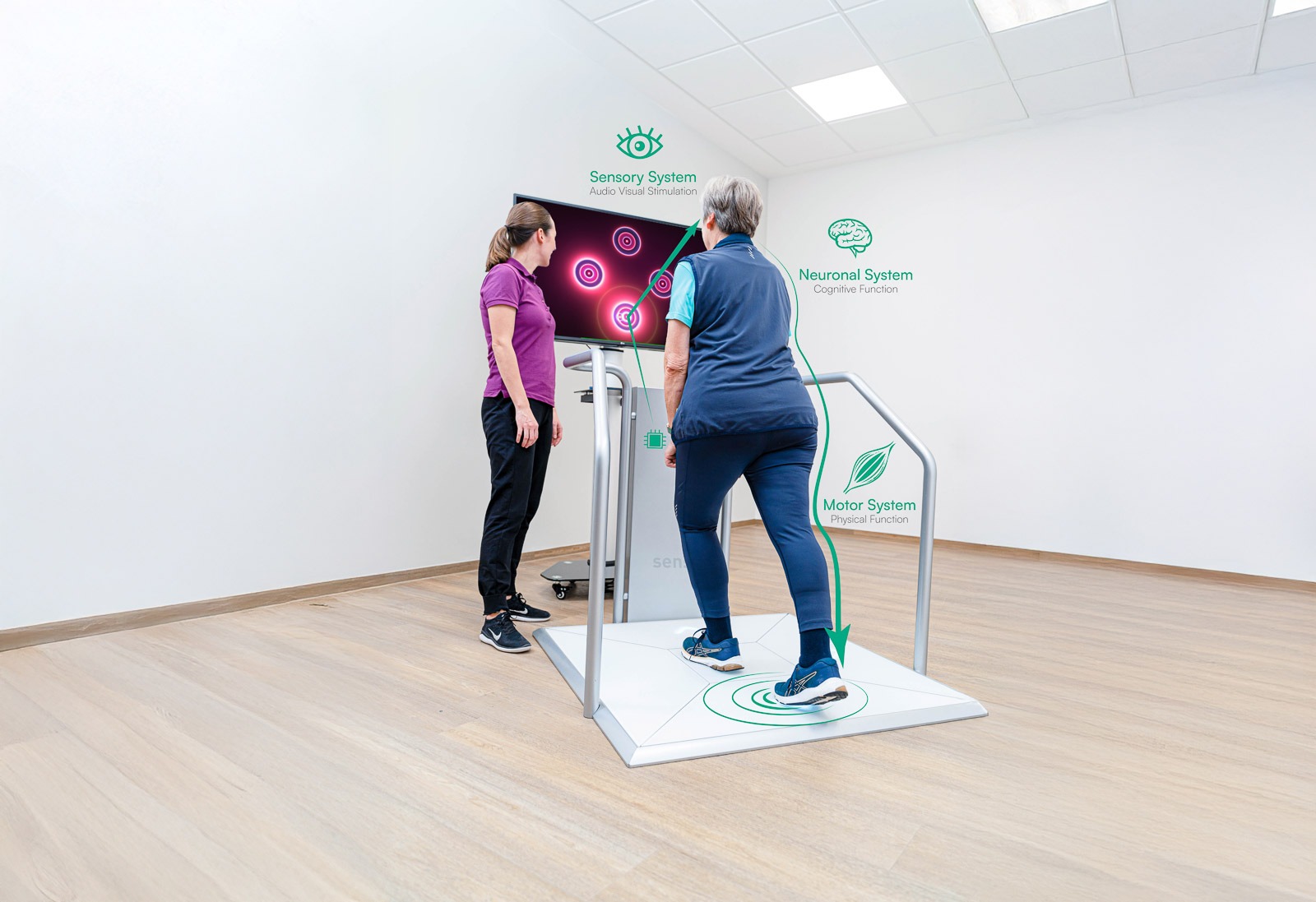
Exergames directly combine physical activity with cognitive challenges.
Exergames with particularly interesting results
Among the forms of exercise examined, exergames achieved the greatest pooled effects on global cognition and memory. Exergames are digital training games in which tasks are completed not merely by pressing a button, but through active physical movements (Singh et al., 2025).
These findings are of particular interest in the field of rehabilitation. Exergames can combine physical activity with cognitive demands such as attention, reactivity, perception, working memory and decision-making. It is precisely these skills that are required for individuals to move safely through complex activities of daily living.
Walking, climbing stairs or avoiding an obstacle are not purely motor processes. At the same time, information from the environment must be processed, movements planned, balance maintained and actions adjusted at short notice as required. Successful mobility is therefore always dependent on cognitive performance as well.
The connection to the THERA-Trainer senso
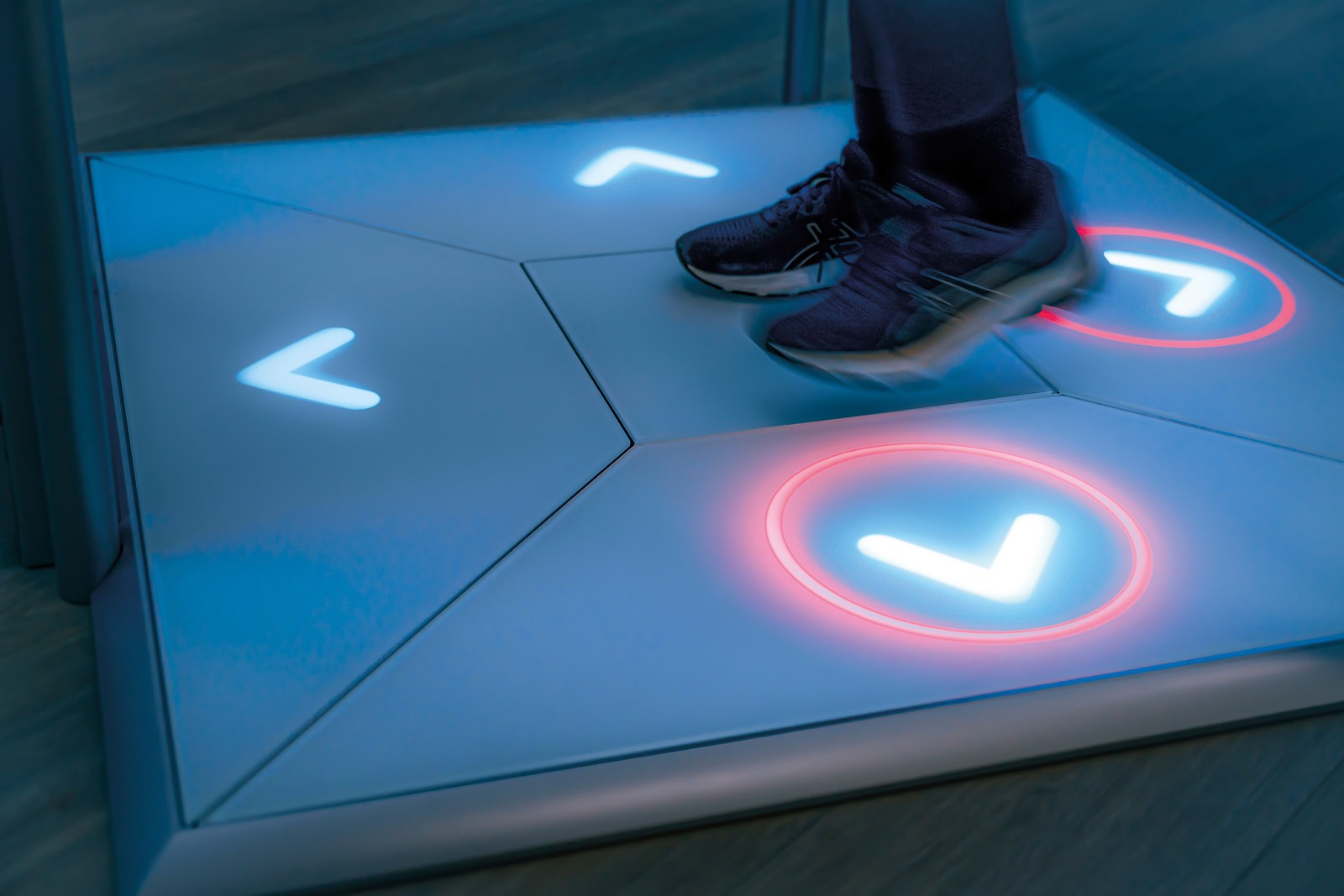
The THERA-Trainer senso specifically applies this principle. The interactive training system combines stepping movements and weight shifts with visual and auditory tasks. Integrated sensors detect movements and contact on the training platform. Users complete tasks by, for example, performing targeted steps, shifting their centre of gravity, or responding to changing shapes, colours and signals (Keifert et al., 2023).
In this way, the senso precisely replicates the connection between physical activity and cognitive load for which the umbrella review shows particularly compelling findings. During an exercise session, motor and cognitive demands must be managed in parallel. Balance, coordination and stepping movements are linked to attention, reaction, decision-making and the processing of visual information.
The focus is therefore not on isolated single-muscle training, nor on purely seated cognitive exercises. Training with the THERA-Trainer senso challenges the body and brain within a single activity.
The training software continuously adapts the level of difficulty to the individual’s performance level. This allows patients to train within an appropriate challenge level. Interactive feedback, a range of therapeutic games and documentable training progress support individual, progressive training design (THERA-Trainer, n.d.).
GET IN TOUCH
From playful engagement to therapeutic task
The playful nature of the senso is not an end in itself. Exergames can enable a high number of repetitions, provide immediate feedback and direct attention towards a concrete goal. Movement is often performed implicitly: rather than focusing exclusively on correct movement execution, the patient directs their attention towards the task within the game.
This allows movements to be practised under conditions that more closely resemble typical activities of daily living. The individual must divide their attention, respond to changes and adapt their movements accordingly. In this way, training with the THERA-Trainer senso can create dual-task situations that place concurrent demands on cognitive and motor processes (Keifert et al., 2023).
Therapy can be tailored to focus on specific goals, for example:
• Balance control under conditions of divided attention
• Targeted and rapid step reactions
• Coordination of perception and movement
• Response to changing environmental stimuli
• Cognitive flexibility and decision-making ability
• Stability in dual-task situations
The THERA-Trainer senso therefore provides a structured technical environment in which physical activity is not separated from cognitive challenge. It is this combination that appears particularly relevant in light of current research findings.
Scientifically compelling and clinically applicable
The umbrella review by Singh et al. examined exercise and exergames in general terms and does not provide isolated evidence of efficacy for any single training device. Its findings, however, provide a robust scientific foundation for the training principle underlying the THERA-Trainer senso: cognitive function can be enhanced through physical activity, and it is specifically the combination of movement and interactive cognitive tasks that demonstrates particularly promising effects.
The senso translates this principle into practical use within rehabilitation. It enables tailored, motivating and quantifiable training that simultaneously challenges perception, decision-making and movement.
This creates favourable conditions for the targeted training of cognitive-motor skills and their subsequent transfer into activities of daily living.
Targeted training of body and mind, together.
Conclusion
The most comprehensive evidence synthesis on exercise and cognition to date shows that physical activity not only improves physical function but also supports global cognition, memory and executive functions. Of particular interest are the findings on low- to moderate-intensity training modalities and movement-based exergames.
The THERA-Trainer senso translates these findings into a modern therapeutic training concept. The interactive combination of stepping movements, balance, attention and reaction challenges both the body and the brain.
This transforms movement into targeted cognitive-motor training,
The THERA-Trainer senso translates these findings into a modern therapeutic training concept. The interactive combination of stepping movements, balance, attention and reaction challenges both the body and the brain.
This transforms movement into targeted cognitive-motor training,
Jakob Tiebel
Health Business Consultant
Jakob Tiebel is OT and studied applied psychology with a focus on health economics. He has clinical expertise from his previous therapeutic work in neurorehabilitation. He conducts research and publishes on the theory-practice transfer in neurorehabilitation and is the owner of an agency for digital health marketing.
References:
- Originalarbeit Singh, B., Bennett, H., Miatke, A., Dumuid, D., Curtis, R., Ferguson, T., Brinsley, J., Szeto, K., Petersen, J. M., Gough, C., Eglitis, E., Simpson, C. E. M., Ekegren, C. L., Smith, A. E., Erickson, K. I., & Maher, C. (2025). Effectiveness of exercise for improving cognition, memory and executive function: A systematic umbrella review and meta meta-analysis. British Journal of Sports Medicine, 59(12), 866 876. https://doi.org/10.1136/bjsports-2024-108589
- Keifert, M., Tiebel, J., & Huber, M. (2023). Motorisches Lernen mit dem THERA-Trainer senso: Dual-Task-Training alltagsnah und wirksam gestalten. THERA-Trainer. https://thera-trainer.com/de/ articles/motorisches-lernen-mit-dem-thera-trainer-senso/
- Singh, B., Bennett, H., Miatke, A., Dumuid, D., Curtis, R., Ferguson, T., Brinsley, J., Szeto, K., Petersen, J. M., Gough, C., Eglitis, E., Simpson, C. E. M., Ekegren, C. L., Smith, A. E., Erickson, K. I., & Maher, C. (2025). Effectiveness of exercise for improving cognition, memory and executive function: A systematic umbrella review and meta-meta analysis. British Journal of Sports Medicine, 59(12), 866–876. https://doi.org/10.1136/bjsports-2024-108589
- THERA-Trainer. (o. D.). senso: Interaktives kognitiv-motorisches Training. Abgerufen am 27. Juli 2026, von https://thera-trainer. com/de/produkte/senso/