



SCIENCE
Moving individually despite dementia: A combined training program that works in nursing homes
A recent study published in the Journal of Aging Research & Lifestyle shows that a 10-week, individually tailored exercise program led by physiotherapists is feasible for nursing home residents living with dementia.

Dennis Boer
Physiotherapist and Junior Researcher
Exercise Training for Nursing Home Residents with Dementia: Current Evidence and Challenges
Dementia is highly prevalent among nursing home residents and affects between 42% and 84%, depending on the country and type of facility. [1] In addition to cognitive impairments, the condition is frequently associated with reduced mobility, decreased muscle strength, impaired balance, and lower endurance. [2] These factors increase dependence in everyday activities as well as the risk of falls. [3]
Guided exercise programs are therefore widely used and recommended by both professional societies and patients. However, training programs for people with dementia vary substantially in their content, intensity, supervision, and dosage, which complicates comparisons across studies and weakens the evidence base. [4] Moreover, many interventions do not meet international guidelines regarding training frequency, duration, and the combination of endurance, strength, balance, and flexibility components – raising concerns about their therapeutic validity. [5] Low adherence further limits their potential effectiveness.
Exergaming – combining physical exercise with interactive, cognitively stimulating elements – may help increase engagement and adherence. However, the feasibility of a guideline-based, therapist-supervised program incorporating exergaming components has so far been insufficiently examined for nursing home residents with dementia.
Study Design and Intervention
The aim of the presented study was therefore to assess the feasibility of such an intervention before evaluating its effectiveness in subsequent research.
Between February and June 2025, a single-arm observational feasibility study was conducted across two sites of a nursing home organization in Haarlem, the Netherlands. The study design followed the extended CONSORT guidelines for feasibility studies. Residents diagnosed with dementia who were able to walk at least 50 meters with or without a walking aid and who had a generally positive attitude toward exercise such as cycling were included, ensuring that participation in the study and the exercise program was voluntary.
The intervention spanned ten weeks and comprised four weekly training sessions. Two of these were 45-minute group classes focusing on strength, balance, and flexibility. In addition, participants completed two individual 20-minute exergaming cycling sessions on a THERA-Trainer tigo 562, using virtual, interactive cycling routes provided by BikeLabyrinth.
GET IN TOUCH
Feasibility Criteria
Primary feasibility criteria included completion of at least 80% of clinical assessments, an adherence rate above 75%, and the absence of serious intervention-related adverse events. Secondary outcomes included the recruitment rate, participant ratings of the training sessions, and caregivers’ experiences in supporting the intervention.
Results of the Feasibility Study
The intervention met all predefined feasibility criteria and demonstrated high adherence and acceptance compared with previously published exercise programs for individuals with dementia. Participation rates were well above those reported in earlier meta-analyses (62.3%) [6] and higher than adherence observed in therapist-led programs (73–75%). [7,8]
The recruitment process, however, proved challenging due to strict inclusion criteria and organizational factors. Since many training components can be performed even with limited mobility, adjusting the criteria—such as requiring only the ability to independently rise from a chair—could improve future recruitability.
The sessions were generally rated as pleasant or very pleasant. No serious adverse events occurred, and fewer than 10% of the minor events were considered possibly related to the intervention, primarily fatigue. Whether fatigue should be categorized as an adverse event is debatable, as it represents a typical response to moderately intensive exercise. [9]
Conclusion
The 10-week training program—combining traditional exercises with exergaming cycling—demonstrates that such an approach is feasible, safe, and consistently experienced as positive by nursing home residents with dementia.
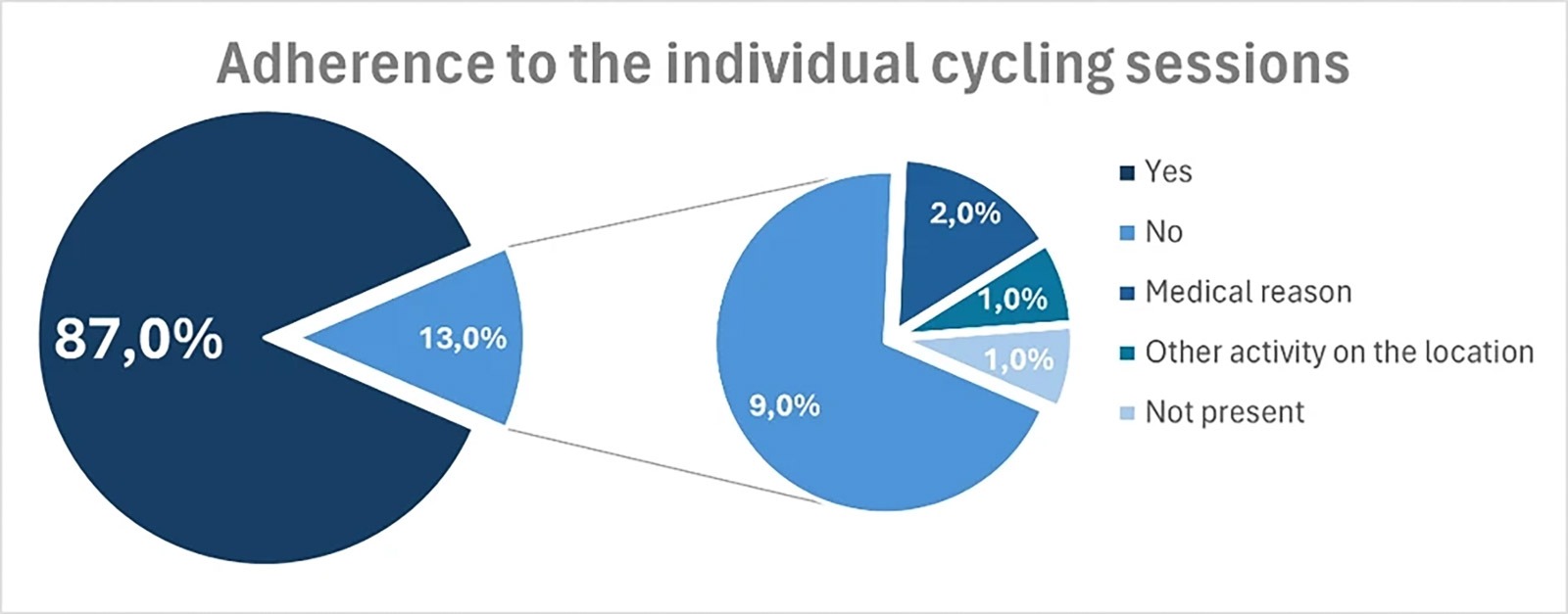
Adherence to the individual cycling sessions
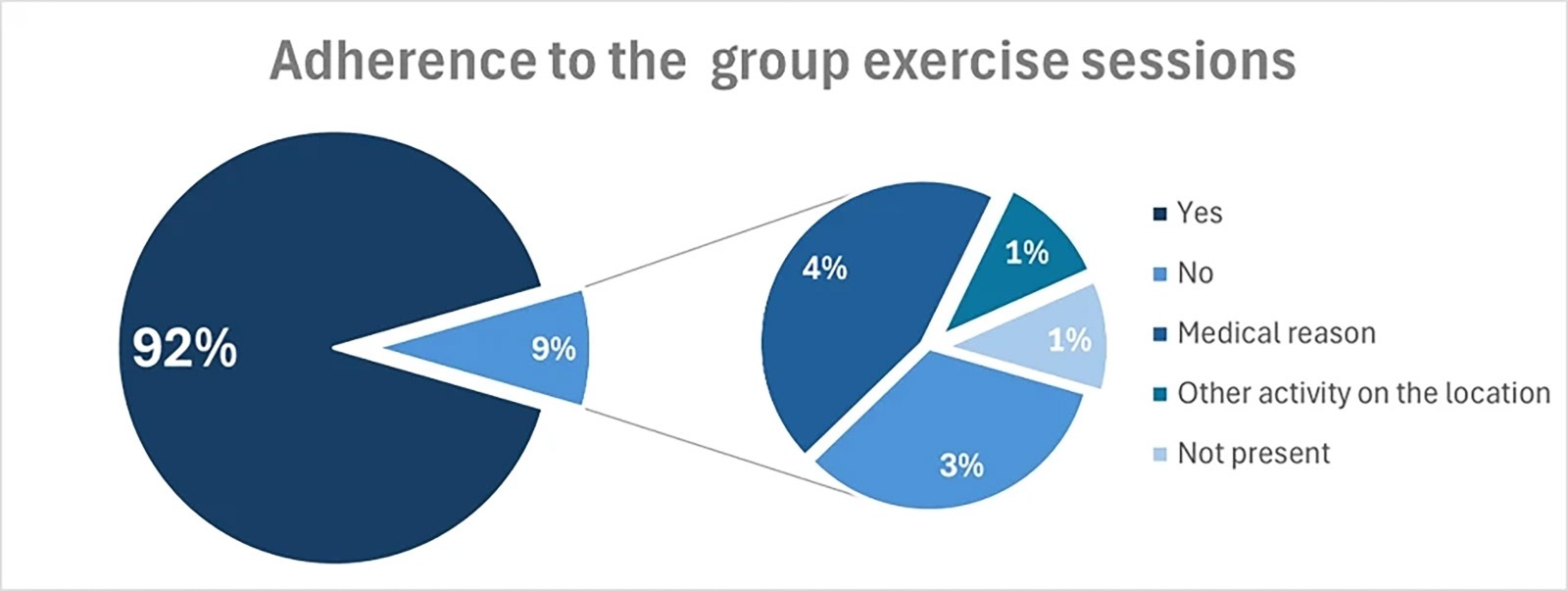
Adherence to the group exercise sessions
Dennis Boer
Physiotherapist and Junior Researcher
Dennis Boer is a physiotherapist and junior researcher whose work focuses primarily on physiotherapy for nursing home residents with dementia. He is affiliated with the aged care organisation Kennemerhart in the Haarlem region of the Netherlands, and with Leiden University Medical Center.
References:
- [1] Røen I, Selbæk G, Kirkevold Ø, Engedal K, Testad I, Bergh S. Resourse Use and Disease Couse in dementia - Nursing Home (REDIC-NH), a longitudinal cohort study; design and patient characteristics at admission to Norwegian nursing homes. BMC Health Serv Res. 2017;17(1). doi:10.1186/s12913-017-2289-x
- [2] Sverdrup K, Selbæk G, Bergh S. Physical performance across the cognitive spectrum and between dementia subtypes in a population-based sample of older adults : The HUNT study. 2021;95(January). doi:10.1016/j.archger.2021.104400
- [3] Telenius EW, Engedal K, Bergland A. Physical performance and quality of life of nursing-home residents with mild and moderate dementia. Int J Environ Res Public Health. 2013;10(12):6672-6686. doi:10.3390/ijerph10126672
- [4] Boer D, Schmidt C, Sterke S, Schoones J, Elbers R, Vliet Vlieland T. Characteristics and Effectiveness of Physical Therapist Supervised Exercise Interventions for Nursing Home Residents With Dementia: A Systematic Review. Makaroun LK, ed. Innov Aging. 2024;8(7). doi:10.1093/geroni/igae061
- [5] Souto P De, Morley JE, Chodzko-zajko W, et al. Recommendations Term Care Facilities : A Taskforce Report. J Am Med Dir Assoc. 2016;17(5):381-392. doi:10.1016/j.jamda.2016.01.021
- [6] Di Lorito C, Bosco A, Booth V, Goldberg S, Harwood RH. Adherence to exercise interventions in older people with mild cognitive impairment and dementia : A systematic review and meta-analysis. Prev Med Rep. 2020;19(June):101139. doi:10.1016/j. pmedr.2020.101139
- [7] Toots A, Lindelöf N, Littbrand H, et al. Effects of a High-Intensity Functional Exercise Program on Dependence in Activities of Daily Living and Balance in Older Adults with Dementia. J Am Geriatr Soc. 2016;64(1):55-64. doi:10.1111/jgs.13880
- [8] Telenius EW, Engedal K, Bergland A. Effect of a high-intensity exercise program on physical function and mental health in nursing home residents with dementia: An assessor blinded randomized controlled trial. PLoS One. 2015;10(5):1-18. doi:10.1371/journal. pone.0126102
- [9] Hargreaves M, Spriet LL. Skeletal muscle energy metabolism during exercise. Nat Metab.Nature Research. 2020;2(9):817-828. doi:10.1038/s42255-020-0251-4