


THERAPY & PRACTICE
Fall prevention in geriatrics
Cognitive-motor training with the THERA-Trainer senso in geriatric rehabilitation – an insight into clinical practice

Thomas C. Kosiolek
OMT physiotherapist
Falls are among the most common health risks in older age. Cognitive-motor training can simultaneously enhance balance, mobility and cognitive function. This article introduces the THERA-Trainer senso and, drawing on practical experience, illustrates its use in geriatric rehabilitation at the AGAPLESION BETHESDA KLINIK ULM.
Fall prevention as a key challenge of geriatrics
As the population continues to age, fall prevention is becoming increasingly important. Approximately one third of all people over the age of 65 fall at least once per year (Hagedoorn et al., 2025; Xu et al., 2022). The consequences range from injuries and fractures to long-term restrictions in mobility and independence. Furthermore, falls frequently lead to fear of falling and withdrawal from physical and social activities. This resulting inactivity, in turn, heightens the risk of subsequent falls (Xu et al., 2022).
As the maintenance of balance depends on the interplay of sensory, cognitive and motor processes, older adults with cognitive impairments in particular may struggle to respond appropriately to changing environmental demands. Consequently, the risk of falling is particularly high in this population group (Perreira & Kanashiro, 2022). The aim of geriatric rehabilitation is therefore to improve mobility and balance and to preserve them for as long as possible.
As the maintenance of balance depends on the interplay of sensory, cognitive and motor processes, older adults with cognitive impairments in particular may struggle to respond appropriately to changing environmental demands. Consequently, the risk of falling is particularly high in this population group (Perreira & Kanashiro, 2022). The aim of geriatric rehabilitation is therefore to improve mobility and balance and to preserve them for as long as possible.
Cognitive-motor training through exergaming
With advancing age, muscle strength and cognitive function decline (Cruz-Jentoft et al., 2019; Popescu et al., 2024). As everyday movements demand both physical and cognitive performance, training approaches that simultaneously address both domains are gaining increasing importance (Hortobágyi et al., 2021).
“Studies show that training with the THERA-Trainer senso can improve balance and mobility and is well accepted by older people.”
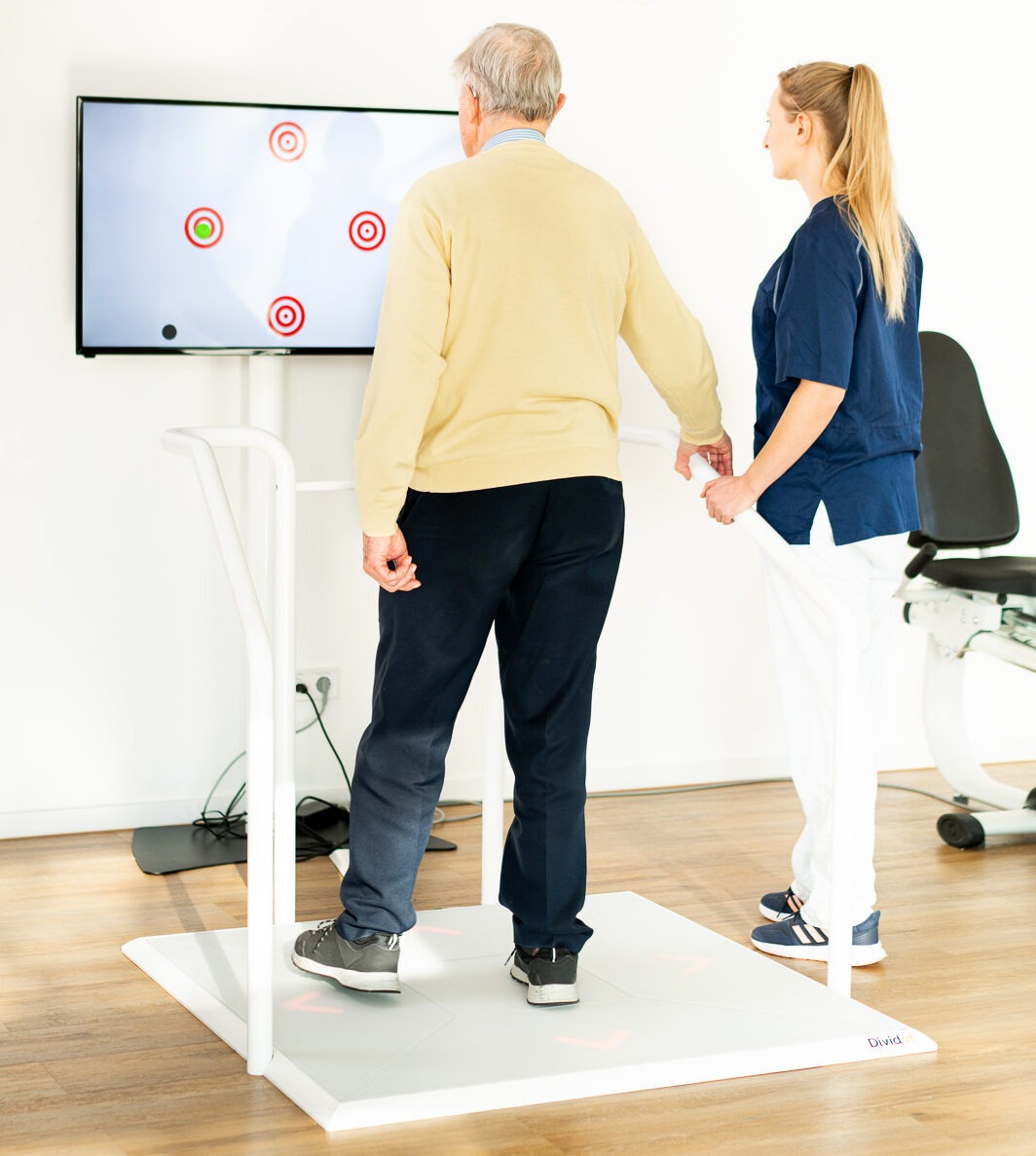
“Patients are also able to train independently following an introductory session. This fosters self-efficacy and eases the burden on the therapeutic team.”
Exergaming is an established form of training. It combines movement tasks with digital gaming elements. In addition to balance, strength and coordination, exergaming also trains attention, reactivity and decision-making (Chen et al., 2021; Monteiro-Junior et al., 2016). Studies demonstrate positive effects on mobility, balance and fall risk, together with high training motivation attributable to the game-based design (Sadeghi et al., 2021; Doherty et al., 2024).
The article “Measuring, training, motivating” on the AS-Tra project (p. 30 in this issue) also demonstrates how digital assistance systems can be used to monitor physical activity, deliver targeted training support and enhance patient motivation throughout the therapy process.
The article “Measuring, training, motivating” on the AS-Tra project (p. 30 in this issue) also demonstrates how digital assistance systems can be used to monitor physical activity, deliver targeted training support and enhance patient motivation throughout the therapy process.
The THERA-Trainer senso as a training system
The THERA-Trainer senso is an exergaming system designed specifically for older people. On a sensor-based platform, stepping movements and weight shifting are combined with cognitive tasks, allowing balance, reactivity and cognitive function to be trained simultaneously. The training demands can be individually adjusted.
Studies show that training with the THERA-Trainer senso can improve balance and mobility and is well accepted by older people. The system therefore offers a practical means of incorporating cognitive-motor training into fall prevention protocols (Manser et al., 2023; Yang & Lee, 2026).
GET IN TOUCH
Studies show that training with the THERA-Trainer senso can improve balance and mobility and is well accepted by older people. The system therefore offers a practical means of incorporating cognitive-motor training into fall prevention protocols (Manser et al., 2023; Yang & Lee, 2026).
GET IN TOUCH
Integration into daily clinical practice
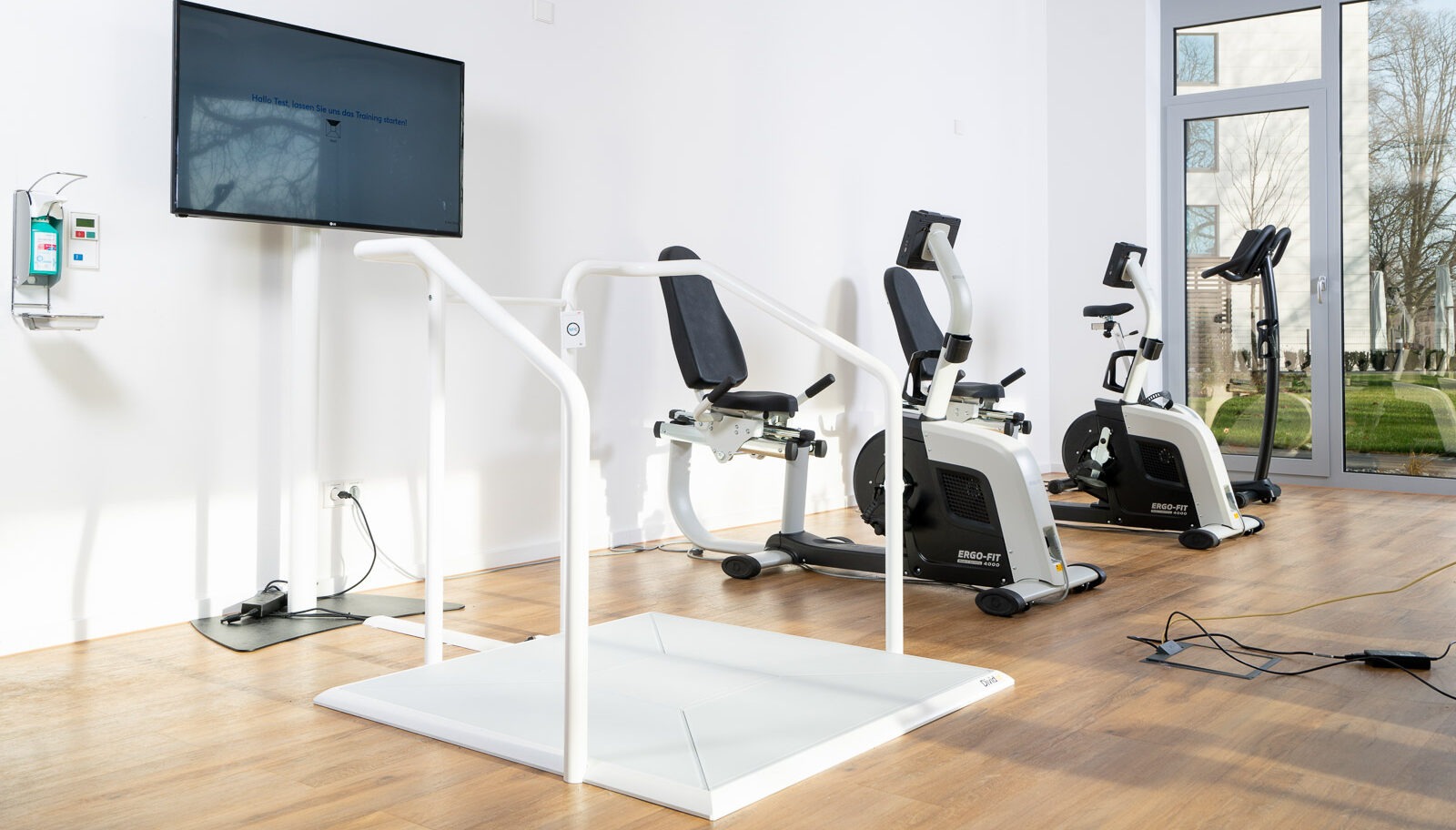
The senso has been firmly integrated into the training room at AGAPLESION BETHESDA KLINIK ULM. Access to the device is controlled via personalised RFID cards, which are also used for the strength training equipment. Bespoke training programmes can be configured and saved during initial setup. This ensures the senso is seamlessly integrated into existing training regimens, and patients are able to train independently following an introductory session. This fosters self-efficacy and eases the burden on the therapeutic team. In addition, short set-up times allow for more efficient use of therapy time, benefiting the patient.
Handrails on the device are available to ensure safe transfer and initial stabilisation. This facilitates entry, particularly for patients using a rollator or transferring from a wheelchair. The longer-term aim, however, is to progress towards training that is as unassisted and closely aligned with everyday activities as possible.
Handrails on the device are available to ensure safe transfer and initial stabilisation. This facilitates entry, particularly for patients using a rollator or transferring from a wheelchair. The longer-term aim, however, is to progress towards training that is as unassisted and closely aligned with everyday activities as possible.
Training design and therapeutic benefits
The senso is employed in both individual therapy sessions and Medical Training Therapy. Popular games include Simple, Targets and Birds. By combining stepping movements and weight shifting with cognitive tasks, balance, attention, reactivity and action planning are trained simultaneously. The automatic difficulty adjustment enables individualised load control.
A key advantage of the system is the clear, visual evaluation of training results. Progress is immediately visible and can be easily tracked by both patients and therapists. This direct feedback has a motivating effect and supports long-term training adherence. Further notable benefits include the ease with which the device can be cleaned, as well as the effective support it offers during patient transfer onto the training platform.
To progress training, elastic resistance bands, balance cushions and functional supplementary tasks such as squats, obstacle negotiation, and throwing and catching exercises are employed. This creates varied training with high relevance to activities of daily living.
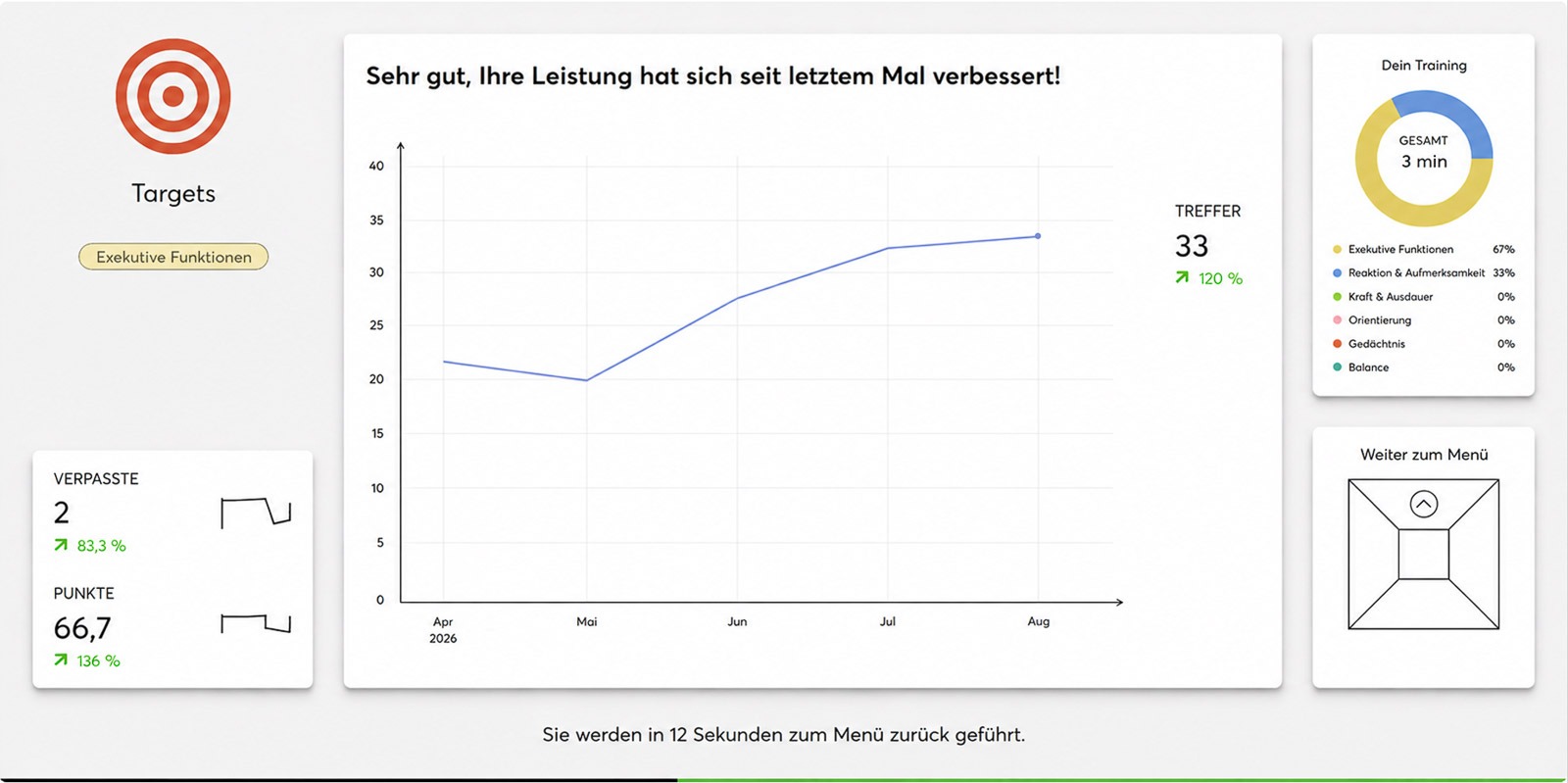
Evaluation of training outcomes using “Targets” as an example
“Progress is immediately visible and can be easily tracked by both patients and therapists.”
Practical experiences and challenges
Challenges arise primarily for patients with pronounced cognitive or sensory impairments. The automatic game continuation feature supports independent use, as games proceed without requiring further input from the patient. Occasionally, internet connectivity issues can also impede the training process. The integrated assessments and training plans offer considerable potential for training control and progress documentation; however, this potential has not yet been fully utilised in our day-to-day clinical practice.
“Overall, it is clear that the senso can be integrated very effectively into everyday geriatric rehabilitation practice.”
Conclusion:
Overall, it is clear that the senso can be integrated very effectively into everyday geriatric rehabilitation practice and is positively accepted by both patients and therapists. The system facilitates motivating, individually tailored training of balance, mobility and cognitive function, thereby addressing key risk factors for falls. Experience to date demonstrates that exergame-based training modalities are also feasible for implementation with geriatric patients and represent a valuable adjunct to established therapeutic approaches.
Authors’ note:
We would like to extend our sincere thanks to Lars Prothmann, Nathali Razmany and Laurin Jenckel, students at Ulm University of Applied Sciences, for their valuable support in the preparation of this article.
Thomas C. Kosiolek
OMT physiotherapist
Thomas C. Kosiolek is an OMT physiotherapist who has been working at AGAPLESION BETHESDA KLINIK ULM since 2026. He works in physiotherapeutic care, the falls clinic and the research department. He is also a research associate at the Institute for Geriatric Research at Ulm University Hospital. He completed his master’s degree in Orthopaedic Manual Therapy (OMT) at Osnabrück University of Applied Sciences. His specialisms include geriatrics, fall prevention and the promotion of physical activity in older age.

Vanessa Haug
M.Sc., sports scientist
Vanessa Haug, M.Sc., is a sports scientist who has worked since 2022 as a movement therapist at AGAPLESION BETHESDA KLINIK ULM and as a research associate at the Institute for Geriatric Research at Ulm University Hospital. Her specialisms are movement therapy and fall prevention in geriatrics. Since 2026, she has been pursuing a doctorate in the field of technology-assisted fall prevention in older age.
References:
- Amatrudo, F., De Luca, V., Aprano, S., Mayol, D., Negri, M., Giardinelli, E., Laudisio, D., Tecce, N., Pivonello, C., Iaccarino, G., Colao, A., Illario,
- M., & Vetrani, C. (2026). Digital Health Tools for the Screening and Management of Malnutrition Risk in the Older Adults: A Narrative Review. Current Nutrition Reports.
- Böttinger, M., Mellone, S., Klenk, J., Jansen, C.-P., Stefanakis, M., Litz, E., Bredenbrock, A., Fischer, J., Bauer, J. M., Becker, C., & Gordt Oesterwind, K. (2024). A Smartphone-Based Timed Up and Go Test Self-Assessment for Older Adults: Validity and Reliability Study. JMIR Aging, 7, e67322. https://doi.org/10.2196/67322
- Chaudhary, G., Chaudhari, H., Mundhe, R., & Gaikwad, Y. B. (2026). The Effectiveness of Digital Health Interventions in Reducing Frailty Progression among Community-dwelling Older Adults: A Systematic Review.
- Chen, W., Yao, J., Wang, H., Jia, S., Zhu, X., & Mao, L. (2025). Effects of digital health interventions on muscle mass, muscle strength, and physical function in older adults with sarcopenia: a systematic review and meta-analysis. Frontiers in Public Health.
- Cieślik, B., Wrzeciono, A., Mazurek, J., Federico, S., Szczepańska Gieracha, J., & Kiper, P. (2024). Balance Board or Motion Capture? A Meta-Analysis Exploring the Effectiveness of Commercially Available Virtual Reality Exergaming in Enhancing Balance and Functional Mobility Among the Elderly.
- Dai, T., Guo, C., Gao, L., Huang, J., Chen, Y., Zhang, Y., Gao, J., & Feng, X. (2025). Effectiveness of Digital Health Interventions in Older Adults With Frailty and Sarcopenia: Systematic Review and Meta-Analysis of Randomized Controlled Trials.
- Fawole, H., Itua, S. A., Idowu, O. A., Adandom, I., Kolawole, F. O., Adeniji, T., Obaseki, C., Oni, O., & Akinrolie, O. (2025). Effects of transtheoretical model of change-based interventions on physical activity among older adults: a systematic review of randomised controlled and non-randomised controlled trials.
- Foerster, M., Timper, M., Puhlemann, R., Quinten, V., & Diekmann, R. (2026b). A Digital Assistive System for Maintaining Nutrition and Mobility in Older Adults: Usability and Feasibility Findings From a Pilot Study.
- Förster, M., Happe, L., Quinten, V., & Diekmann, R. (2024). Development of a technical assistance system to improve nutrition and mobility in old age. THERAPY 2024-I. Verfügbar unter: https://thera trainer.com/en/articles/development-of-atechnicalassistance system-to-improve-nutritionand-mobility-inoldage/
- Förster, M., Happe, L., Quinten, V., & Diekmann, R. (2026a). Development and iterative optimization of an independently usable assistance system to assess, maintain and improve the nutritional and mobility status of older adults: an iterative usability study.
- French, C., McKenzie, Y. A., Stanmore, E., & Burden, S. (2024). Are Mobile Apps Effective at Targeting Physical Activity or Malnutrition in Community-Dwelling Older Adults? A Systematic Review and Meta-Analysis.
- Happe, L., Sgraja, M., Quinten, V., Förster, M., & Diekmann, R. (2024). and Training Station for Older Adults at Risk of Malnutrition and Reduced Mobility: Focus Group Study. JMIR Aging.
- Leung, W., Yau, C., Chan, B., Wong, Y., Chow, J. N. L., Lam, S. C., Suen, L. K.-P., & Moyle, W. (2026). Standalone commercial exergame training to improve balance in older adults in care facilities: a systematic review and meta-analysis of recent 10-year randomized controlled trials.
- Makizako, H., Shiratsuchi, D., Akaida, S., Tateishi, M., Maeda, K., Iijima, K., Shimada, H., Inoue, T., Yamada, M., Momosaki, R., Wakabayashi, H., Yamamoto, K., & Arai, H. (2025). Effects of digital-based interventions on the outcomes of the eligibility criteria for sarcopenia in healthy older adults: a systematic review and meta-analysis.
- Mehra, A., Perez, J., Krok-Schoen, J. L., Benzo, R. M., Spees, C. K., Wang, S., Clinton, S. K., Czerwinski, S. A., & Nickerson, B. S. (2026). Advancing sarcopenia assessment with wearable and app based technology: a scoping review.
- Polo-Ferrero, L., Méndez-Sánchez, R., Martín-Vallejo, J., Torres Alonso, J., Carrera-Villegas, M. B., Barbero-Iglesias, F., Cruz Jentoft, A. J., & Montero-Errasquín, B. (2026). Validity, reliability, and diagnostic accuracy of the InGrip digital dynamometer compared with the Jamar hydraulic model in older adults. European Geriatric Medicine.
- Sönmez Sarı, E., & Kitiş, Y. (2024). The effect of nurse-led motivational interviewing based on the trans-theoretical model on promoting physical activity in healthy older adults: A randomized controlled trial.
- Sturnieks, D., Hicks, C., Smith, N., Ratanapongleka, M., Menant, J., Turner, J., Lo, J. C. M., Chaplin, C., Garcia, J., Valenzuela, M., Delbaere, K., Herbert, R., Sherrington, C., Toson, B., & Lord, S. R. (2024). Exergame and cognitive training for preventing falls in community-dwelling older people: a randomized controlled trial.
- Szaflik, P., Nowakowska-Lipiec, K., Zadoń, H., & Michnik, R. (2026). Usefulness of the Instrumented Timed Up and Go Test for Walking Assessment in Older Adults.
- Originalarbeit Förster, M., Happe, L., Quinten, V., & Diekmann, R. (2024). Development of a technical assistance system to improve nutrition and mobility in old age. THERAPY 2024-I. Verfügbar unter: https://thera trainer.com/en/articles/development-of-atechnicalassistance- system-to-improve-nutritionand-mobility-inoldage/