


THERAPY & PRACTICE
Robotics in Gait Rehabilitation: New Opportunities, New Workflows
Modern rehabilitation technologies enable intensive, highly repetitive training even for severely affected neurological patients. Using the example of the lyra, Dr Martin Schorl, Chief Physician of Neurology at Waldburg-Zeil Klinik Bad Wurzach, explains how robotics not only supports gait therapy, but also fundamentally changes therapy workflows.

Miriam Keifert
Product Manager Clinical & Scientific, THERA-Trainer
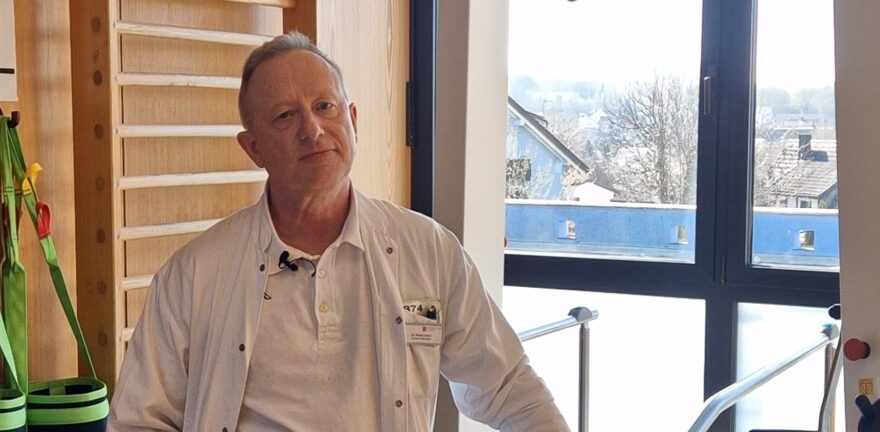
Miriam Keifert in an interview with Dr Martin Schorl, Chief Physician of Neurology, Waldburg-Zeil Klinik Bad Wurzach
Intensive therapy for severely affected neurological patients presents a particular challenge in everyday clinical practice. Modern rehabilitation technologies can help to transfer evidence-based findings on motor learning into practice and enable the necessary therapy frequencies.
In this interview, Dr Martin Schorl explains the role of robot-assisted gait rehabilitation with the THERA-Trainer lyra in neurological rehabilitation, how it changes everyday therapy and what experience has been gained with severely affected patients.
Miriam Keifert: Why are modern rehabilitation technologies so important for neurological rehabilitation today?
Dr. Schorl: Modern rehabilitation technologies are essential for us in order to transfer evidence-based treatment approaches into everyday clinical practice. This applies in particular to current findings on motor learning.
A decisive factor here is the frequency of therapy: patients need a high number of repetitions in order to regain or improve motor skills. Particularly in severely affected patients, achieving this intensity with conventional therapy methods often requires considerable staff resources.
Modern technologies help us to treat these patients more frequently, more intensively and more systematically, thereby enabling the necessary therapy frequencies even in cases of severe impairment.
„By bringing locomotion therapy together in one room, completely new workflows have emerged – both for patients and for therapists.“
Miriam Keifert: How has the THERA-Trainer lyra changed your everyday therapy?
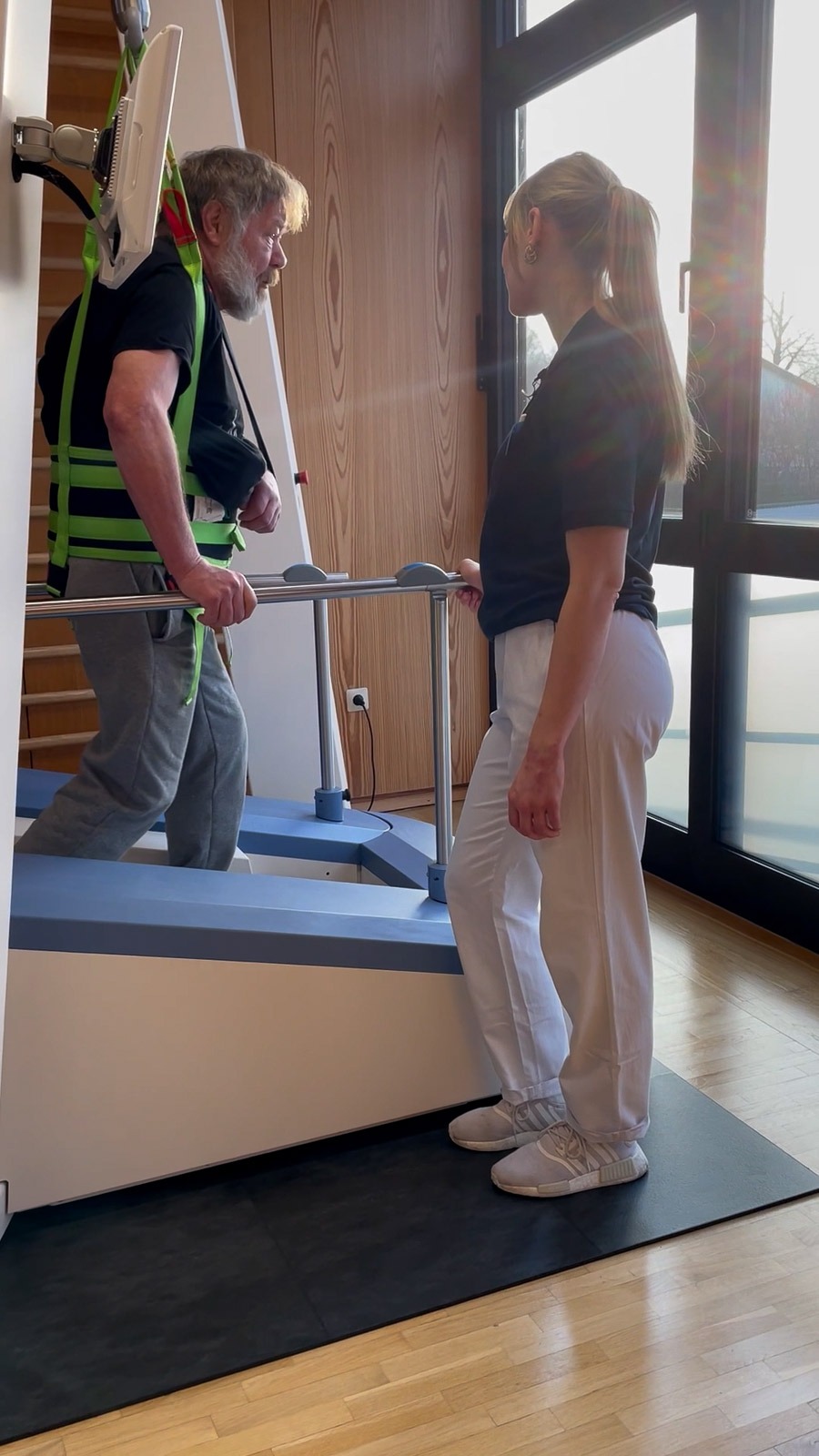
Dr. Schorl: The lyra has massively changed our everyday therapy. Its use enabled us to centralise locomotion therapy in one dedicated therapy room. Previously, therapy devices sometimes had to be taken to the wards, and severely affected patients were often treated there by two or even three therapists at the same time. This approach was very time- and staff-intensive.
With the establishment of a central locomotion studio, a completely new therapy setting has developed. Patients can be treated consecutively on different devices. This makes both traditional one-to-one therapy and group-based therapy workflows possible.
The changes can be seen in many areas: treatments are organised centrally, set-up times are shorter and easier to plan, and patients can train sequentially on different devices. At the same time, this opens new possibilities for group therapy, therapist scheduling can be organised more efficiently, patient journeys can be planned more effectively, and staff resources can be used more economically overall.
In the end, the lyra not only provided a new treatment option but also fundamentally changed our entire approach to locomotion therapy.
Miriam Keifert: Which patient groups do you primarily use the THERA-Trainer lyra for?
Dr. Schorl: In our neurological rehabilitation, we primarily use the THERA-Trainer lyra for patients in rehabilitation phases C and D. A large proportion of this patient group consists of people following a stroke.
For this patient group, the lyra has proven to be an effective therapy device, characterised by comparatively short preparation and adjustment times.
It is particularly valuable for patients who are not yet able to walk, or are only able to walk to a very limited extent, at the beginning of rehabilitation. Especially during this phase, the technical support enables intensive and safe gait training, an important prerequisite for neurological rehabilitation.
Miriam Keifert: What experience have you gained with the THERA-Trainer lyra in severely affected patients?
Dr. Schorl: Our experience with severely affected patients has been particularly impressive. Through more intensive gait rehabilitation with the THERA-Trainer lyra, we were able to restore walking ability in individual patients, even though they had previously been discharged from other facilities as no longer eligible for further rehabilitation or without a realistic prospect of regaining mobility.
For those affected, this means far more than clinical progress. Even partially regained walking ability can significantly change everyday life, independence and opportunities for social participation.
Based on our experience, intensive robot-assisted gait rehabilitation can also unlock additional rehabilitation potential in severely affected patients. It is important to emphasise that the success of therapy always depends on the individual starting situation and cannot be predicted in general terms.
GET IN TOUCH
„We were able to achieve walking ability in patients who had previously been assessed as no longer eligible for further rehabilitation.“
Miriam Keifert: What role does the THERA-Trainer lyra play within a holistic therapy concept?
Dr. Schorl: We do not consider the THERA-Trainer lyra as an isolated treatment option. Particularly for severely affected patients, gait rehabilitation is part of a multimodal treatment concept in which different therapeutic approaches are combined.
These include, in particular, botulinum toxin injections, corrective orthoses or comparable corrective aids, standing training and intensive gait rehabilitation with the lyra. This combination is used, for example, in patients with pronounced leg or foot spasticity and resulting malpositions.
In our assessment, the interaction of the different measures can help to restore the prerequisites for standing and walking. The decisive factor is often not a single measure, but the coordinated combination of spasticity treatment, orthotic provision and intensive gait rehabilitation.
„New technologies must fit into the existing therapy concept. They will only actually be used in everyday practice if they gain broad acceptance.“
Miriam Keifert: How important is a practical testing phase before purchasing new rehabilitation technologies?
Dr. Schorl: A practical testing phase is a central prerequisite for us before we purchase a new technology and integrate it into everyday therapy. New devices are always initially tested in a clinical environment in order to assess their actual suitability for our workflows.
We ask ourselves various questions: How easy is the device to operate? How do the therapists get on with it? How do the patients respond to the therapy? Does the technology fit in with the existing forms of therapy? What spatial and organisational adjustments are required? How can its use be implemented economically? And above all: Will the device actually be used regularly in everyday practice?
When introducing the THERA-Trainer lyra, we initially carried out two test days. This enabled our team to familiarise themselves with the device and its possible applications even before installation.
Our principle is therefore: no new technologies are introduced without a practical testing phase.
Miriam Keifert: How was the THERA-Trainer lyra integrated into the team’s daily practice, and which factors are key to its long-term use?
Dr. Schorl: As our team had already had the opportunity to familiarise themselves with the THERA-Trainer lyra during the trial days, the subsequent training was completed very quickly. Following installation, a one-day training session was sufficient to enable the team to integrate the device independently into their daily therapy routine. As a result, the implementation process was largely smooth and without any significant disruption.
For the long-term use of a new technology, however, technical ease of operation is not the only decisive factor. Rather, it must be possible to integrate it into existing therapy workflows, and it must be accepted by both therapists and patients.
A technology can only be used successfully over the long term if it provides added value in everyday therapy and is accepted by everyone involved.
„Especially for severely affected patients, combining different therapeutic approaches can open up new possibilities for standing and walking.“
Miriam Keifert: How important is cooperation between the clinic and the manufacturer for the successful introduction and further development of a rehabilitation technology?
Dr. Schorl: From our perspective, successful cooperation between a clinic and a manufacturer begins even before the actual purchase. Several factors are crucial: the opportunity to trial the device, comprehensive training, close support during the implementation phase, and ongoing collaboration thereafter.
In addition, joint projects to assess effectiveness and usability, documentation of therapy outcomes and integration of the data into existing IT and reporting processes are important components of successful cooperation.
As a clinic, we were able to contribute our own experience and documentation requirements. Through the practice-oriented development of THERA-Trainer, solutions are created that provide real added value in everyday clinical practice, such as the new patient management software. This enabled us to switch to efficient, time-saving digital documentation.
Manufacturers and users should therefore not only work together during the installation of a system, but should jointly investigate how effective and practical a technology actually is in everyday clinical practice.
Miriam Keifert: What economic and structural challenges do you see in the introduction of modern rehabilitation technologies?
Dr. Schorl: From our perspective, the greatest challenge is the mismatch between the necessary investments and the existing reimbursement structures. Technologically sophisticated therapy devices involve high acquisition costs. At the same time, their use and clinical added value are often not adequately taken into account in current reimbursement systems.
Nevertheless, we decided to purchase the THERA-Trainer lyra because we particularly wanted to offer non-ambulatory patients a better chance of regaining their mobility. Robot-assisted gait rehabilitation has been the treatment of choice in guidelines for ten or fifteen years, with a very good “number needed to treat”, and it is actually ethically unjustifiable to withhold such technology from patients.
The existing shortage of staff is another factor. Modern rehabilitation technologies can help to organise therapies more efficiently and reduce the staff required for certain treatment steps. We see considerable potential in this.
At the same time, many facilities face the problem that they can only implement the necessary investments with difficulty due to the existing financing situation. Modern rehabilitation technologies are urgently needed in order to provide intensive, high-quality therapy even under conditions of staff shortages. At the same time, current reimbursement structures make it difficult for many facilities to gain access to precisely these technologies.
The experience of Waldburg-Zeil Klinik Bad Wurzach demonstrates the role that modern rehabilitation technologies can play in neurological rehabilitation. The THERA-Trainer lyra supports the implementation of intensive gait rehabilitation even for severely affected patients and meaningfully complements existing therapeutic approaches.
The technology itself is not the sole focus; rather, it is about targeted integration into a multimodal treatment concept. The combination of different therapeutic measures, structured organisation of workflows and a high therapy frequency can help to unlock additional rehabilitation potential.
We would like to thank Dr Martin Schorl for his valuable insights into his clinical experience and his practical perspectives on robot-assisted gait rehabilitation.
„Robot-assisted gait rehabilitation has been the therapy of choice in clinical guidelines for the past ten to fifteen years, with a very favorable ‘number needed to treat’. From an ethical perspective, it is therefore difficult to justify withholding such technology from patients.“
Miriam Keifert
Product Manager Clinical & Scientific, THERA-Trainer
Miriam Keifert has a degree in sports science
(M.Sc.) and
works in product management
of THERA-Trainer with the
specialising in "Clinical & Scientific".
References: