



THERAPY & PRACTICE
From lone warrior to team player
How interdisciplinary collaboration improves patient care

Katharina Zierold
Author & Physical Therapist
In the past, therapy was often a solitary, isolated skill set: the doctor prescribes, the therapist treats and in between there is radio silence. But modern medicine is dispelling the myth of the lone warrior. The meta-analysis by Struck et al. provides impressive evidence: patients reach their destination faster when the team works in a network. Find out how a simple therapy diary can become a data protection-compliant miracle weapon.
The myth of the lone wolf
Hand on heart: we are all familiar with that moment that we feel like we’re on a desert island in the treatment room. We do our best, mobilise and motivate – but what the colleague from occupational therapy on the other side of town did yesterday or why the neurologist adjusted the medication often remains a mystery. “Silo thinking” used to be the standard. Everyone was an expert in their own little Garden, but the fence between them was high and the only source of information was an often overwhelmed patient.
But the days of one-on-one therapeutic battles are over. Why? Because our patients do not have static problems, but complex lives. A stroke patient does not need an “isolation specialist”, but an orchestra that plays the symphony of recovery. If the speech therapist knows that the physiotherapist is currently working on trunk stability, this can be used as the basis for swallowing training. This is not a luxury, but highly efficient medicine in everyday practice.
But the days of one-on-one therapeutic battles are over. Why? Because our patients do not have static problems, but complex lives. A stroke patient does not need an “isolation specialist”, but an orchestra that plays the symphony of recovery. If the speech therapist knows that the physiotherapist is currently working on trunk stability, this can be used as the basis for swallowing training. This is not a luxury, but highly efficient medicine in everyday practice.
Current data shows that collaboration not only improves the working atmosphere, but also offers measurable clinical benefits.
What the science says
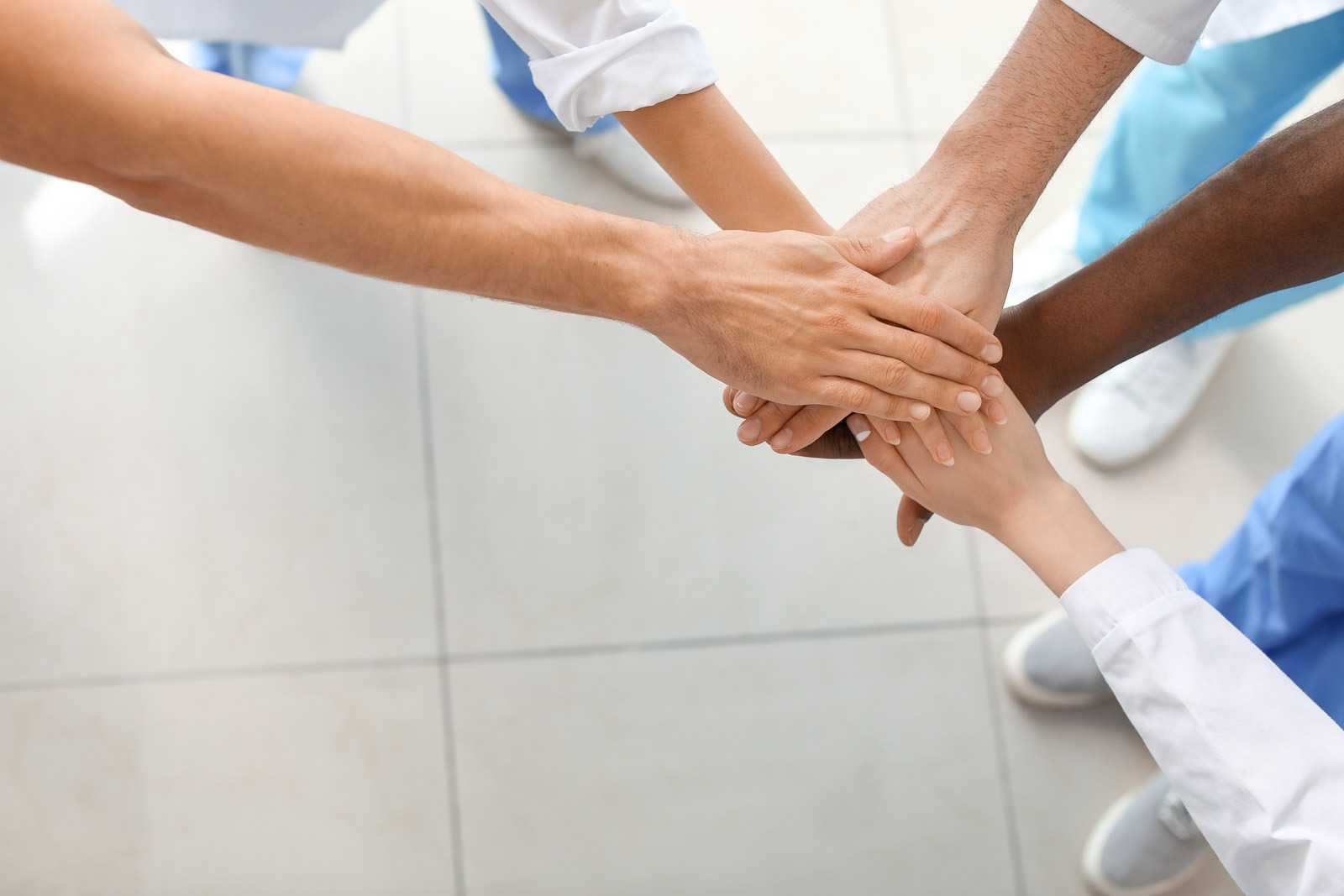
Current data shows that collaboration is not only good for the working atmosphere, but also brings tangible clinical benefits. A groundbreaking meta-analysis by Struck et al. (2024) has investigated the effectiveness of interdisciplinary interventions. The result is clear: interdisciplinary team care (ITC) is clearly superior to conventional, purely multidisciplinary treatment, in which disciplines tend to work side by side.
According to the study, not only does the fall rate decrease, but patients also achieve a significantly higher level of independence in everyday life (activities of daily living, ADL). The common ground acts as a catalyst. When everyone is working on the same parameters, patients often reach their goals weeks earlier than with sequential treatment. This saves resources and provides valuable quality of life.
According to the study, not only does the fall rate decrease, but patients also achieve a significantly higher level of independence in everyday life (activities of daily living, ADL). The common ground acts as a catalyst. When everyone is working on the same parameters, patients often reach their goals weeks earlier than with sequential treatment. This saves resources and provides valuable quality of life.
Communication over data protection drama
In theory, networking sounds great, but in practice, data protection often suffers when reports are sent back and forth by email. The solution is as simple as it is ingenious: the analogue therapy diary.
Instead of laboriously searching for fax numbers or typing unsecure emails, we use the patient as an active information carrier. No novels are written in the diary, but goals are briefly outlined according to the ICF model (International Classification of Functioning, Disability and Health).
An entry such as “Physio: Focus on transfer training today – Ergo: Please pay attention to hand support” immediately links the disciplines. As the book remains in the patient’s possession, data sovereignty is maintained and the exchange takes place directly at the point of treatment.
Instead of laboriously searching for fax numbers or typing unsecure emails, we use the patient as an active information carrier. No novels are written in the diary, but goals are briefly outlined according to the ICF model (International Classification of Functioning, Disability and Health).
An entry such as “Physio: Focus on transfer training today – Ergo: Please pay attention to hand support” immediately links the disciplines. As the book remains in the patient’s possession, data sovereignty is maintained and the exchange takes place directly at the point of treatment.
Patients who understand why they are doing something are more motivated.
The haptic anchor in the digital age
Why paper? In a world full of apps and digital overload, a physical diary offers an invaluable advantage: it is present. It sits on the patients’ kitchen tables, and is in their pocket when they come to the practice. It serves as a reminder of progress that is often overlooked in everyday life. For patients, it becomes a record of their own achievements. When they look back and see which goals seemed unattainable three months ago, it strengthens their self-efficacy more than any verbal encouragement.
For us as therapists, it means: 60 seconds at the end of the session for an entry saves us hours of clarification and phone calls. It is an investment in quality that pays off twice and three times over through faster therapeutic success.
For us as therapists, it means: 60 seconds at the end of the session for an entry saves us hours of clarification and phone calls. It is an investment in quality that pays off twice and three times over through faster therapeutic success.
It is an investment in quality that pays off twice and three times over through faster therapeutic success.
Making the “invisible” practice visible
In many cases, we do not even know who else is looking after the patient. The therapy diary serves as a business card for colleagues. It makes the “invisible” allies tangible.
As a physiotherapist, when I see that occupational therapy is already successfully working on fine motor skills for doing up buttons, I can integrate this sense of achievement into my gait training: “If you walk to the baker’s, maybe we can manage to do up the jacket on our own today?” This networking not only motivates us therapists, but also creates a quality of care that patients can feel, in the sense that an entire network is pulling in the same direction here.
As a physiotherapist, when I see that occupational therapy is already successfully working on fine motor skills for doing up buttons, I can integrate this sense of achievement into my gait training: “If you walk to the baker’s, maybe we can manage to do up the jacket on our own today?” This networking not only motivates us therapists, but also creates a quality of care that patients can feel, in the sense that an entire network is pulling in the same direction here.
The patient in the driving seat
We must not forget the most important player: the patient themselves. In a networked setting, they no longer play passive roles, but are the drivers of their recovery. They see in black and white how the gears mesh. When they realise that their exercises in speech therapy perfectly complement the goals of physiotherapy, adherence – i.e. compliance with therapy – increases massively. Patients who understand why they are doing something are more motivated. And all of us know that a motivated patient is half the battle.
Working together for a greater impact
The switch from lone warrior to team player requires perhaps five minutes more time for an entry in the Diary at the beginning. But the rewards are great: less frustration from miscommunication, better results and a mutually supportive working environment. Interdisciplinary cooperation is not a trend for large centres, but the answer to the challenges of every modern practice. Let’s tackle it together – with the diary under our arm, for our patients and for our own enjoyment of the profession.
Katharina Zierold
Author & Physical Therapist
Katharina Zierold is an author and physiotherapist with an interdisciplinary perspective on the body, psyche, and societal dynamics. In her work, she combines medical expertise with clear, accessible language. Professionally, she has many years of experience in the treatment of chronic pain as well as psychosomatic conditions. As an author, she engages with topics such as bodily self-awareness, healing processes, and identity. Her work contributes to the destigmatization of bodily processes and promotes a nuanced understanding of human wholeness.
References:
- Meta-analysis by Struck et al. (2024) “Interdisciplinary Team Care” (ITC)
Related contents
Find related exciting contents in our media library.
Mehr laden
This is not what you are searching for? Knowledge

Meet our specialists.
Are you interested in our solutions? Schedule a meeting with a Consultant to talk through your strategy and understand how TEHRA-Trainer can help you to advance rehabilitation.